Clear Sky Science · en
Nonlocality of quantum states can be transitive
Spooky links that spread
Quantum physics is famous for its “spooky action at a distance,” where particles seem mysteriously connected even when far apart. This paper asks a striking question: if one particle is strongly linked to a second, and that second is strongly linked to a third, can those rules of quantum physics *force* a similar spooky link between the first and the third? The authors show that, at the level of quantum states, the answer can be yes: quantum nonlocality can be transitive.
From shared secrets to impossible explanations
In everyday life, correlations usually have simple causes: if two people carry the same umbrella, it is probably because both saw the same weather forecast. Quantum “nonlocality” is different. When two distant labs measure specially prepared particles, they can obtain outcomes that no explanation based on shared information and ordinary cause-and-effect—limited by the speed of light—can fully reproduce. Such behavior, revealed by violations of Bell inequalities, underpins device-independent quantum cryptography and other cutting-edge technologies.
When sharing has strict limits
Nonlocal quantum links are not freely shareable. If two parties share the strongest possible nonlocal correlations, a third party cannot be equally strongly connected to them—a feature known as monogamy. Still, there are surprising ways in which correlations can spread. Earlier work showed a cousin effect called “entanglement transitivity”: in some mixed states, if systems A and B are entangled and B and C are entangled, then *any* larger state consistent with these two pieces must also leave A and C entangled. A similar effect for nonlocality had been proven in a more abstract, non-quantum setting, but whether it could happen with real quantum systems was unknown for more than a decade. 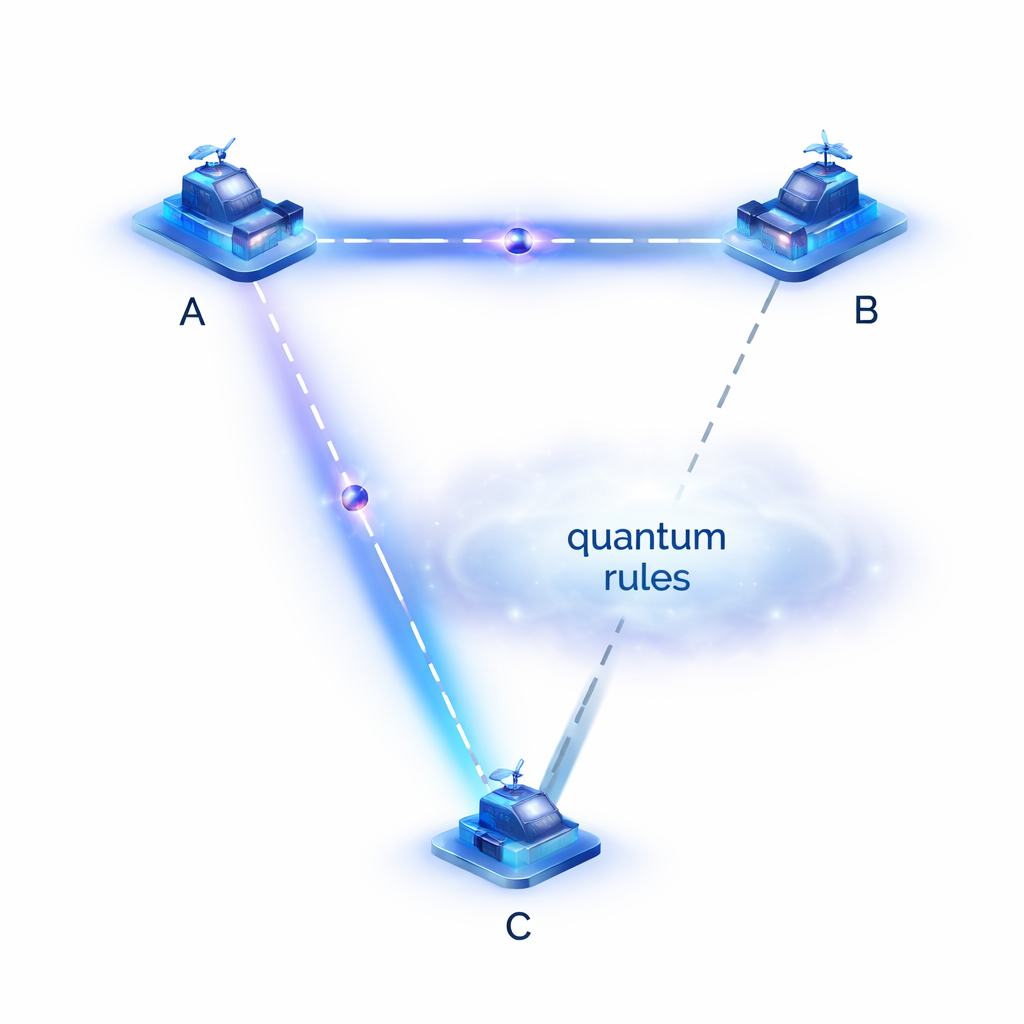
Making parts that fix the whole
The authors attack this problem by looking at situations where knowing certain two-particle “slices” of a larger system uniquely pins down the entire global quantum state. A key role is played by the so-called W state, a special three-qubit state where exactly one of three particles is excited but all share this excitation in a perfectly symmetric way. Any two-particle reduction of a W state looks the same, and previous work showed that, on certain simple networks, specifying these two-particle states already determines the full many-particle state. Here, the authors generalize this idea: if along a tree-like network every link is described by multiple copies of the same W-state marginal, then the only compatible global state is multiple copies of the full W state itself.
Forcing nonlocality across the network
Armed with this uniqueness property, the authors construct tripartite quantum states of three parties, A, B, and C, whose two-party reductions between A and B and between B and C are not only entangled but provably Bell-nonlocal. Because these two reductions uniquely fix the entire three-party state, the remaining reduction between A and C is no longer free to be chosen: it is forced to be a specific state, and this state too can be shown to be nonlocal, provided one considers enough copies. In this way, whenever A–B and B–C share this special kind of nonlocal state, *every* overall state consistent with those facts must also make A–C nonlocal. That is precisely nonlocality becoming transitive at the level of quantum states.
Random quantum worlds that behave the same
To check how widespread this phenomenon might be, the authors also explore large numbers of randomly chosen three-party pure states on small quantum systems (qubits, qutrits, and higher). For three qutrits—systems with three levels instead of two—they find that in roughly 11 percent of cases, all three two-party reductions are nonlocal, and the pair involving A–B and B–C again forces the A–C pair to be nonlocal whenever one insists on a compatible global quantum state. This suggests that transitive nonlocality is not a rare curiosity but can appear naturally in higher-dimensional quantum systems. 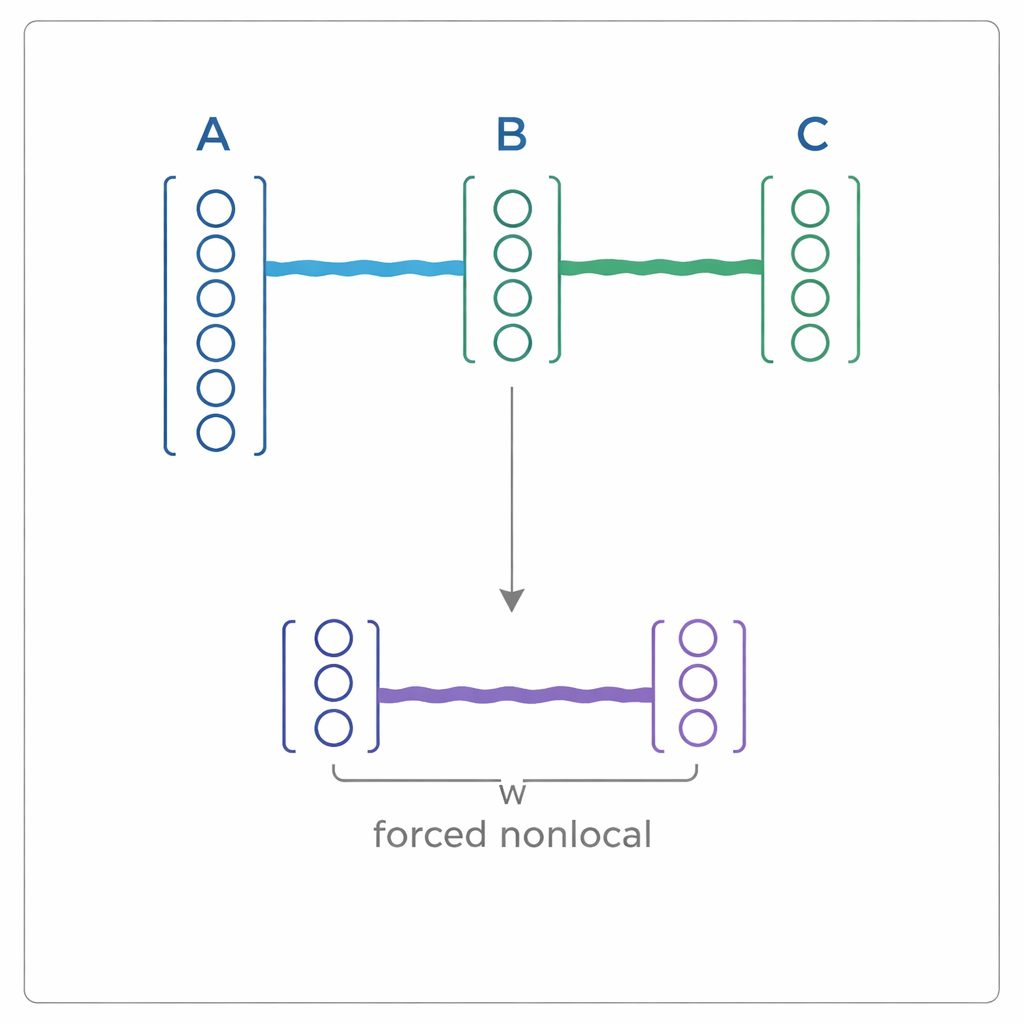
Why this matters for future quantum networks
For non-experts, the upshot is that certain quantum connections behave more like a chain reaction than isolated links: strong, rule-constrained nonlocal ties on two sides can compel a similar tie on the third side, leaving no room for a mundane explanation. This sheds light on how quantum reality differs from classical pictures based on hidden causes, and it hints at practical payoffs. In future quantum networks, one might certify that two distant nodes share a powerful, nonlocal resource simply by testing their links to a central hub, without having to perform the hardest direct tests on the distant pair itself.
Citation: Chen, KS., Tabia, G.N.M., Hsieh, CY. et al. Nonlocality of quantum states can be transitive. npj Quantum Inf 12, 37 (2026). https://doi.org/10.1038/s41534-025-01173-z
Keywords: quantum nonlocality, Bell inequalities, entanglement, quantum networks, device-independent cryptography