Clear Sky Science · en
Discovery of ST2 centers in natural and CVD diamond
A new kind of tiny compass in diamond
Modern science often needs to measure magnetic fields on the scale of individual molecules or tiny magnetic structures, but our everyday magnets and sensors are far too large and clumsy for the job. This paper reports the discovery and detailed study of a new kind of atomic-scale “compass” inside diamond, called the ST2 center, which can operate at room temperature and can feel strong magnetic fields coming from almost any direction. Such quantum sensors could one day help map the inner workings of next‑generation computer chips, exotic magnetic materials, or even biological systems with unprecedented detail.
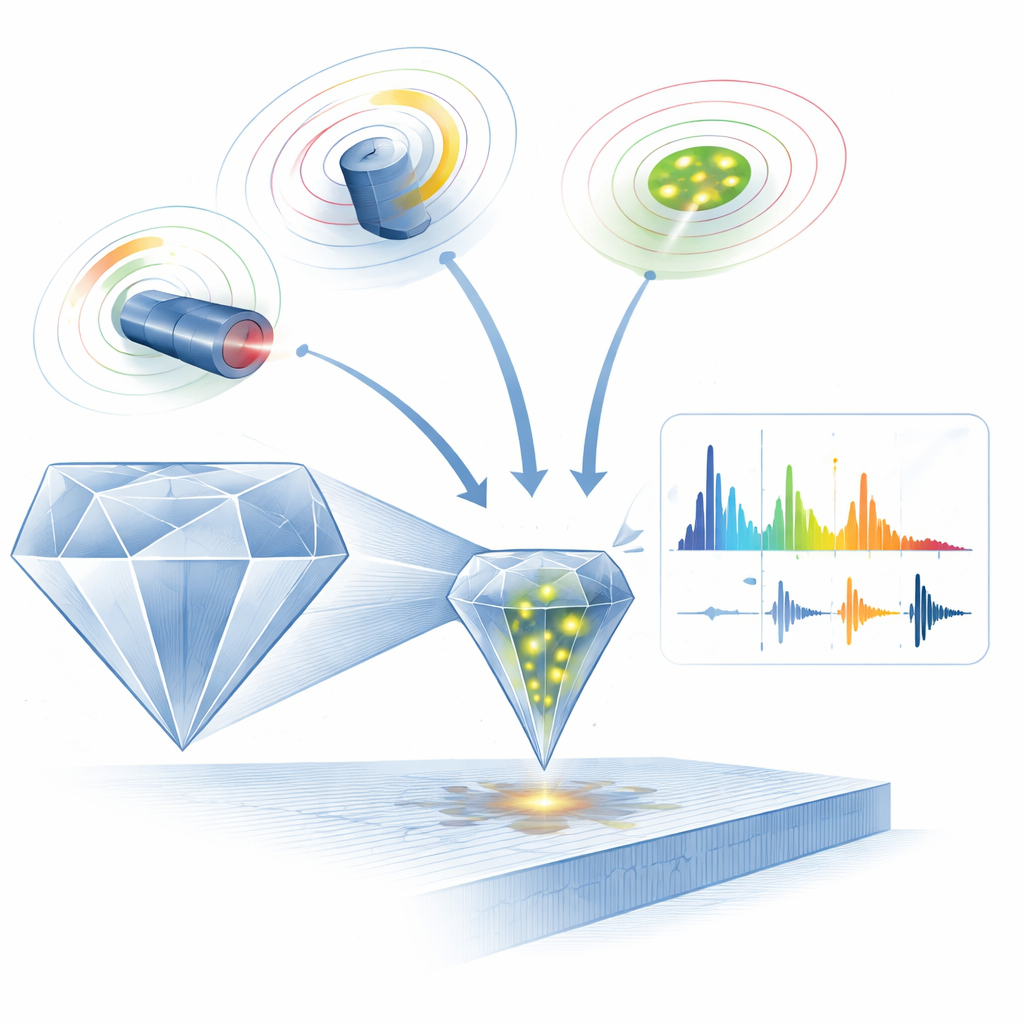
Making special defects on purpose
The key idea is to use tiny imperfections in the otherwise regular carbon lattice of diamond as sensitive probes. The authors first spotted ST2 centers in a natural diamond whose history was unknown, by their sharp glow at a specific color of blue light and by how that glow changed in a magnetic field. They then figured out how to make these centers deliberately in laboratory‑grown diamond: they shot carbon ions into the crystal at carefully chosen energies and doses, and then heated the diamond up to very high temperatures. By varying the heating temperature and slowly etching away thin layers, they showed that the number and depth of ST2 centers follow the pattern of damage created by the incoming ions. This strongly suggests that ST2 centers are “intrinsic” defects made only from displaced carbon atoms and empty lattice sites, without any foreign atoms mixed in.
Light, spin, and a long‑lived hidden state
To understand how ST2 centers behave, the team studied individual defects one by one using a custom microscope and very faint laser light. Each ST2 center emits single photons, confirming that they act as true quantum light sources. More importantly, their brightness changes when microwaves and magnetic fields are applied, a hallmark of a controllable quantum “spin” inside the defect. The data are consistent with a simple internal structure: two bright states that absorb and emit light, and a darker, long‑lived trio of states in between. When the center is driven strongly by light, some of the population leaks into this dark trio and lingers there for tens of microseconds—long enough to be manipulated by microwaves. By carefully timing light and microwave pulses, the researchers measured the lifetimes of all three dark states and observed subtle quantum effects in how population is shuffled among them.
Seeing magnetic fields from almost any direction
The standout property of ST2 centers is how they respond to magnetic fields. By moving a strong permanent magnet around the diamond, the authors recorded how the glow of a single ST2 center brightened or dimmed as the field direction changed. They then matched these patterns to detailed simulations of a three‑level spin system. This analysis revealed that ST2 centers come in twelve distinct orientations within the diamond and that their internal axes line up with the crystal’s bonding directions. Crucially, the microwave response that underlies sensing—known as optically detected magnetic resonance—remains strong for almost all field directions at typical laboratory strengths. This is in sharp contrast to the widely used nitrogen‑vacancy (NV) center, whose sensitivity collapses when the field is tilted too far away from its symmetry axis.
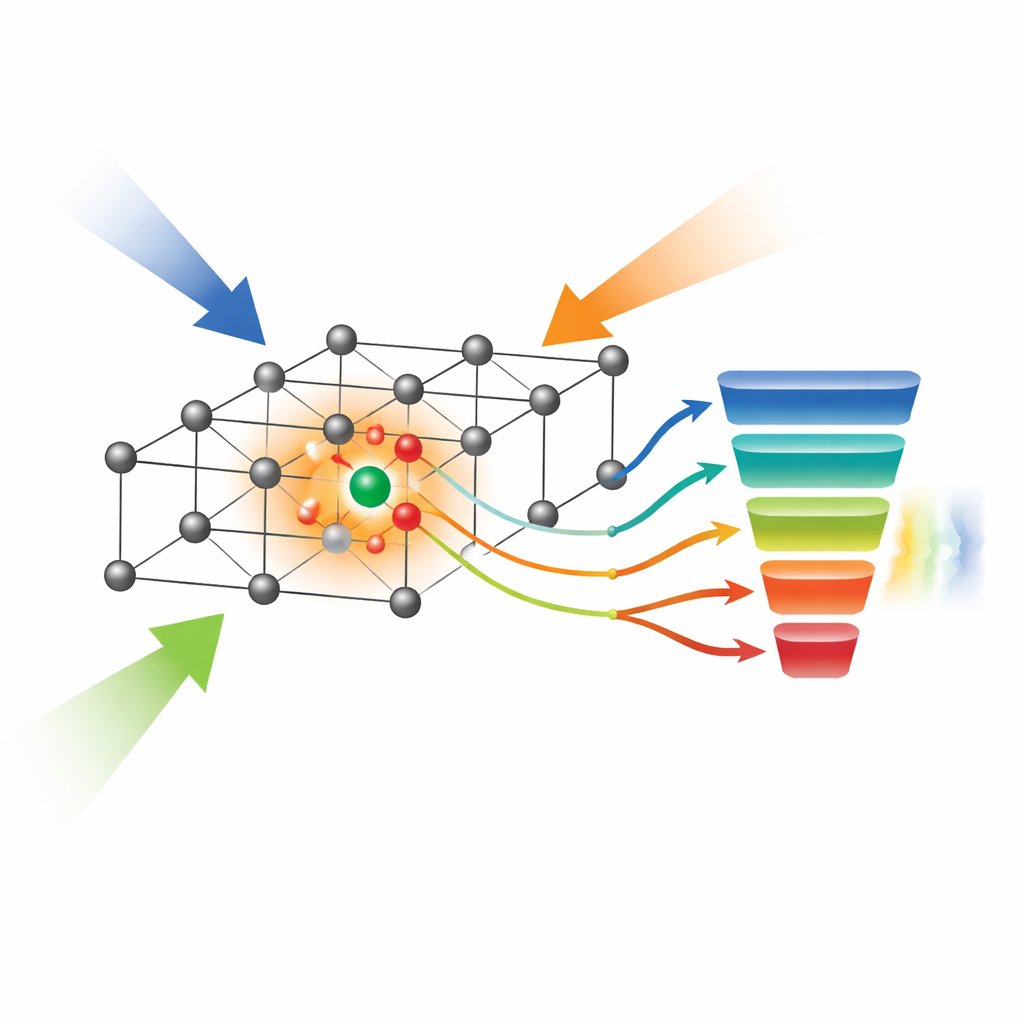
What else can this defect feel?
Because other diamond defects can also sense temperature and electric fields, the team explored these possibilities for ST2. They found that changing the temperature between about 40 and 60 degrees Celsius causes the key microwave frequencies of ST2 to shift in a steady, predictable way, though not as strongly as in NV centers. That means ST2 could still serve as a local thermometer when needed, but is not the best choice when temperature is the main signal of interest. On the other hand, even very strong electric fields produced no detectable change, which fits with the idea that the ST2 center is symmetric in a way that cancels a permanent electric dipole. This makes ST2 less useful as an electric‑field sensor, but also less vulnerable to unwanted electrical noise.
Why this matters for future quantum tools
Overall, the ST2 center emerges as a robust new building block for nanoscale magnetic sensing. Although the current method for creating these defects has a low yield and limits how many can be packed into a device, single ST2 centers already offer magnetic sensitivity on par with other promising defects while working well under strong, arbitrarily oriented fields. That makes them an ideal complement to NV centers: NV shines in detecting very weak fields, while ST2 excels when the fields are stronger and less aligned. If methods can be found to fabricate ST2 centers more efficiently and to integrate them into engineered diamond tips and microstructures, they could power compact quantum probes that reveal the detailed magnetic landscape of advanced materials and devices.
Citation: Foglszinger, J., Denisenko, A., Astakhov, G.V. et al. Discovery of ST2 centers in natural and CVD diamond. npj Quantum Inf 12, 42 (2026). https://doi.org/10.1038/s41534-025-01116-8
Keywords: diamond defects, quantum sensing, magnetometry, spin centers, solid-state qubits