Clear Sky Science · en
Association between instrumental activities of daily living and incidence of Parkinson’s disease: a nationwide population-based cohort study
Why everyday tasks can signal brain changes
For many older adults, staying independent means continuing to cook, shop, manage money, and use the phone without much help. This study suggests that subtle difficulties with these kinds of everyday tasks may be an early warning sign of Parkinson’s disease—years before the classic tremor or stiffness appear. Understanding this link could help families and doctors spot people at higher risk sooner and offer closer monitoring and earlier care.
Looking at daily life in a large older population
The researchers drew on health and long-term care records from Korea’s National Health Insurance Service, which follows virtually the entire population. They focused on more than 21,000 older adults, average age about 78, who had applied for long-term care services and completed a detailed geriatric assessment between 2009 and 2021. A key part of that assessment rated how independently people could perform 10 complex daily tasks, such as cooking, shopping, doing laundry, handling finances, using the telephone, taking transportation, going out short distances, grooming, and managing medications.
Ranking independence and tracking new Parkinson’s cases
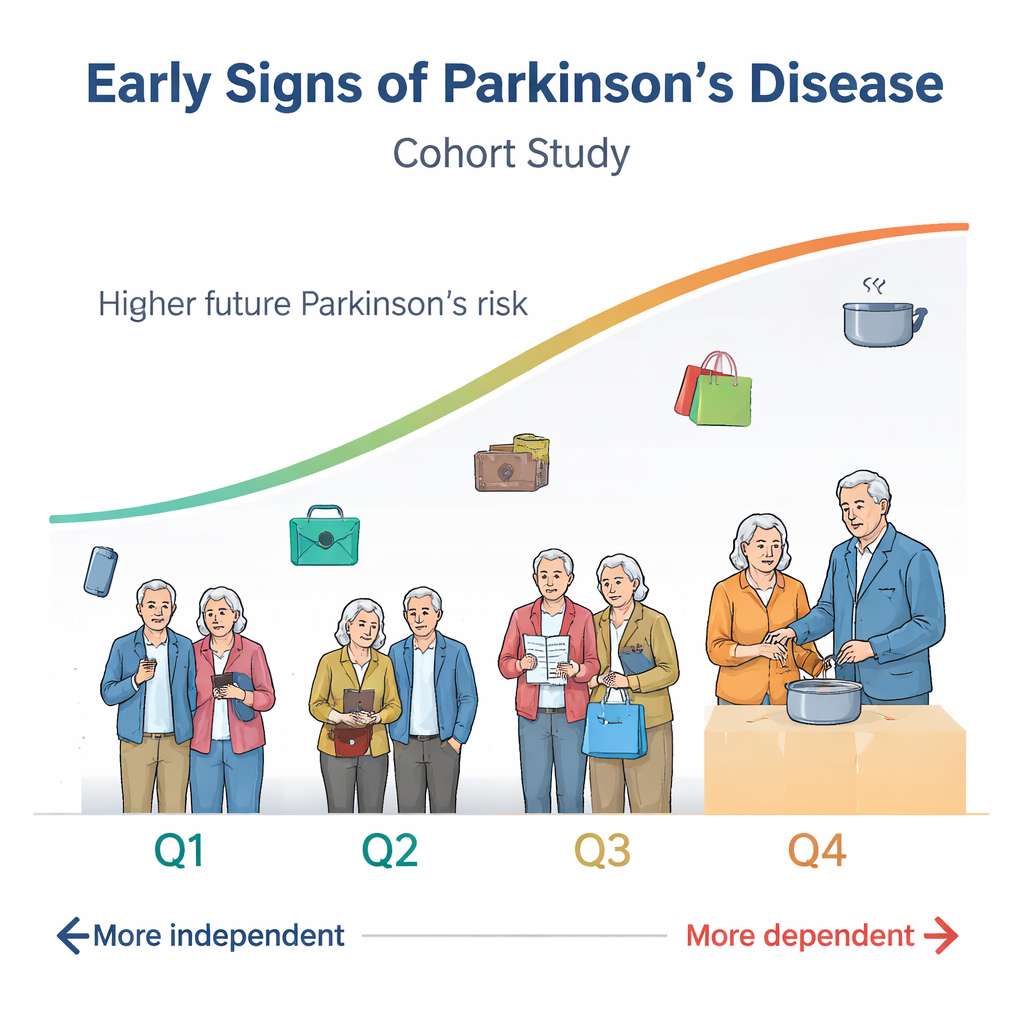
Each person’s scores on these instrumental activities of daily living—often shortened to IADL—were added up and divided into four groups, from the most independent (Q1) to the most dependent (Q4). None of the participants had Parkinson’s disease at the start. The team then followed them for an average of nearly four years, checking national medical records to see who received a first-time Parkinson’s diagnosis based on strict registry criteria. Over this period, 308 people developed Parkinson’s.
More dependence, higher Parkinson’s risk
When the researchers compared the four IADL groups, a clear pattern emerged: people who needed the most help with complex daily tasks were more likely to be diagnosed with Parkinson’s later on. In the most independent group, about 3 out of 1,000 people per year developed the disease. In the most dependent group, this rate roughly doubled to just over 6 per 1,000 per year. After taking into account age, sex, income, where people lived, other medical conditions, and lifestyle factors like smoking, drinking, and exercise, those in the highest-dependency group still had about a 46 percent higher risk of Parkinson’s than those in the most independent group.
Two everyday tasks that stood out
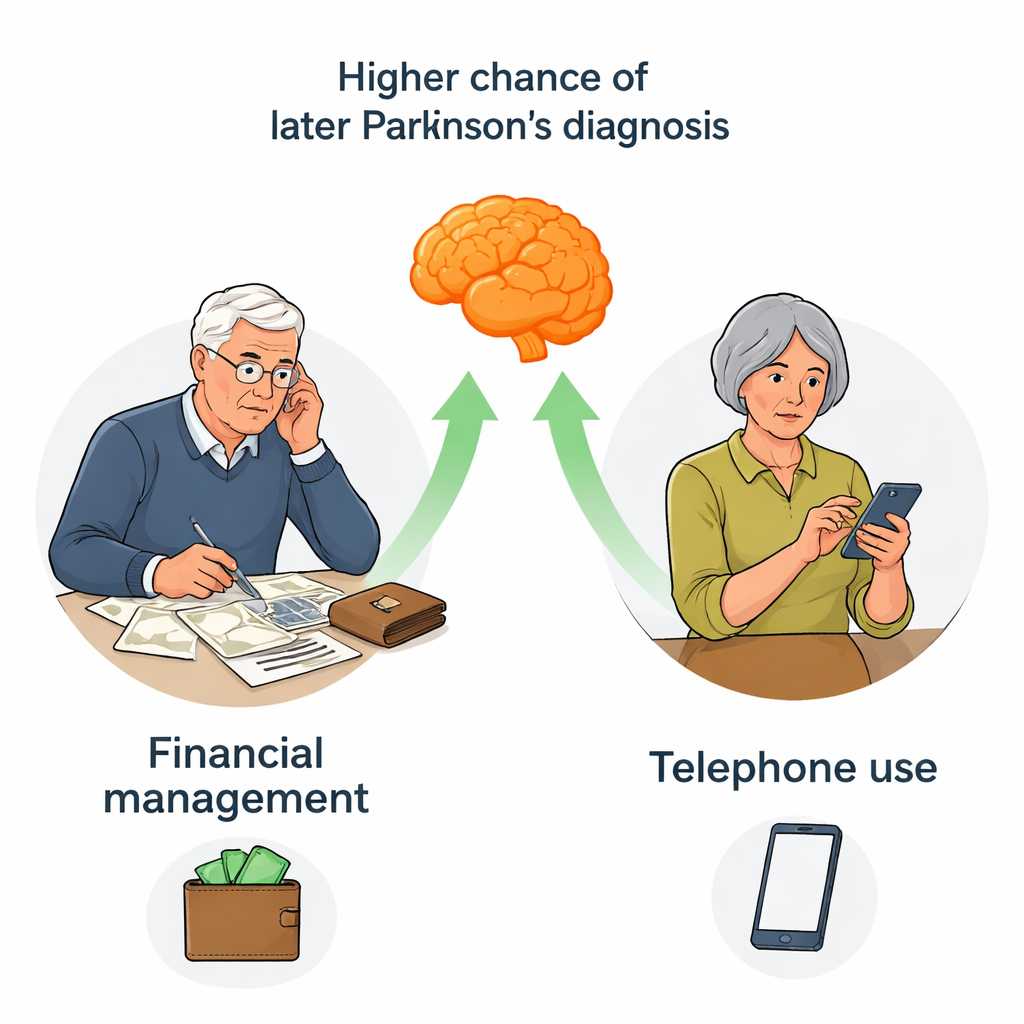
The study also looked at each of the 10 daily tasks separately to see whether any were especially linked to future Parkinson’s. Two stood out: handling money and using the telephone. Older adults who already needed help managing finances or using a phone had a noticeably higher chance of later being diagnosed with Parkinson’s, even after adjusting for many other influences. These activities demand not only physical dexterity but also high-level thinking skills such as attention, planning, and working memory—abilities that can be affected in Parkinson’s years before obvious movement problems arise. The link was particularly clear in women and in people aged 75 and older.
What this means for families and doctors
This research suggests that growing difficulty with complex, everyday tasks—especially money management and telephone or smartphone use—may be an early functional sign of Parkinson’s disease in some older adults. It does not mean that everyone who struggles with these activities will develop Parkinson’s, since many other conditions, or simply aging, can cause similar problems. But paying attention to such changes, and talking about them with a healthcare professional, could help identify people who might benefit from closer follow-up and earlier evaluation. Future studies in different countries and cultural settings will be needed to confirm how well these everyday markers work as early clues to Parkinson’s risk.
Citation: Park, Y.H., Lee, H.J., Kim, Y.W. et al. Association between instrumental activities of daily living and incidence of Parkinson’s disease: a nationwide population-based cohort study. npj Parkinsons Dis. 12, 57 (2026). https://doi.org/10.1038/s41531-026-01293-z
Keywords: Parkinson’s disease, daily living, early warning signs, aging, cognitive decline