Clear Sky Science · en
Micro-nanoplastics and Parkinson’s disease: evidence and perspectives
Plastic Dust and the Aging Brain
Plastic is no longer just wrapping our food or filling our landfills—it has broken down into tiny fragments so small they can drift in the air we breathe and hide in the water and food we consume. This review article asks a pressing question for anyone living in a plastic-saturated world: could these micro- and nanoplastics be quietly nudging the brain toward Parkinson’s disease, one of the fastest-growing brain disorders of older age? By bringing together recent lab and epidemiological findings, the authors explore how these invisible particles might travel through our bodies, lodge in our brains, and interfere with key processes that keep nerve cells healthy.
How Tiny Plastics Get Into Us
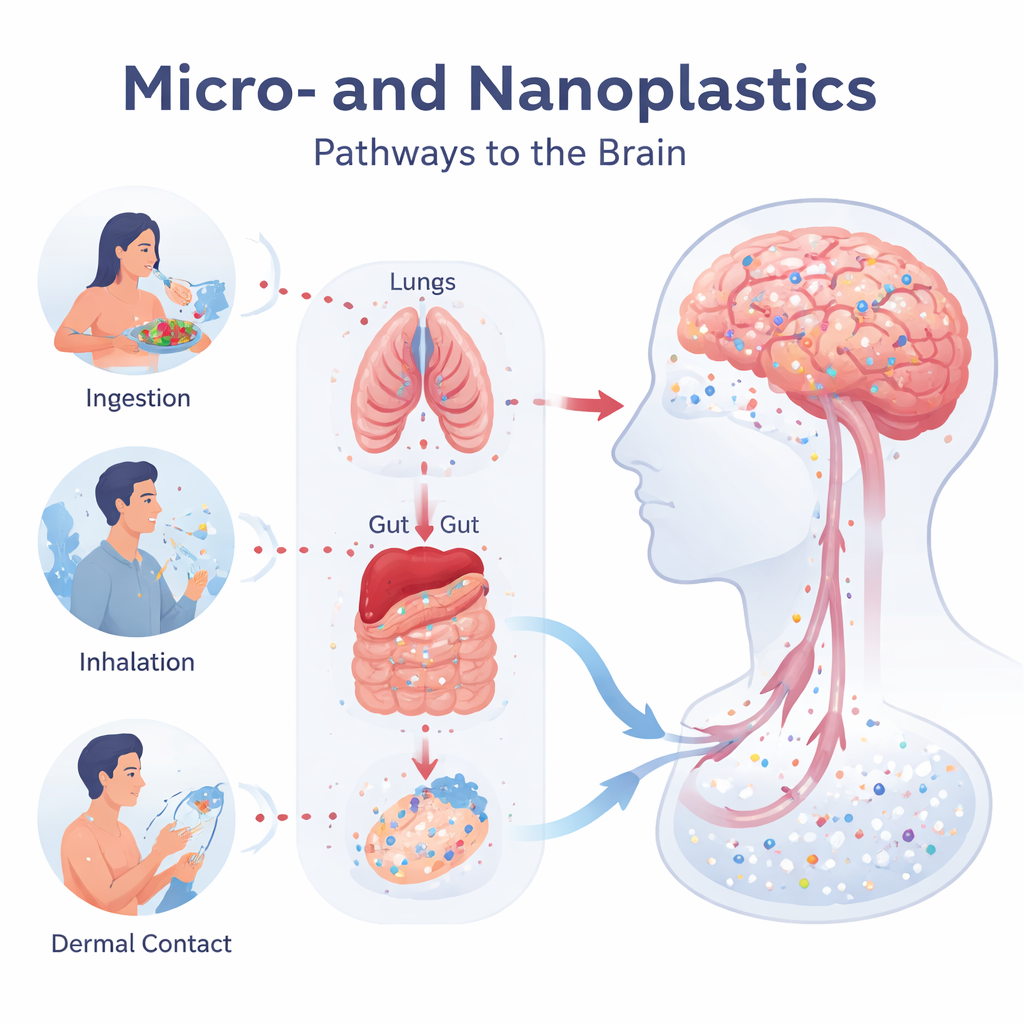
The authors begin by explaining what micro- and nanoplastics are: fragments smaller than a sesame seed, and in the case of nanoplastics, far smaller than the width of a human hair. Some are manufactured at that size for use in cosmetics and other products, while others form when larger items like bags, bottles, and tires break down under sunlight, friction, and weather. These particles are now found in nearly every environment, from oceans and soil to indoor air. People mainly encounter them by swallowing contaminated food and water, breathing them in, or through limited contact with the skin. Once inside, the fragments can pass through the gut or lungs into the bloodstream and travel throughout the body. Strikingly, studies of human tissues suggest that the brain may be one of the most enriched organs, raising alarms about possible long-term effects on brain health.
Why Parkinson’s Disease Is in the Spotlight
Parkinson’s disease is the second most common neurodegenerative disorder worldwide and is becoming more common as populations age. It is best known for motor problems—shaking, stiffness, and slowed movement—but also involves sleep issues, constipation, depression, and memory difficulties. A key signature of Parkinson’s is the build-up of a misfolded protein called alpha-synuclein inside nerve cells, especially those that produce dopamine in a deep brain region called the substantia nigra. Over time, these cells falter and die. While genes play a role, they explain only a fraction of cases. The rapid rise in Parkinson’s diagnoses has therefore pushed researchers to look hard at environmental factors, and plastics—once considered inert—are now emerging as serious suspects.
What Experiments Reveal About Plastic and Brain Damage
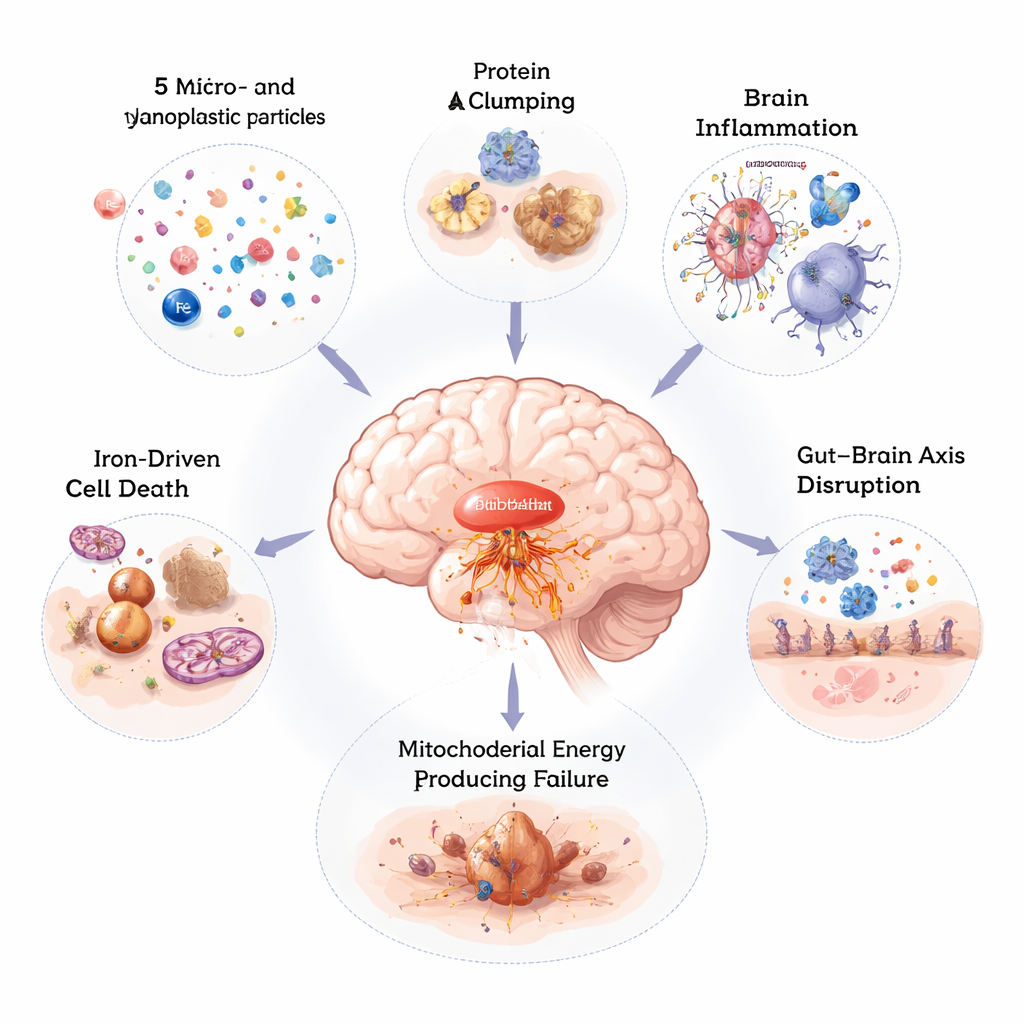
To probe this link, scientists have turned to mice, worms, fish, and cultured human cells. Across these models, exposure to micro- and nanoplastics often accelerates Parkinson-like changes. The particles can latch onto alpha-synuclein and nudge it into sticky clumps, while at the same time jamming the cell’s waste-disposal machinery so those clumps are not cleared. Nerve cells exposed to plastic fragments show overloaded energy factories (mitochondria), increased reactive oxygen “rust,” and disrupted handling of calcium, which together push them toward death. In the brain’s support cells, plastics reduce the ability to mop up the chemical messenger glutamate, increasing the risk of excitotoxic damage. The particles also act as ferries for metals like iron, which in excess can drive a destructive, iron-dependent cell death process called ferroptosis. None of these mechanisms alone proves that plastics cause Parkinson’s, but their convergence paints a worrisome picture.
The Gut–Brain Conversation and Silent Inflammation
Another major theme in the review is the gut–brain axis—the constant biochemical chatter between our intestines and our nervous system. Many people with Parkinson’s develop constipation and other gut problems years before movement symptoms arise, and their gut bacteria look different from those of healthy peers. Micro- and nanoplastics appear to damage the gut barrier, making it “leaky” so that bacterial toxins and inflammatory molecules seep into the bloodstream. They can also shift the balance of gut microbes, reducing the production of short-chain fatty acids that normally help keep both the gut lining and the blood–brain barrier intact. Together, these changes can stoke chronic, low-grade inflammation in the brain and activate its resident immune cells, microglia, which in an overexcited state may harm, rather than protect, vulnerable dopamine-producing neurons.
What This Means for Prevention and Future Research
For now, the evidence mainly comes from animals and cell cultures, often exposed to higher doses of plastics than humans typically encounter. The authors stress that we still lack solid data on real-world human exposures, how quickly these particles build up in the brain, and exactly which sizes or types are most dangerous. They call for large, long-term human studies, more realistic exposure models, and better tracking of how plastics move through the body and into specific brain regions. At the same time, the mechanistic clues already in hand suggest several potential defenses—from antioxidants and anti-inflammatory drugs to gut microbiome therapies and, crucially, policies that reduce plastic pollution at its source. For the layperson, the takeaway is clear: the plastic particles surrounding us may not be harmless bystanders, and cutting down on plastic use and waste is not just an environmental issue—it may also be an investment in the health of our aging brains.
Citation: Lin, L., Li, J., Zhu, S. et al. Micro-nanoplastics and Parkinson’s disease: evidence and perspectives. npj Parkinsons Dis. 12, 56 (2026). https://doi.org/10.1038/s41531-026-01272-4
Keywords: microplastics, nanoplastics, Parkinson’s disease, brain health, gut–brain axis