Clear Sky Science · en
Evaluation of the neurotrophic peptide mixture in pathogenetic therapy of patients with Parkinson’s disease
New Hopes for Easing Parkinson’s Symptoms
For people living with Parkinson’s disease, current medicines mainly help control movement problems but do little to slow the illness itself. This study explored a different kind of treatment: a mixture of brain‑supporting short proteins, or peptides, already used after stroke and brain injury. Researchers asked whether this "neurotrophic peptide mixture" could not only ease day‑to‑day symptoms, but also nudge brain and blood cells toward a healthier state.
A Small but Detailed Patient Trial
Seventeen adults with moderate Parkinson’s disease in Ukraine took part in this exploratory trial. All continued their usual Parkinson’s medication, mainly levodopa, and received daily infusions of the peptide mixture for 10 days. The team measured movement, thinking, and mood using standard clinical scales, and also recorded brain electrical signals and nerve reflexes. In parallel, they collected blood samples to examine platelets and mitochondria under the electron microscope, test markers of oxidative stress, and track changes in the activity of several protective genes. 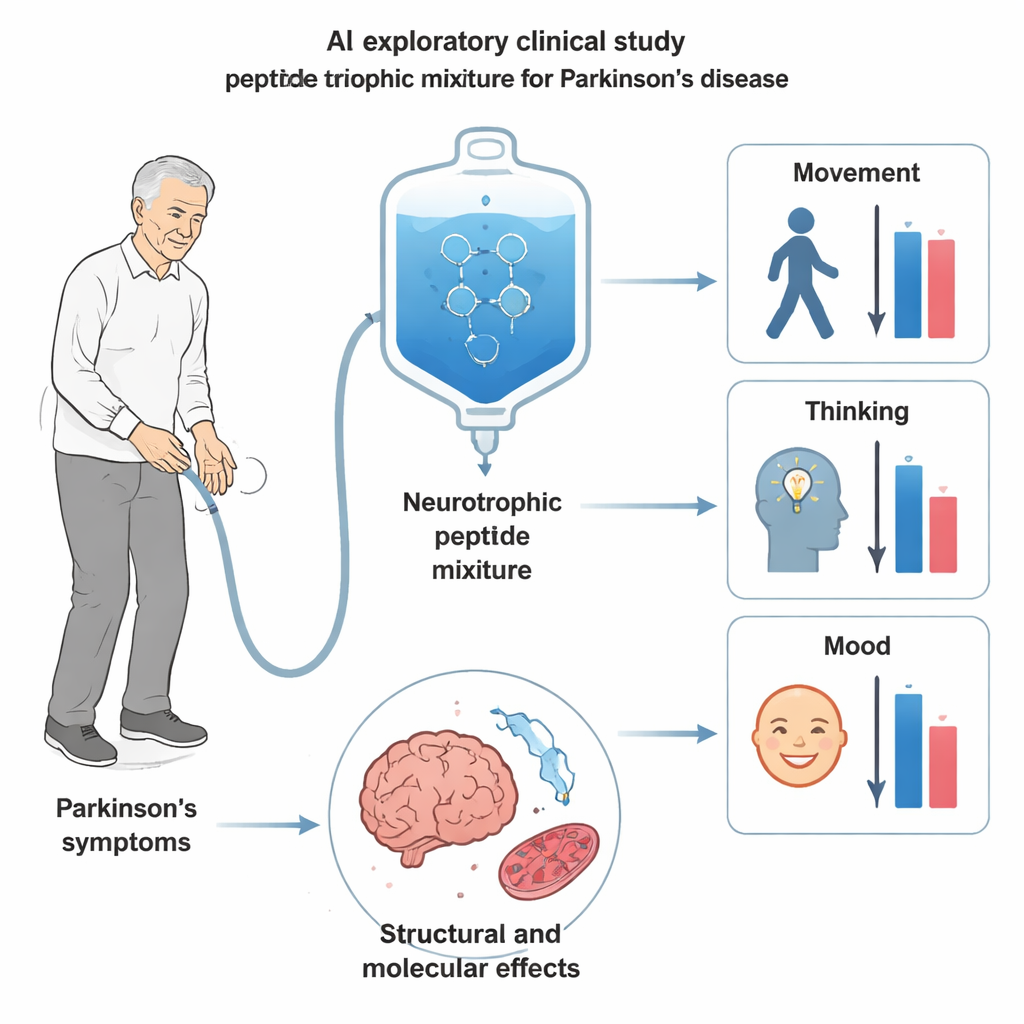
Changes Patients Could Feel
After the treatment course, patients functioned better in everyday life. Scores on the Unified Parkinson’s Disease Rating Scale, which captures overall movement problems and self‑care, improved by about 16 percent. Tests of memory, attention, and planning showed roughly 11 percent gains. Symptoms of depression fell by about 10 percent, and "reactive" anxiety—how strongly people respond to stress in the moment—dropped by almost a quarter, although long‑standing, trait‑like anxiety did not change. A computerized test of finger tapping revealed faster and more consistent movements, especially on the side of the body that had been most affected by Parkinson’s disease. Together, these findings suggest the peptide mixture may help patients move, think, and feel a bit better, at least in the short term.
Signs of Deeper Cellular Repair
The researchers also looked beneath the surface at blood cells, which can mirror changes happening in the nervous system. Before treatment, patients’ platelets showed features of aging and stress: they had fewer dense storage granules (which hold serotonin, a chemical linked to mood and brain signaling) and unusual, misshapen mitochondria. After the peptide infusions, the number of dense granules rose by 45 percent, and mitochondria became more numerous and looked healthier, with fewer abnormal forms. Markers of oxidative stress—chemical damage driven by reactive oxygen molecules—fell in both blood plasma and red blood cells, while levels of the antioxidant glutathione increased. These shifts hint that the peptide mixture may strengthen the body’s own defenses against cellular wear and tear.
Brain Signals and Protective Genes
Electrical recordings from the brain showed that a key signal involved in attention and decision‑making, known as the P3 wave, became faster after treatment, consistent with sharper mental processing. On the genetic level, the picture was more complex. Activity of the BDNF gene, which produces a growth factor that helps neurons survive and form new connections, rose in women but tended to fall in men. In women, higher BDNF levels went hand‑in‑hand with better scores on a standard mental‑status test. Other genes linked to mitochondrial health and inflammation changed little overall. To make sense of the many measurements, the team used machine‑learning models, which highlighted changes in BDNF, mitochondrial gene PINK1, and cognitive test scores as the strongest predictors of who improved the most in movement ratings. 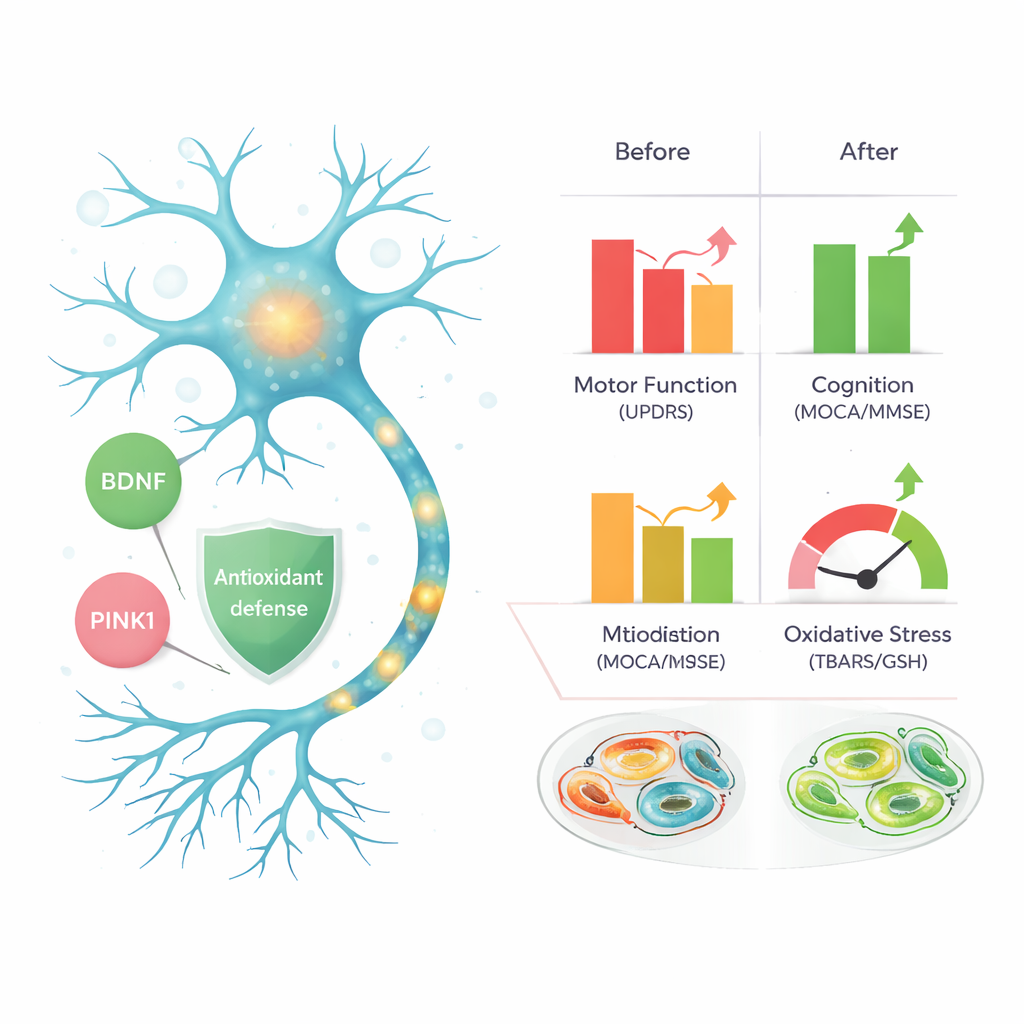
What This Could Mean for People With Parkinson’s
This study is too small, and lacked a placebo control group, to prove that the neurotrophic peptide mixture truly works or to show how long any benefits last. Still, the combination of better movement and mood, healthier‑looking blood cells, dampened oxidative stress, and promising brain‑signal changes suggests that this treatment may touch several layers of Parkinson’s biology at once. For patients and families, the message is cautious but encouraging: supporting the brain with repair‑oriented peptides could one day complement existing drugs that mainly replace missing dopamine. Larger, carefully controlled trials will be needed to confirm whether this approach can reliably improve symptoms and perhaps slow the underlying damage in Parkinson’s disease.
Citation: Krasnienkov, D., Karaban, I., Karasevych, N. et al. Evaluation of the neurotrophic peptide mixture in pathogenetic therapy of patients with Parkinson’s disease. npj Parkinsons Dis. 12, 55 (2026). https://doi.org/10.1038/s41531-026-01270-6
Keywords: Parkinson’s disease, neurotrophic peptides, Cerebrolysin, mitochondrial health, oxidative stress