Clear Sky Science · en
Biological aging predicts mortality in Parkinson’s patients: evidence from UK Biobank
Why this research matters to families
People with Parkinson’s disease and their loved ones often ask a painfully simple question: “How long do I have?” Doctors can offer averages, but predictions for an individual person are still rough. This study explores whether a new measure of “biological age” – how worn out the body really is, based on common blood tests – can better forecast survival in Parkinson’s than calendar years alone, and whether combining it with lifestyle and genetic information can guide more personalized care.
Looking beyond birthdays to body age
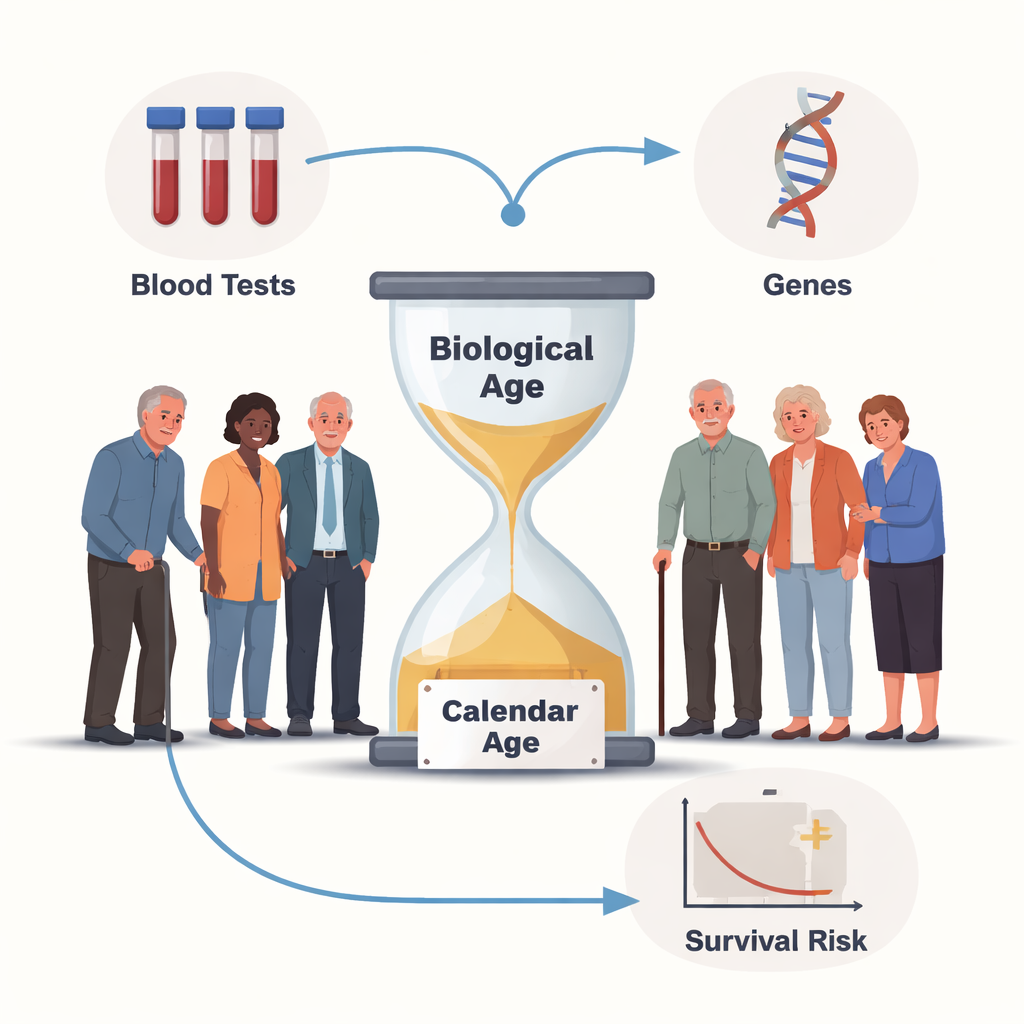
We usually think of age as the number of birthdays we’ve celebrated, but two people of the same age can be very different in health. The researchers used a measure called “Phenotypic Age,” or PhenoAge, which is calculated from nine routine blood markers related to inflammation, liver and kidney function, blood cells, and sugar control, together with actual age. This score acts like a “body age.” They also looked at how much faster or slower a person’s body seemed to be aging compared with their real age, a metric called PhenoAge acceleration. The idea was straightforward: if Parkinson’s patients whose bodies appear older die sooner, then biological age could become a powerful tool for planning treatment and support.
What the UK Biobank revealed
The team drew on the UK Biobank, a large health study that has tracked over half a million volunteers for many years. From this resource they identified 569 people who already had Parkinson’s at the time they joined and who also had complete blood and genetic data. These individuals were followed for a median of about 9.4 years, during which nearly two-thirds died. On average, their biological age was higher than that of more than 300,000 similar adults without Parkinson’s, suggesting that people with Parkinson’s tend to be biologically older than their peers.
Older in body, higher risk of death
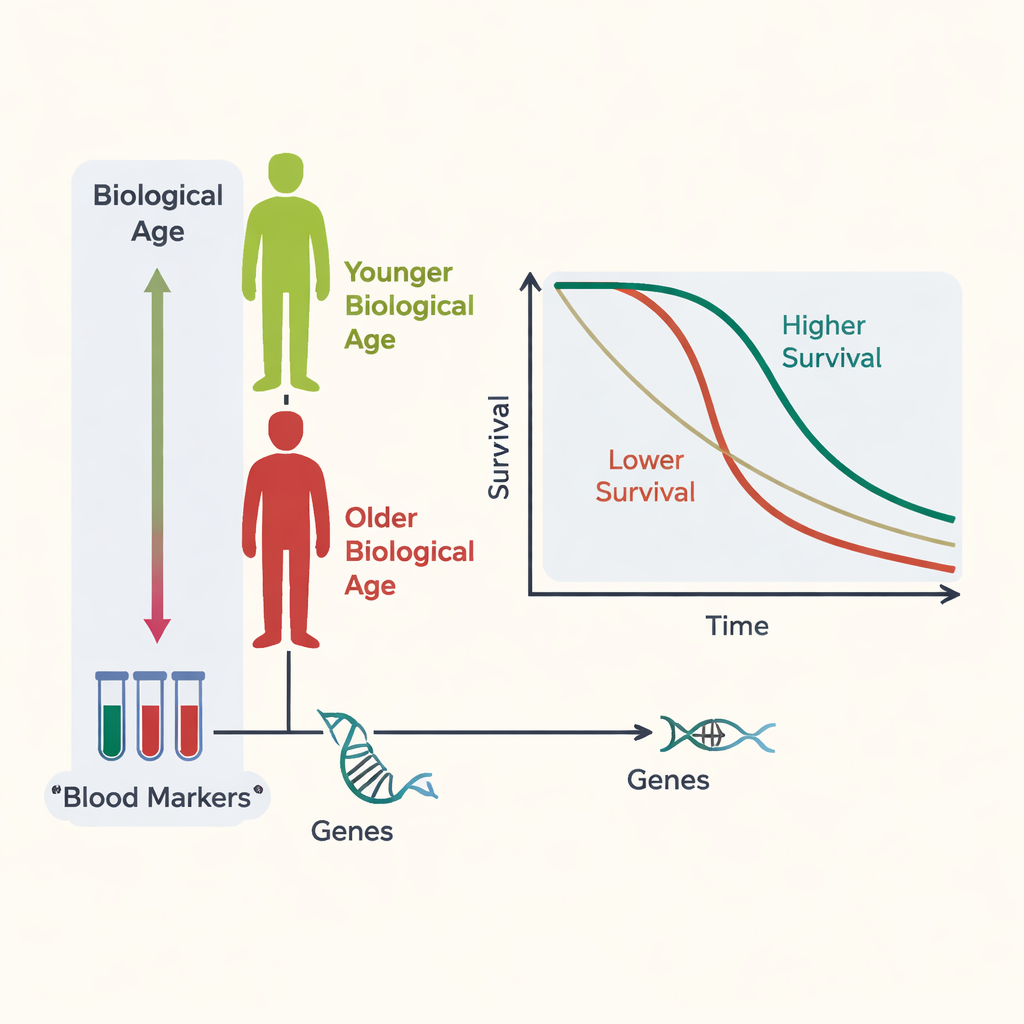
When the researchers compared survival among the Parkinson’s group, a clear pattern emerged. Patients whose body age was 60 or older, or whose bodies were aging faster than their calendar age, were more likely to die during follow-up than those who appeared biologically younger. When they divided biological age and aging speed into four levels, each step up in these levels brought a higher death risk. Even after accounting for many other influences – such as sex, weight, smoking, mood, blood fats, and social disadvantage – biological age and accelerated aging remained independent warning signs for shorter survival.
Genes, habits, and mood also play a part
Biological age was only part of the story. Men with Parkinson’s, people who had ever smoked, and those who were underweight faced higher mortality. Frequent depressive mood was also linked with worse outcomes, underscoring how emotional health can affect the course of a physical brain disorder. Blood levels of “bad” cholesterol (LDL) and a combined genetic risk score built from many Parkinson’s-related DNA variants were tied to greater risk, while one blood fat measure, apolipoprotein B, was unexpectedly associated with better survival. Together, these findings support the view that Parkinson’s progression reflects a tangle of aging processes, lifestyle exposures, and inherited vulnerability.
A practical scorecard for the clinic
To turn these insights into something doctors could use, the team built a prediction tool called a nomogram – essentially a visual scorecard. It combines nine factors: biological age, sex, age at study entry, smoking status, body mass index, frequency of depressed mood, apolipoprotein B, LDL, and the genetic risk score. Tested in separate subsets of patients, this tool estimated the chances of being alive at five, seven, and ten years with good accuracy, outperforming simpler models that relied just on ordinary age and sex. Patients classified as high risk by this scorecard died sooner than those labeled low risk, confirming its power to sort people into meaningful risk groups.
What this means for people living with Parkinson’s
For non-specialists, the key message is that how old your body is matters at least as much as how old the calendar says you are. In this study, Parkinson’s patients with an older biological age had a clearly higher chance of dying over the next decade. By combining routine blood tests, simple clinical information, and genetic risk into a single prediction tool, doctors may eventually be able to identify patients who need closer monitoring, more aggressive treatment of risk factors like smoking and depression, and earlier planning for support. While the work needs to be confirmed in more diverse groups, it points toward a future in which slowing biological aging – not just treating symptoms – could help people with Parkinson’s live longer and better lives.
Citation: Duan, QQ., Su, WM., Yin, KF. et al. Biological aging predicts mortality in Parkinson’s patients: evidence from UK Biobank. npj Parkinsons Dis. 12, 53 (2026). https://doi.org/10.1038/s41531-026-01268-0
Keywords: Parkinson’s disease, biological age, survival prediction, genetic risk, blood biomarkers