Clear Sky Science · en
Association of LRRK2 p.A419V with Parkinson’s Disease in East Asians and analysis of age at onset
Why a tiny DNA change matters
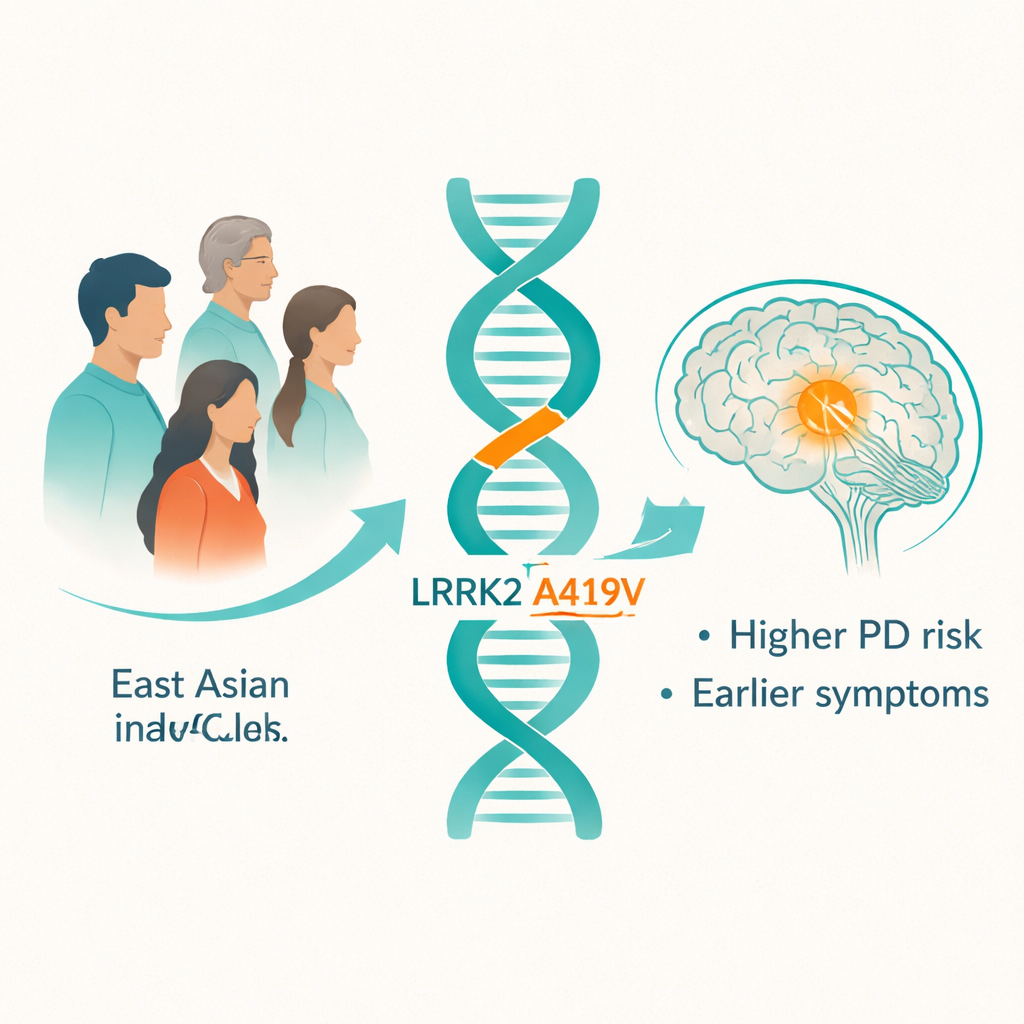
Parkinson’s disease is usually thought of as a problem of aging brain cells, but part of the story lies in our DNA. This study focuses on a rare change in a single gene, called LRRK2, and asks two questions: does this change raise the chance of developing Parkinson’s, and does it shift when symptoms start? By pooling genetic data from more than 200,000 people around the world, the researchers show that this subtle change is an important risk factor for people of East Asian ancestry and may nudge the disease to appear a little earlier in life.
A closer look at Parkinson’s risk genes
The LRRK2 gene has long been known as one of the major genetic players in Parkinson’s disease. Some versions of this gene directly cause inherited forms of the illness; others make Parkinson’s slightly more or less likely to occur. In Asian populations, two such risk versions, called p.G2385R and p.R1628P, are already well established. Another version, p.A419V, had produced mixed results in earlier, smaller studies: some hinted at increased risk, while others saw no clear effect. This uncertainty meant the variant was often left out of deeper clinical and laboratory research.
Global data reveal a clearer signal
To settle the debate, the team combined information from multiple large genetic projects, including the Global Parkinson’s Genetics Program, international biobanks, and dedicated East Asian sequencing efforts. Altogether, they analyzed over 40,000 people with Parkinson’s and more than 160,000 people without the disease, grouped by ancestry. They found that the p.A419V version of LRRK2 is rare overall but noticeably more common in East Asians than in Europeans, Africans, or people from the Americas. Among individuals of East Asian ancestry, carrying p.A419V was linked to roughly a two- to threefold increase in Parkinson’s risk—similar in size to the effect of the better-known Asian LRRK2 variants.
Who is affected and when disease begins
The researchers then asked whether this variant changes the age at which Parkinson’s symptoms begin. In East Asian patients, those who carried p.A419V tended to develop Parkinson’s about two to three years earlier than those without it. When different East Asian groups were combined, the trend toward earlier onset remained, though it was statistically modest. Notably, the variant was extremely rare in people of European ancestry, and an apparent signal in one European dataset turned out to be driven largely by participants with mixed or Central Asian genetic backgrounds. This highlights how important it is to match patients and comparison groups by ancestry when studying rare genetic changes.
What happens inside brain cells
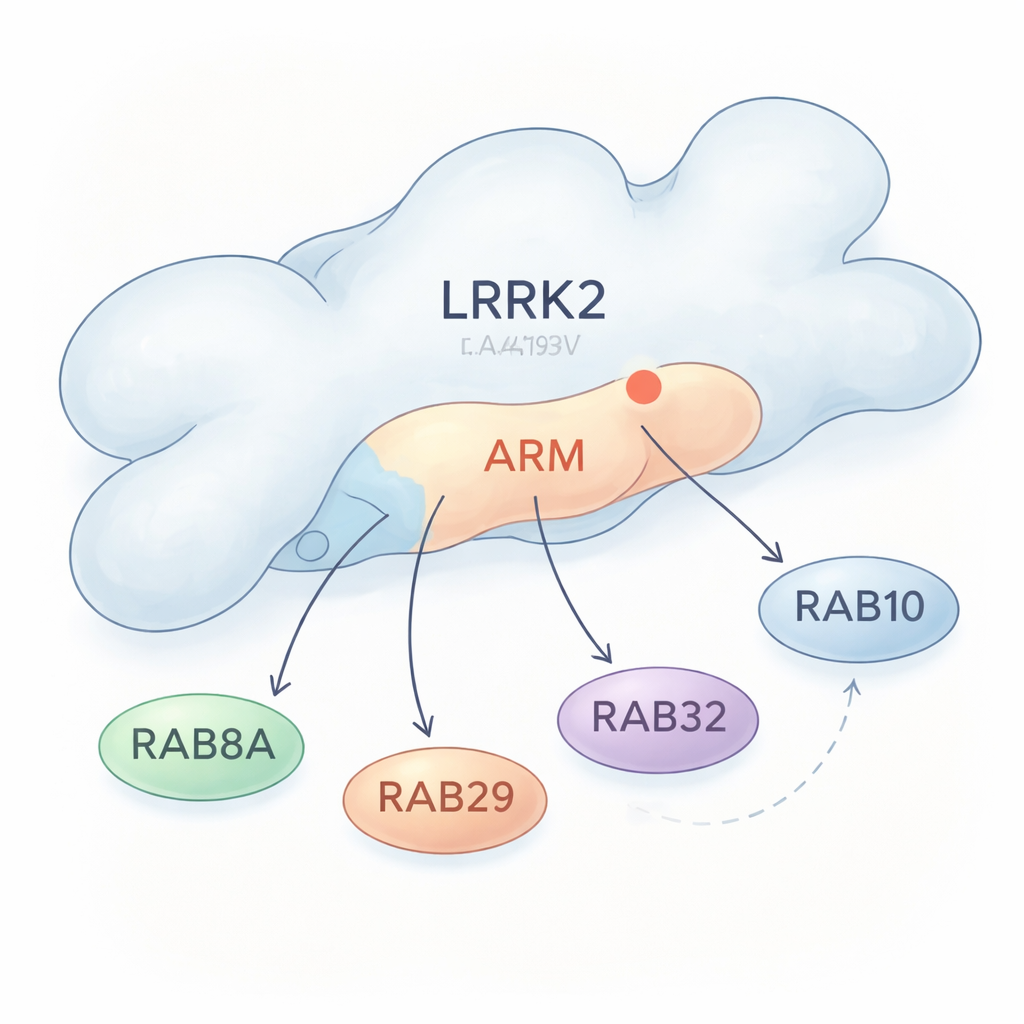
Genes matter because they shape proteins, the working molecules of cells. LRRK2 is a large protein that helps control traffic inside cells by working with a family of “switch” proteins called RABs. Computer-based 3D modeling in this study showed that the p.A419V change sits in a region of LRRK2 known as the ARM domain, close to the docking sites for several RAB proteins (RAB8A, RAB29, and RAB32). Earlier lab experiments have suggested that this change makes LRRK2 more active and alters how it attaches to cell structures. By shifting how LRRK2 talks to RAB proteins and cell transport systems, p.A419V may subtly disturb the health of nerve cells over many years.
What this means for patients and future therapies
For people of East Asian ancestry, this work firmly places LRRK2 p.A419V alongside other known LRRK2 risk variants that clinicians and researchers already track. While carrying this variant does not guarantee Parkinson’s disease, it measurably raises the odds and may bring symptoms on slightly sooner. Because LRRK2 is a major drug target—with several LRRK2-blocking treatments under development—pinpointing which variants matter in which populations is essential for future precision medicine. This study shows that even rare changes in a single gene can offer valuable clues about who is at risk, how early disease may start, and which biological pathways might be most promising to target with new therapies.
Citation: Lim, K.S., Periñan, M.T., Chew, E.G.Y. et al. Association of LRRK2 p.A419V with Parkinson’s Disease in East Asians and analysis of age at onset. npj Parkinsons Dis. 12, 51 (2026). https://doi.org/10.1038/s41531-026-01265-3
Keywords: Parkinson’s disease, LRRK2 gene, genetic risk, East Asian populations, age at onset