Clear Sky Science · en
Pallidal beta power is associated with depression in Parkinson’s disease
Why Mood Problems Matter in Parkinson’s
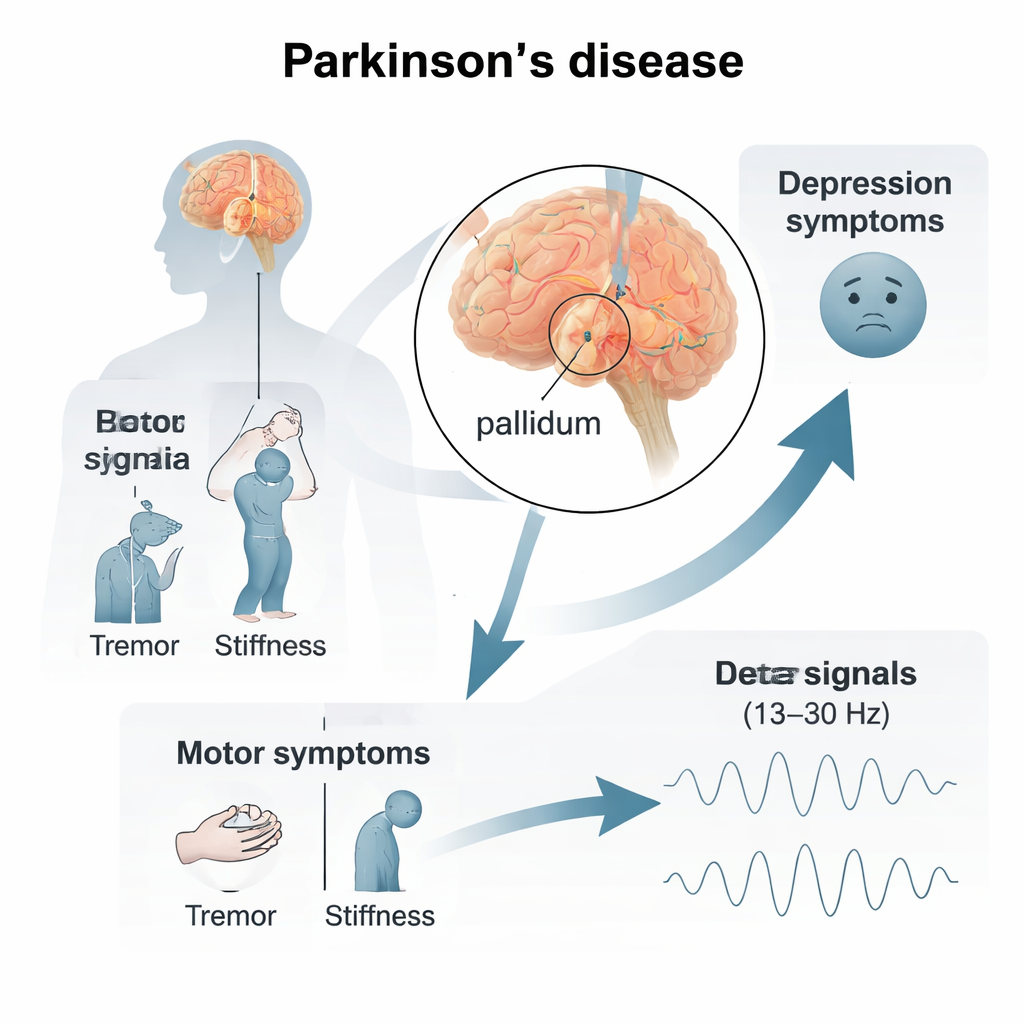
Parkinson’s disease is best known for its motor symptoms—slowness, stiffness, tremor, and balance problems. Yet for many people, low mood and lack of motivation are just as disabling as movement difficulties. This study explores a basic question with big clinical implications: is there a measurable brain signal that tracks depression in people with Parkinson’s, and could that signal one day help doctors fine‑tune brain stimulation treatments not only for movement, but also for mood?
A Closer Look Inside a Small but Powerful Brain Hub
The researchers focused on the pallidum, a deep brain structure that acts as a major relay station, helping route information between the cortex, the thalamus, and other parts of the basal ganglia. The pallidum is already a common target for deep brain stimulation (DBS), a surgical therapy that uses implanted electrodes to improve movement problems in Parkinson’s disease. But while many studies have measured movement-related activity in this region, almost nothing was known about whether its electrical patterns relate to depression. The team set out to fill that gap by recording brain signals directly from the pallidum during DBS surgery.
Listening to Brain Rhythms During Surgery
The study included 50 people with Parkinson’s disease who were undergoing DBS electrode placement in the pallidum. Before surgery—on average about four months earlier—each patient completed standard questionnaires that rated depression, anxiety, and apathy. During awake surgery, doctors briefly recorded resting brain activity from the newly implanted electrodes. These signals were analyzed to measure power in different frequency bands, including “beta” rhythms (13–30 cycles per second), which are well known for their role in Parkinsonian movement symptoms. The question was whether any of these frequency bands, particularly beta, would differ between people with and without clinically elevated depression symptoms.
Stronger Beta Rhythms Track Stronger Depression
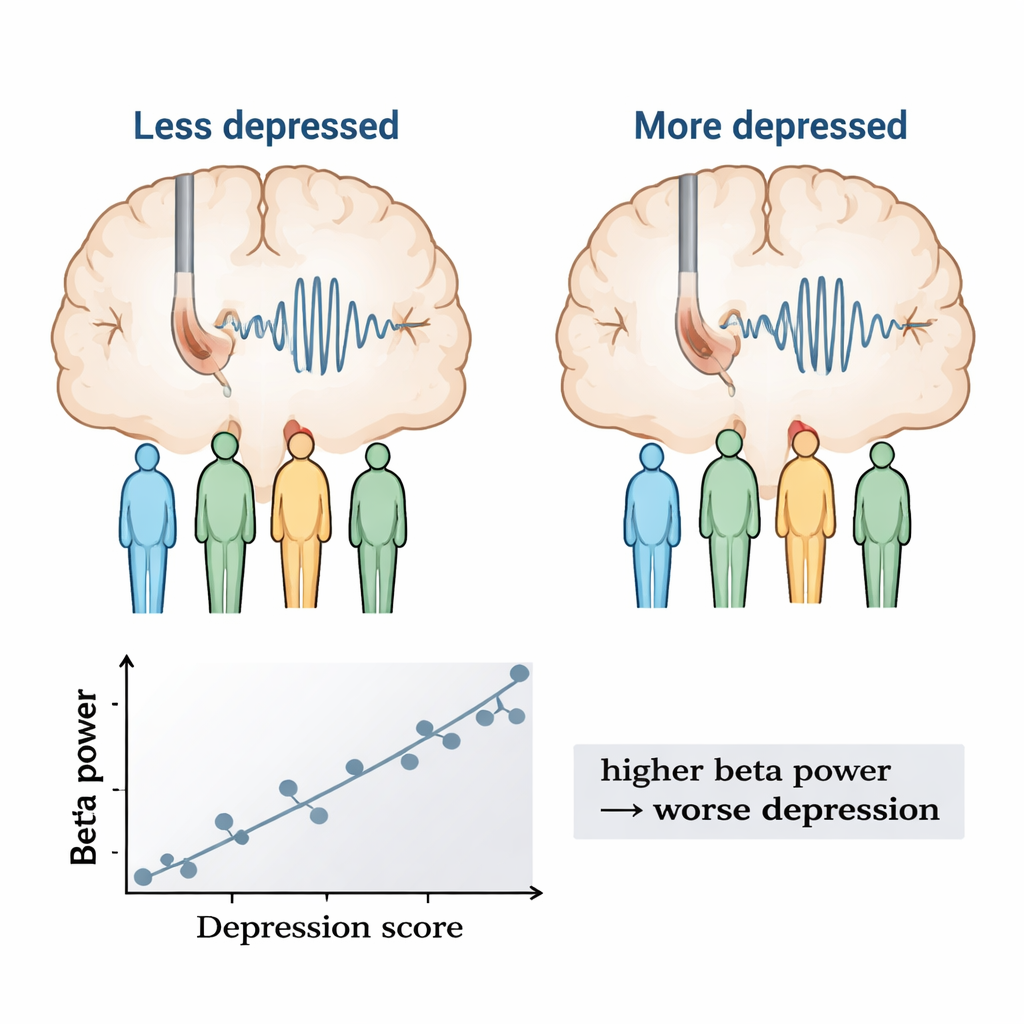
When the researchers compared patients with clinically significant depression to those without, one pattern stood out: people with higher depression scores had stronger beta activity in the pallidum. This effect was especially clear in the higher portion of the beta range (20–30 Hz). Beta power not only separated depressed from non‑depressed patients; it also rose in step with depression severity across the entire group. Importantly, pallidal beta did not track how bad the motor symptoms were, and depression scores themselves were not tied to motor severity, suggesting this signal was not just a by‑product of worse movement problems.
Ruling Out Other Explanations
Depression in Parkinson’s is influenced by many factors, including age, disease duration, medications, and co‑occurring anxiety or apathy. To make sure beta activity was not simply reflecting one of these other influences, the team used a statistical model that considered them all at once—demographic features, motor ratings on and off medication, doses of Parkinson’s drugs, use of antidepressants or other psychiatric medications, and scores for anxiety and apathy. Even after accounting for all of these, higher beta power in the pallidum still predicted worse depression. Anxiety was also linked with higher depression scores, but it did not erase the unique contribution of beta activity.
What This Could Mean for Future Treatment
These findings suggest that unusually strong beta rhythms in the pallidum may be a biological marker of depression in Parkinson’s disease. Because DBS electrodes already sit in this region for many patients, future devices that can sense and respond to brain signals might use beta power as part of a feedback loop to adjust stimulation in real time. While this study is an early step—based on brief recordings during surgery and mostly mild to moderate depression—it points toward a future where doctors could tune DBS not only to smooth movement, but also to ease mood symptoms, guided by objective signals from deep within the brain.
Citation: Johnson, K.A., Coutinho, P.B., Kenney, L.E. et al. Pallidal beta power is associated with depression in Parkinson’s disease. npj Parkinsons Dis. 12, 50 (2026). https://doi.org/10.1038/s41531-026-01264-4
Keywords: Parkinson’s disease, depression, deep brain stimulation, basal ganglia, beta oscillations