Clear Sky Science · en
Speciation and radiation stability of Cr and Ln “Grey-Phases” within Cr-doped (Ln,U)O2 spent fuel model materials
Why this research matters for nuclear energy
Nuclear power is often promoted as a low‑carbon backbone for future energy systems, but what happens to the fuel after it has done its job remains a major concern. This study looks at a new generation of uranium dioxide (UO₂) fuels that are improved with tiny amounts of chromium and other elements. These additives help the fuel perform better inside a reactor and reduce the volume of spent fuel, but they also change the tiny internal structures that form after years of radiation. Understanding those changes is essential for predicting how spent fuel will behave over decades in storage or disposal.
Smarter fuel pellets with hidden helpers
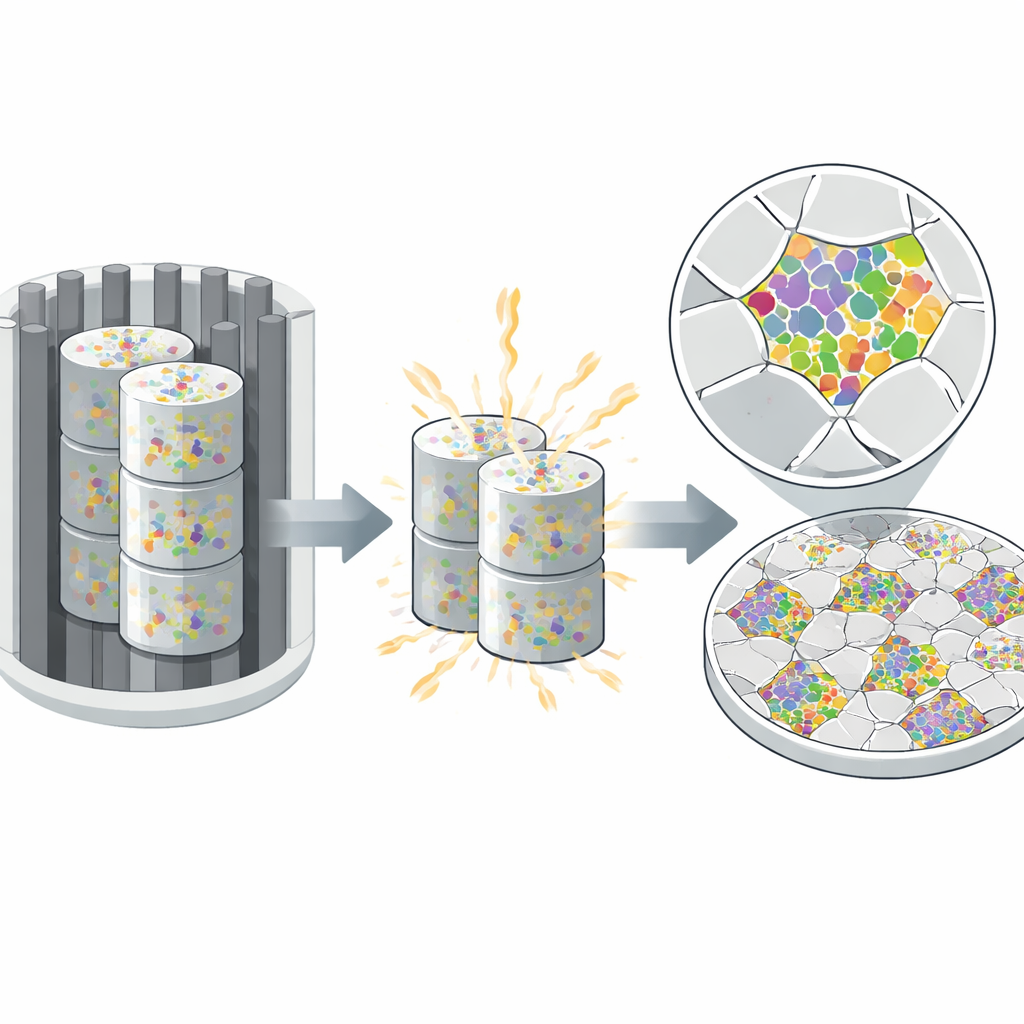
Modern reactor fuels increasingly use so‑called advanced technology fuels, where classic UO₂ is subtly modified. Adding only a few hundred parts per million of chromium causes the microscopic grains inside a fuel pellet to grow larger. Larger grains trap fission gases more effectively, which allows the fuel to be used longer and to higher “burn‑up” before it must be removed. Utilities also add certain rare‑earth elements such as gadolinium to help control the reactor power during operation. While these tricks improve in‑reactor performance, much less is known about how all these additives rearrange themselves once the fuel has been heavily irradiated and becomes spent fuel.
Probing the fuel’s inner chemistry with sharp X‑ray eyes
Direct experiments on highly radioactive spent fuel are technically demanding, so the researchers created carefully controlled model materials. They synthesized uranium dioxide that contained both trace chromium and a substantial fraction of either praseodymium or gadolinium, elements that mimic the behavior of important fission and transmutation products. Using high‑energy synchrotron X‑rays and a very high‑resolution technique called HERFD‑XANES, they were able to distinguish not just where uranium sits in the crystal, but also in what oxidation state it exists, and how the chromium and rare‑earth atoms are bonded. These measurements showed that introducing trivalent rare‑earth ions forces a portion of the uranium to oxidize, subtly shrinking the crystal lattice and changing the internal balance of charges.
Unexpected formation of grey‑phase islands
The most striking finding is that chromium and the rare‑earth elements do not remain evenly dissolved in the uranium dioxide as might be expected from simple solubility limits. Instead, a large fraction of the chromium teams up with praseodymium or gadolinium and oxygen to form a distinct family of mixed oxides with a perovskite‑type structure, written chemically as LnCrO₃. These compounds closely resemble the so‑called “grey phases” known from conventional spent fuel, but here they are built from elements that normally prefer to stay dissolved in the fuel matrix. Advanced spectral analysis showed that roughly two‑thirds to three‑quarters of the chromium had moved into these grey‑phase‑like regions, even though the overall chromium content was well below the level at which separate chromium phases were expected to appear.
Testing resilience under intense ion bombardment
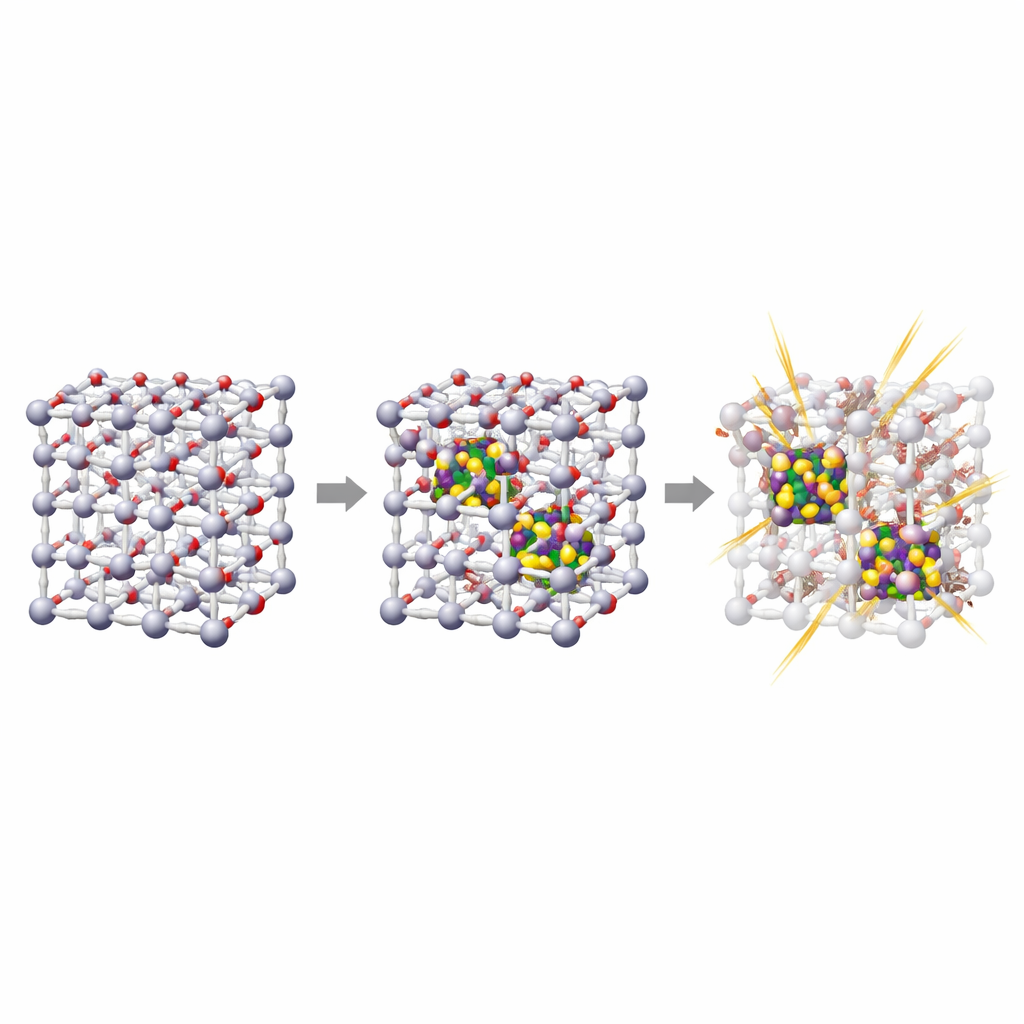
Forming new microscopic phases raises an immediate question: are these tiny islands stable under the extreme radiation fields inside fuel and during long‑term storage? To test this, the team synthesized pure pellets of the two perovskite compounds, PrCrO₃ and GdCrO₃, and bombarded their polished surfaces with a beam of very energetic gold ions, simulating severe radiation damage. Electron microscope images showed that the once crisp grain structure near the surface became smoothed and glass‑like, signaling partial amorphization. However, grazing‑incidence X‑ray diffraction, which probes the near‑surface layers, still revealed the characteristic diffraction peaks of the original perovskite crystal, though broadened and shifted. This means that while the materials suffer heavy damage, their underlying structure and identity persist.
What this means for the future of spent nuclear fuel
For non‑specialists, the key message is that tiny amounts of chromium introduced to make reactor fuel more robust can also drive the fuel to form new, very stable mixed‑oxide islands once it is spent. These grey‑phase‑like pockets lock chromium and certain fission‑product‑like elements into a structure that resists heat, chemistry and radiation. That is reassuring from the standpoint of containing radioactivity, but it also means that the internal makeup of spent fuel from chromium‑doped advanced fuels will differ from traditional UO₂. Disposal and dissolution models designed for older fuels may need to be updated to reflect this new phase chemistry. In short, improving fuel performance inside the reactor inevitably reshapes the long‑term story of how that fuel behaves after it has been used.
Citation: Shirokiy, D., Bukaemskiy, A., Henkes, M. et al. Speciation and radiation stability of Cr and Ln “Grey-Phases” within Cr-doped (Ln,U)O2 spent fuel model materials. npj Mater Degrad 10, 39 (2026). https://doi.org/10.1038/s41529-026-00752-5
Keywords: chromium-doped nuclear fuel, spent fuel grey phases, uranium dioxide microstructure, perovskite mixed oxides, radiation damage tolerance