Clear Sky Science · en
Enhancement mechanisms of Cr and RE on the corrosion resistance of HRB400 rebar in chloride-containing concrete pore solution
Why Rusty Rebar Matters
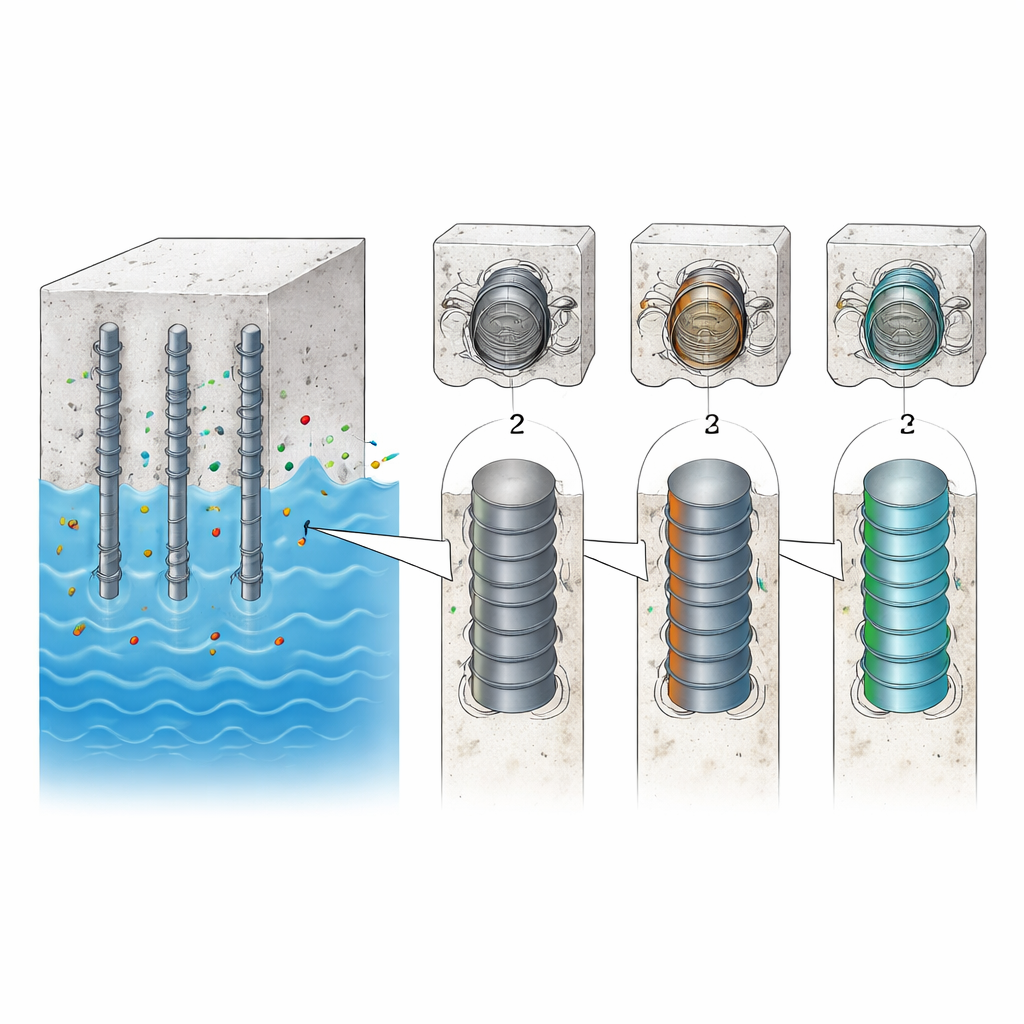
Hidden inside most bridges, tunnels, and coastal buildings are steel bars that quietly carry the load. When those bars begin to rust, the surrounding concrete can crack, spall, and ultimately fail—sometimes decades earlier than planned. This study explores a new way to make those steel bars more resistant to salt-driven corrosion by changing the steel itself, rather than just adding better coatings or thicker concrete around it.
Salt, Steel, and Crumbling Concrete
In marine environments and in structures exposed to de-icing salts, chloride ions gradually work their way through concrete until they reach the reinforcing steel. Under normal conditions the steel is protected by a thin, stable film formed in the highly alkaline concrete pore fluid. Chloride, however, undermines this film and triggers local attack that starts as tiny pits and can grow into serious rust damage. Conventional countermeasures focus on the concrete or on external coatings, which improve conditions around the steel but do not change how the steel itself responds to an aggressive, salty environment.
Designing Smarter Steel
The researchers examined three versions of a common construction steel known as HRB400: the standard grade, a chromium-enriched version, and a third version containing both chromium and a trace of rare earth elements (cerium and lanthanum). They focused on the steel’s microscopic inclusions—tiny non-metallic particles left over from processing that often become the starting points for corrosion. In the standard steel, these inclusions are rich in manganese sulfide and complex oxides that dissolve easily in chloride-rich solutions, opening gaps at the steel–inclusion interface and creating microenvironments where pits can rapidly form and grow.
Taming the Weak Spots Inside Steel
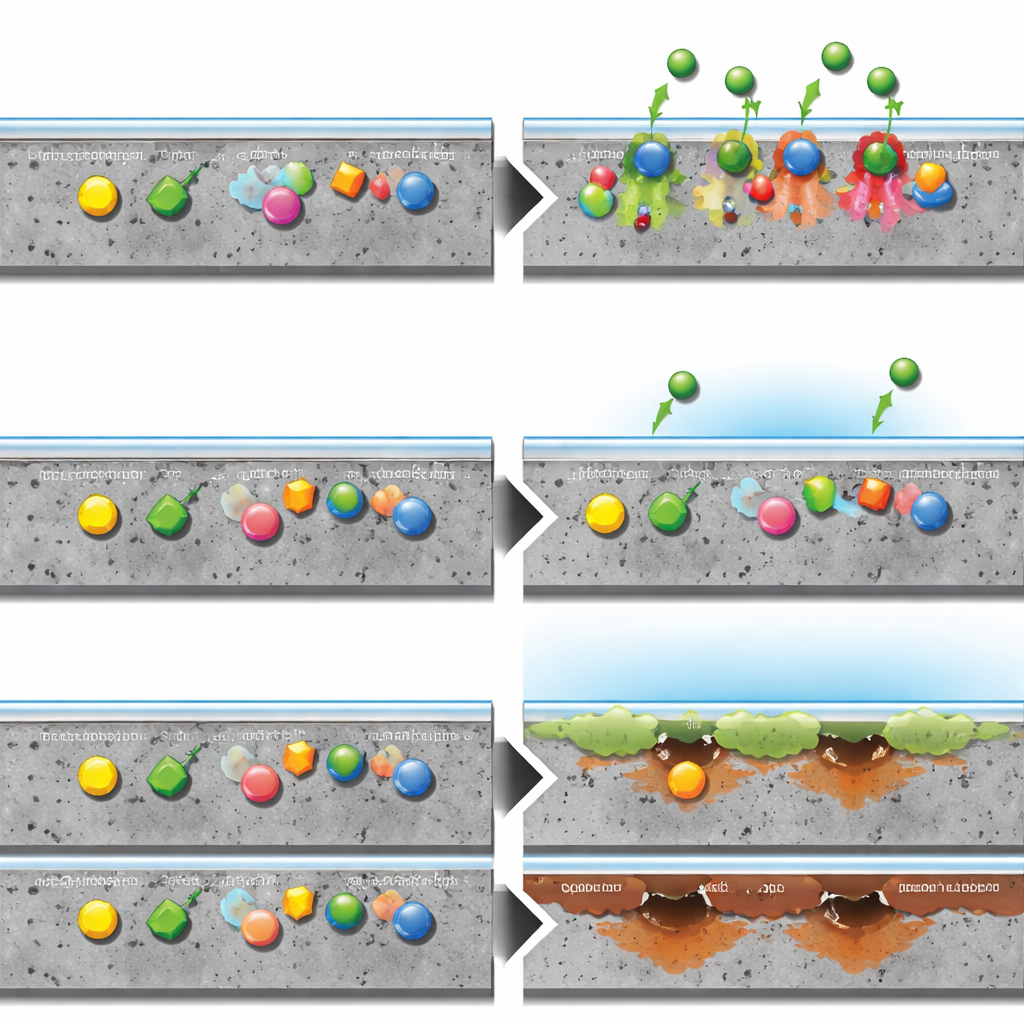
Adding chromium and rare earths transforms both the microstructure and the inclusions. Chromium reduces the amount of certain microstructural phases and helps build a more protective surface film. Rare earths reorganize the inclusions into rare-earth–aluminum oxides, often wrapped in a thin manganese sulfide shell, and significantly reduce the number of bare manganese sulfide particles. Detailed electron microscopy shows that, in the rare-earth–modified steel, the sulfide shells dissolve first, but the rare-earth–oxide cores dissolve only slowly. These tougher inclusions act less like open doors for chloride attack and more like barriers that slow pit growth around them, even when chloride levels are high.
Measuring How Fast the Damage Spreads
To compare performance, the team immersed the three steels in simulated concrete pore solutions containing various amounts of salt and used electrochemical tests to track how easily corrosion occurred. The chromium–rare-earth steel consistently showed the highest resistance: its passive film broke down at higher potentials, carried lower corrosion currents, and presented larger impedance arcs—signs of a stronger barrier to charge and ion movement. After days in chloride-rich solution, weight-loss tests and 3D surface maps revealed that this steel developed the shallowest pits and the smallest damaged areas. In fact, after seven days the corrosion rate of the chromium–rare-earth steel was roughly one-third that of the conventional HRB400, and its pits were less sharp and less penetrating.
How the Protective Film Holds Up
Surface analysis of the rust and passive layers confirmed that chromium and rare earths are drawn into the outer film, where they form stable oxides that plug defects and make it harder for chloride to burrow in. Electrical measurements of the film’s semiconductor-like behavior showed that the chromium–rare-earth steel had the lowest density of charge carriers, indicating a more orderly, less defective oxide layer. Even as salt concentration rose and all steels became more vulnerable, this modified alloy consistently maintained the thickest, most protective barrier and the fewest pathways for corrosive ions to travel.
What This Means for Future Structures
In simple terms, the study shows that carefully tweaking the recipe of reinforcing steel—by adding small amounts of chromium and rare earth elements—can significantly slow the way salt attacks from the inside out. Instead of relying solely on better concrete or coatings, engineers can use steels whose internal weak spots are redesigned so that pits start later and grow more slowly. For bridges, docks, and coastal buildings, such steels could translate into longer service lives, fewer repairs, and safer structures in some of the harshest environments our infrastructure must face.
Citation: Zhu, R., Chen, T., Hao, L. et al. Enhancement mechanisms of Cr and RE on the corrosion resistance of HRB400 rebar in chloride-containing concrete pore solution. npj Mater Degrad 10, 36 (2026). https://doi.org/10.1038/s41529-026-00746-3
Keywords: reinforced concrete durability, rebar corrosion, chloride attack, microalloyed steel, rare earth alloying