Clear Sky Science · en
Enhancing the protective performance of waterborne polyurethane coatings by non-covalent functionalized MXene
Why Protecting Everyday Metals Matters
From bridges and ships to cars and household appliances, metal structures quietly hold up much of modern life. Yet all of them share a persistent enemy: rust. Traditional paints and coatings slow corrosion, but they often rely on polluting solvents and can fail over time, especially in salty or humid environments. This study explores a greener, smarter coating that not only blocks corrosive substances more effectively, but can also partly “self-heal” when scratched, extending the life of metal while reducing environmental impact.
A Green Coating with Hidden Helpers
The researchers focused on waterborne polyurethane (WPU), a more environmentally friendly coating that uses water instead of harsh organic solvents. While WPU cuts down on toxic emissions, it has a weakness: as the water evaporates during drying, tiny defects and pathways form in the film. Through these channels, oxygen, water, and salt can sneak in and attack the metal surface. To solve this, the team introduced a specially designed microscopic filler made from a two-dimensional material called MXene, combined with cerium compounds and a plant-derived molecule called tannic acid. These ultra-thin sheets, named MCT, are engineered to both physically block corrosive species and chemically fight rust at the metal surface.
Building a Better Shield at the Nanoscale
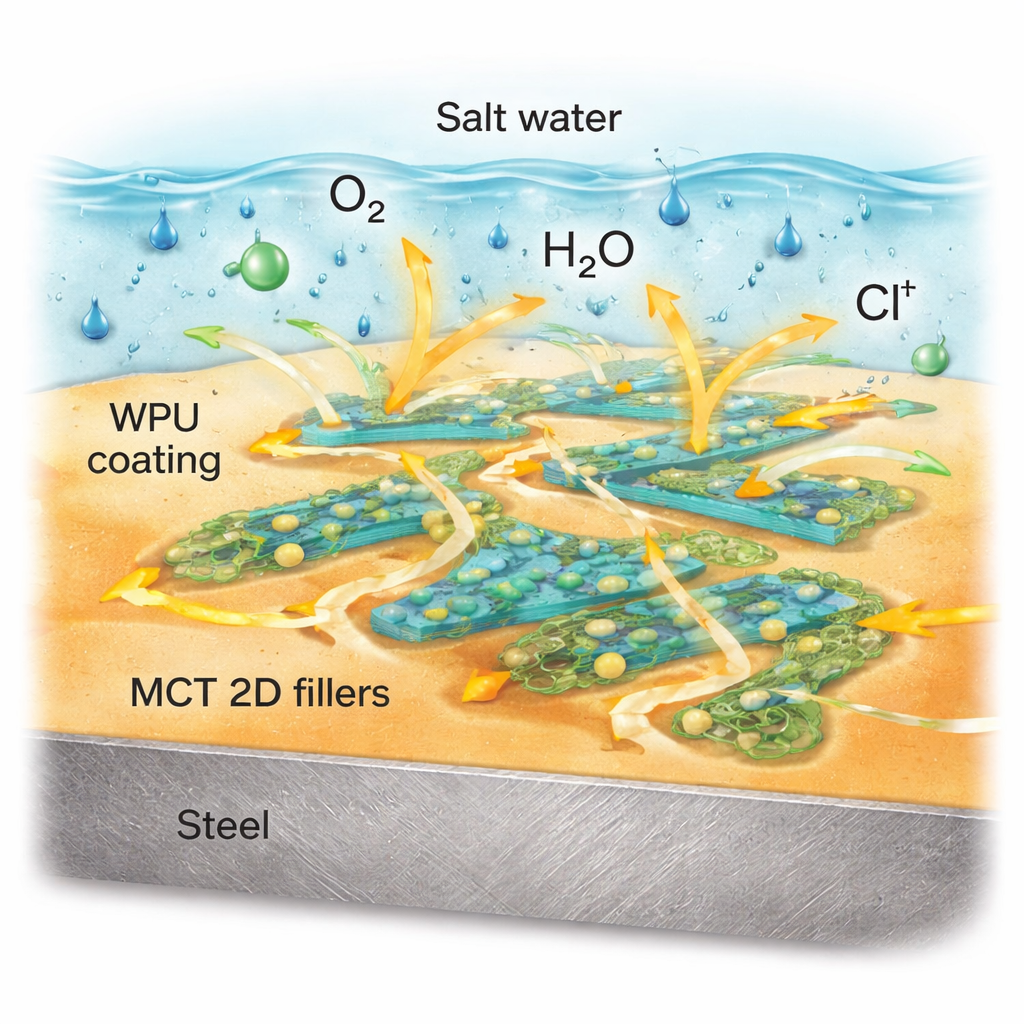
Under powerful microscopes, the starting MXene appears as stacks of atomically thin layers. The scientists used a one-step water-based process to decorate these layers with tiny cerium oxide particles and a thin coating of polymerized tannic acid, without resorting to toxic organic chemicals. This treatment kept the MXene sheets from clumping or breaking down and helped them mix smoothly into the WPU. In the final coating, the MCT sheets lie dispersed like overlapping tiles in a roof. Corrosive molecules in salty water no longer travel in a straight line; instead they must weave around many barriers, greatly lengthening their path and slowing their progress toward the metal.
Stronger, Drier, and More Water-Repellent
To see how well this new filler works, the team compared plain WPU, WPU with unmodified MXene, and WPU with the MCT filler. They measured how easily electrical current could pass through the coating in salty water—a sensitive indicator of how much corrosion is occurring underneath. After 25 days of immersion, the MCT-based coating still showed a low-frequency impedance roughly 19 times higher than that of plain WPU, meaning it resisted corrosion much better. It also absorbed about 20% less water and had a higher water contact angle, shifting from clearly wetting to more water-repellent behavior. Mechanical tests showed that the dry adhesion strength to steel increased by over 27%, and the coating lost less adhesion after long exposure to salt solution. Microscopic cross-sections revealed that the MCT-filled coating was more uniform and less defect-prone, with a wavy, tightly packed structure compared with the more fractured look of the unfilled film.
Self-Healing Action When Scratched
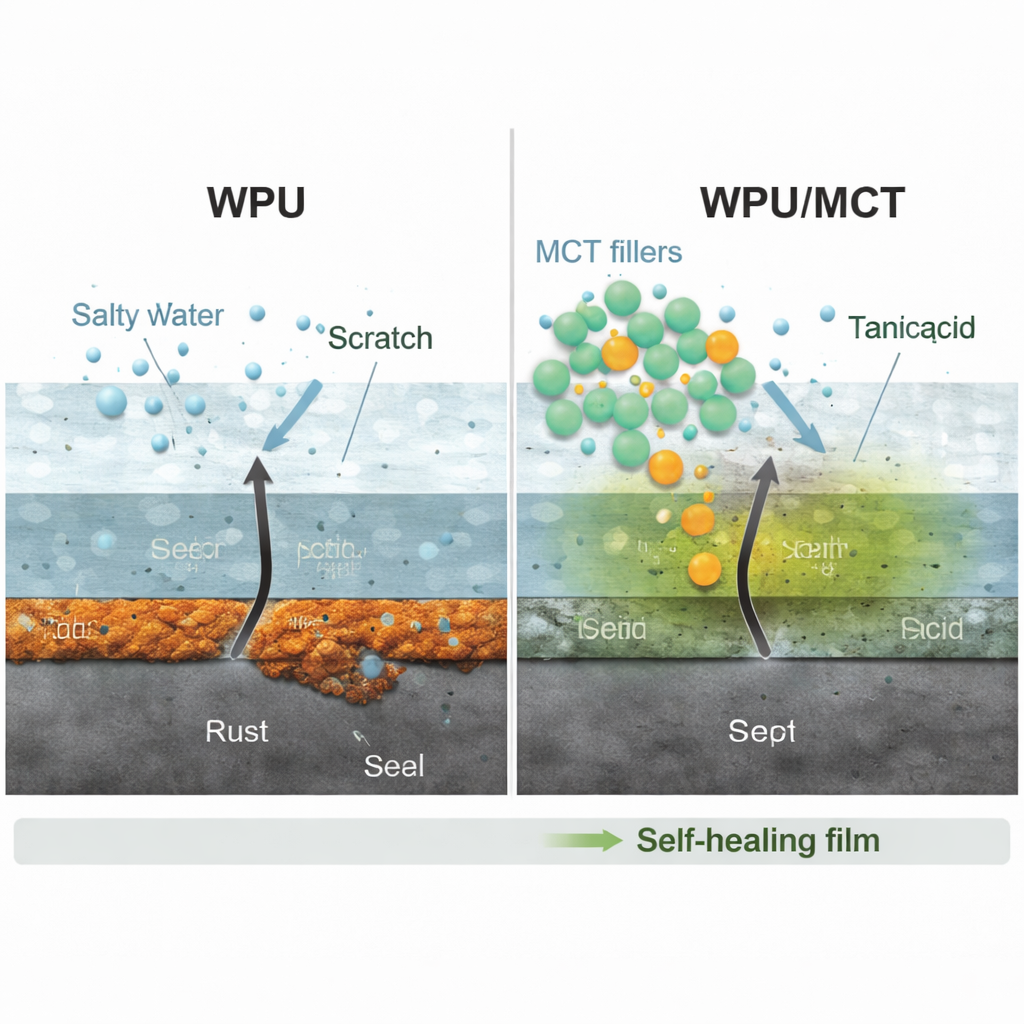
Real-world coatings inevitably get scratched, so the researchers deliberately cut an X-shaped groove in the films and soaked them in salt water. Plain WPU quickly allowed rust to spread from the scratch, and its protective performance dropped toward that of bare metal. In contrast, the MCT-filled coating continued to show relatively high corrosion resistance over time and displayed less visible rust. The authors propose that cerium ions and tannic acid, stored on the MXene sheets, are released near damaged regions. There, they react with the steel surface and dissolved metal ions to form a thin, insoluble protective layer made of cerium oxides and iron–tannate complexes. This new film helps plug the damaged area and slows further attack, giving the coating a degree of self-healing behavior without any external trigger.
What This Means for Everyday Metal Protection
In practical terms, this work shows that it is possible to make a water-based, low-toxicity coating that performs as a high-end anti-corrosion barrier while also offering built-in defense when scratched. By combining a layered nanomaterial with plant-derived tannic acid and relatively benign cerium compounds, the researchers created a multifunctional filler that improves barrier properties, reduces defects, strengthens adhesion, and delivers active corrosion inhibitors where they are most needed. If translated to industrial scales, such coatings could help infrastructure, vehicles, and marine equipment last longer with fewer maintenance cycles—protecting both metal assets and the environment.
Citation: Tang, S., Xu, P., Wang, T. et al. Enhancing the protective performance of waterborne polyurethane coatings by non-covalent functionalized MXene. npj Mater Degrad 10, 31 (2026). https://doi.org/10.1038/s41529-026-00744-5
Keywords: anticorrosion coatings, waterborne polyurethane, MXene nanomaterials, self-healing materials, metal protection