Clear Sky Science · en
Evaluating and interpreting biodegradability of a tree bark–based green composite through tensile properties
Turning Tree Bark Waste into Helpful Plastics
Most of the plastic we use every day lingers in landfills or the natural environment for decades. This study explores a very different kind of plastic: a material made largely from tree bark, designed to be strong enough for practical use yet able to slowly fall apart after disposal. For readers interested in cutting plastic waste and creating smarter, greener products, this work shows how forestry leftovers can become useful materials that ultimately return to nature.
From Forest By‑Product to Useful Material
The researchers started with bark from the Yakushima Jisugi tree, grown on a Japanese island. This bark is usually thrown away and burned, costing money and adding emissions. Instead, the team mixed finely crushed bark with a biodegradable plastic called polybutylene succinate (PBS), which is already known to break down in compost and even on the sea floor. They pushed the bark content very high—60 percent by weight—to make the most of this low‑value waste while reducing the amount of synthetic polymer needed. The mixture was hot‑pressed into pellets and standard test strips for mechanical and degradation experiments. 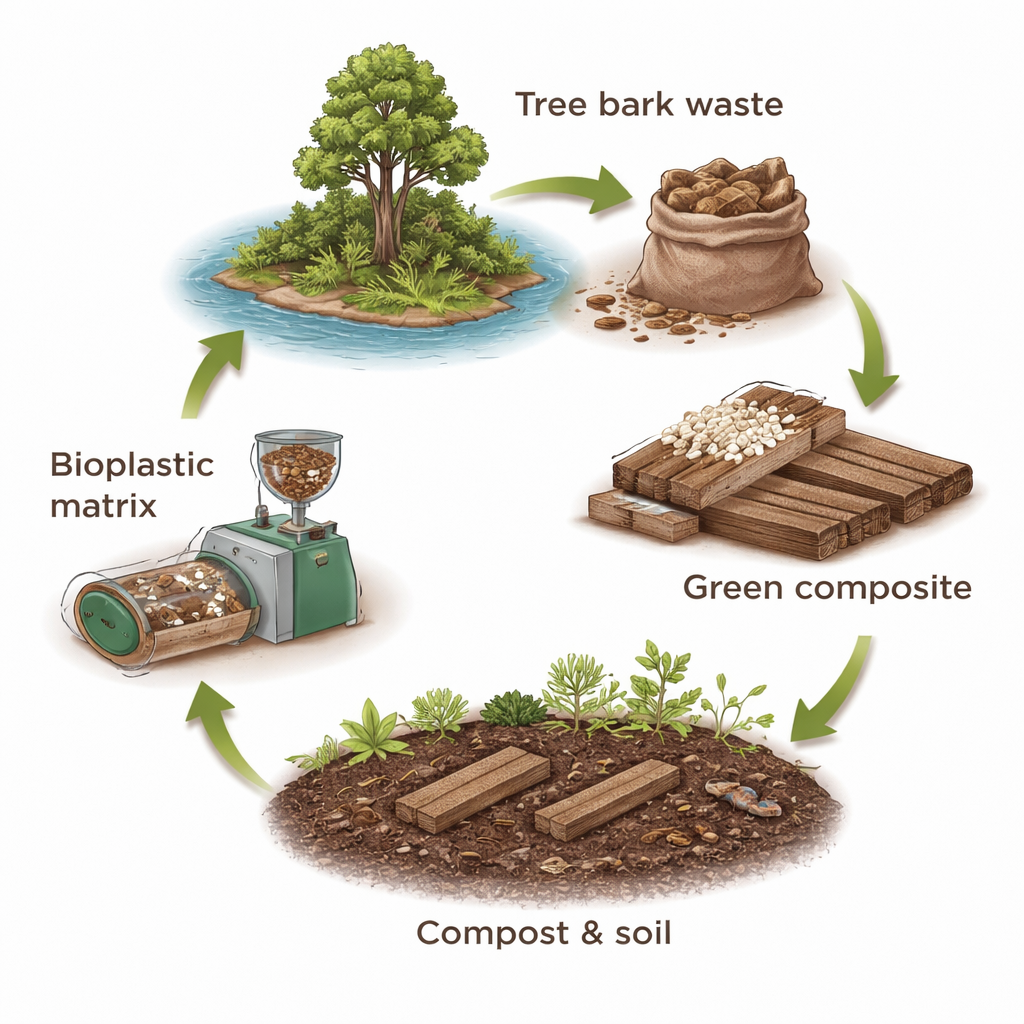
How Strong Is a Bark‑Rich Plastic?
Adding so much bark changed the way the plastic behaved when stretched. Compared with pure PBS, the new composite was stiffer but also more brittle: it resisted bending at first, then snapped more suddenly and at a lower overall strength. Microscopic images revealed why. Large bark fragments acted like hard spots inside a softer background, focusing stress and encouraging cracks to form where the bark and plastic met. Because the bark pieces were relatively big, the total contact area between bark and plastic was limited, reducing how well forces could be shared. The authors note that grinding the bark into much smaller particles could improve strength, but that would require extra processing and cost—highlighting the trade‑offs between performance, price, and sustainability.
Watching the Material Disappear in Compost and Soil
To see how the composite breaks down in real settings, the team tested it in two places: a controlled industrial‑style compost at high temperature and humidity, and ordinary outdoor garden soil over half a year. In compost, the material converted about 13 percent of its carbon into carbon dioxide in eight weeks, a sign that microbes were actively digesting it. At the same time, the test strips steadily lost stiffness, strength, and stretchability, while their melting temperature dropped by about 2 degrees Celsius—evidence that the inner structure of the plastic was changing as chains of molecules were cut into shorter pieces. In cooler outdoor soil, the changes were slower but still clear: after 30 weeks, the composite had lost roughly 40 percent of its original strength, showed surface erosion, exposed bark pieces, and displayed microscopic cracks and gaps between bark and plastic. By comparing these strength losses with the compost data, the researchers estimated that the composite underwent about 5 percent biodegradation in soil over the same period.
A Simple Rule Linking Decay and Strength
To move beyond trial‑and‑error testing, the authors built a simple mathematical picture of how the material weakens as it biodegrades. They treated the plastic chains like long strings that are randomly snipped over time by water and enzymes. As more bonds are cut, the average chain length shrinks, and the material can no longer hold as much load. Earlier work has shown that the strength of many plastics is closely tied to this average chain length. Putting these ideas together, the team derived an equation that predicts an exponential drop in tensile strength as biodegradation advances—and found that their compost data fit this pattern well. Although losing strength does not prove that every fragment has turned into carbon dioxide and water, it provides a practical way to estimate how far degradation has progressed when direct gas measurements or detailed chemical analyses are not possible. 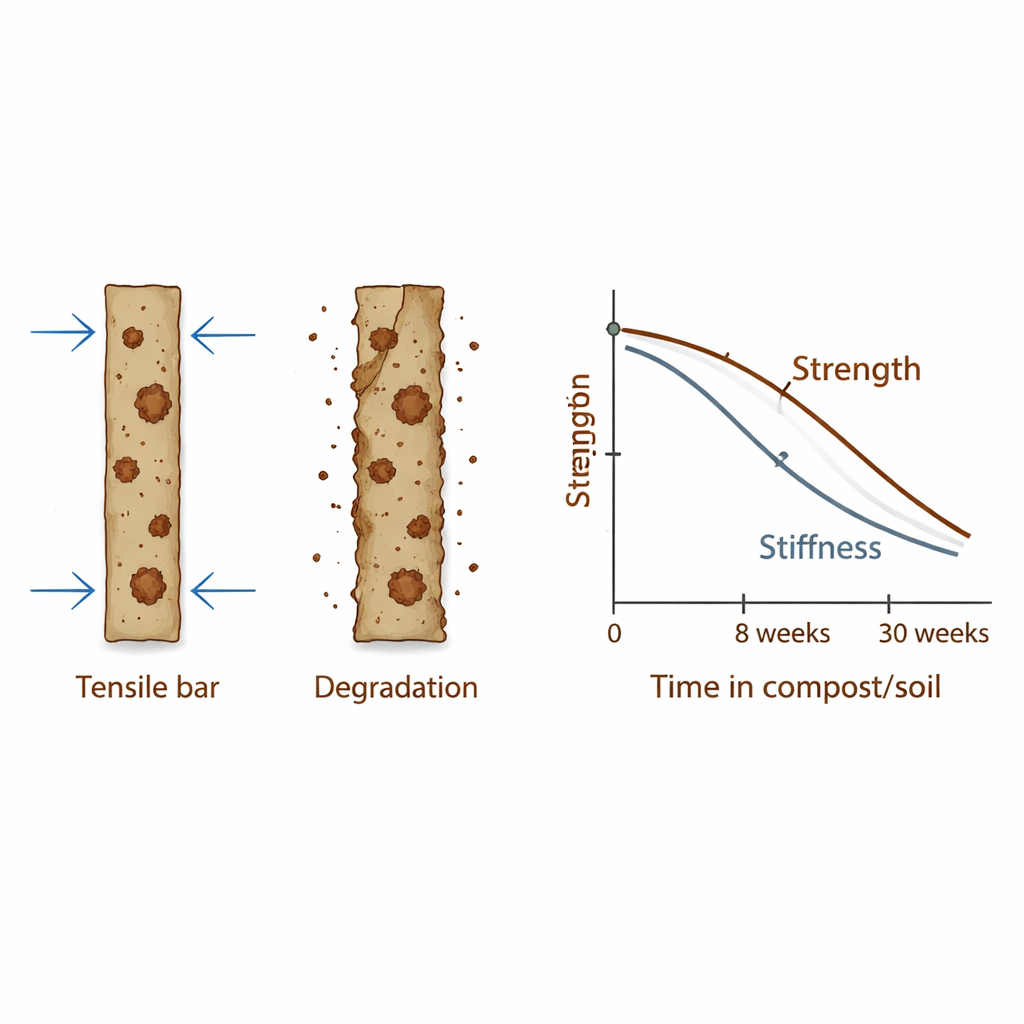
Toward Smart, Vanishing Devices
This bark‑based composite does more than just weaken and crumble. Tests showed that it also has adequate initial electrical insulation, with no harmful discharges up to 5,000 volts when immersed in insulating oil. That means it could safely serve as a temporary housing or protective layer in low‑voltage electronics—such as agricultural sensors or disposable packaging—that are meant to function for a limited time and then disintegrate. In plain terms, the study demonstrates that a plastic made mostly from tree bark waste can work well enough during its useful life, then gradually break down in compost and soil, guided by a simple, physics‑based rule connecting its loss of strength to its ongoing return to the environment.
Citation: Rova, L., Wang, Z., Kurita, H. et al. Evaluating and interpreting biodegradability of a tree bark–based green composite through tensile properties. npj Mater Degrad 10, 27 (2026). https://doi.org/10.1038/s41529-026-00740-9
Keywords: biodegradable plastics, green composites, tree bark waste, soil and compost degradation, transient electronics