Clear Sky Science · en
The impact of gravitational sedimentation on the sulfate-reducing bacterium biofilms formation that induced biocorrosion of X80 steel
Why Tank Floors Rust Faster Than Their Walls
Oil and water pipelines and storage tanks cost billions of dollars to build, yet many quietly weaken from the inside as microbes eat away at the metal. This study shows that something as ordinary as gravity helps decide where that damage is worst. By watching how corrosion‑causing bacteria settle and grow on steel surfaces facing up, sideways, or down, the researchers reveal why the “bottom” of a system is often the most at risk—and what engineers can do about it.
Microbes That Breathe Sulfur and Feed on Steel
Deep inside pipelines and tanks, where oxygen is scarce, certain microbes thrive by using dissolved sulfate instead of oxygen to “breathe.” One common species, Desulfovibrio vulgaris, can pull electrons directly from steel, turning solid metal into ions while forming iron sulfide scales. The microbes live in slimy communities called biofilms that stick to the metal surface. Within these films, they exchange electrons and chemicals efficiently, accelerating a type of damage known as microbiologically influenced corrosion. The thicker and more stable the biofilm, the easier it is for the microbes to keep drawing energy from the metal and the faster the steel disappears.
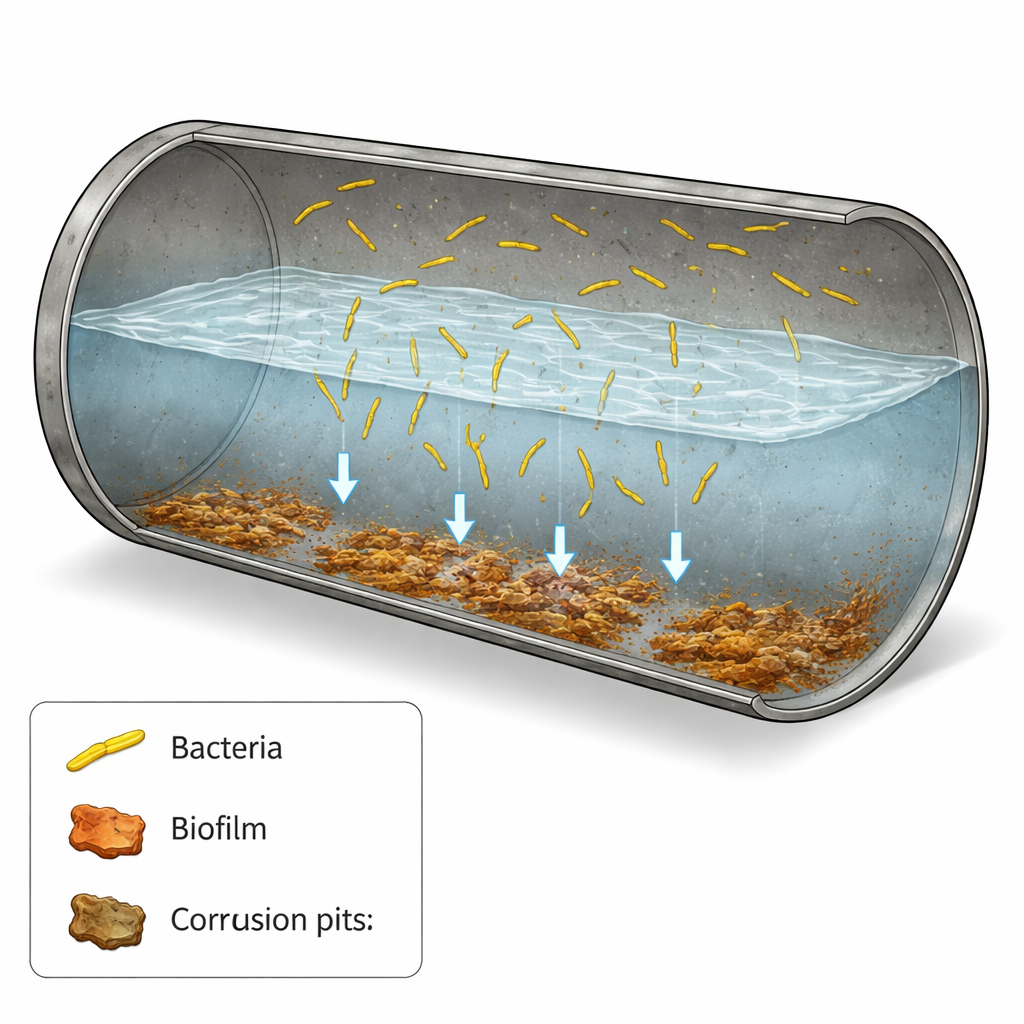
Turning Steel Coupons to Test the Pull of Gravity
To see how gravity shapes this hidden attack, the team immersed small X80 pipeline‑grade steel squares in bottles containing D. vulgaris and nutrient solution. Identical samples were mounted so that their working faces pointed upward, sideways, or downward, changing how sinking bacteria and particles could land on them. Over seven days—long enough for one full generation of the microbes—the scientists tracked how many cells stuck, how much metal weight was lost, how deep pits grew, and how easily electricity flowed at the surface. They also used high‑resolution microscopes and X‑ray techniques to inspect the biofilms and the rust products left behind.
Thicker Slime, Deeper Pits on Upward‑Facing Steel
The results showed a clear trend: the upward‑facing steel suffered the worst attack, the side‑facing steel showed moderate damage, and the downward‑facing steel corroded the least. Cell counts and imaging revealed that gravity pulled bacteria onto the upward surface, where they settled and built the thickest biofilms, over 160 micrometers deep. Side‑oriented steel carried thinner films, while downward‑facing steel had the sparsest, most porous coverage—biofilm pieces there were more likely to detach instead of accumulating. Matching this pattern, the upward samples lost more than twice as much mass as the downward ones, and they developed the widest and deepest pits. Electrochemical tests confirmed that corrosion reactions ran fastest where the biofilm was thickest and slowest where it barely held on.
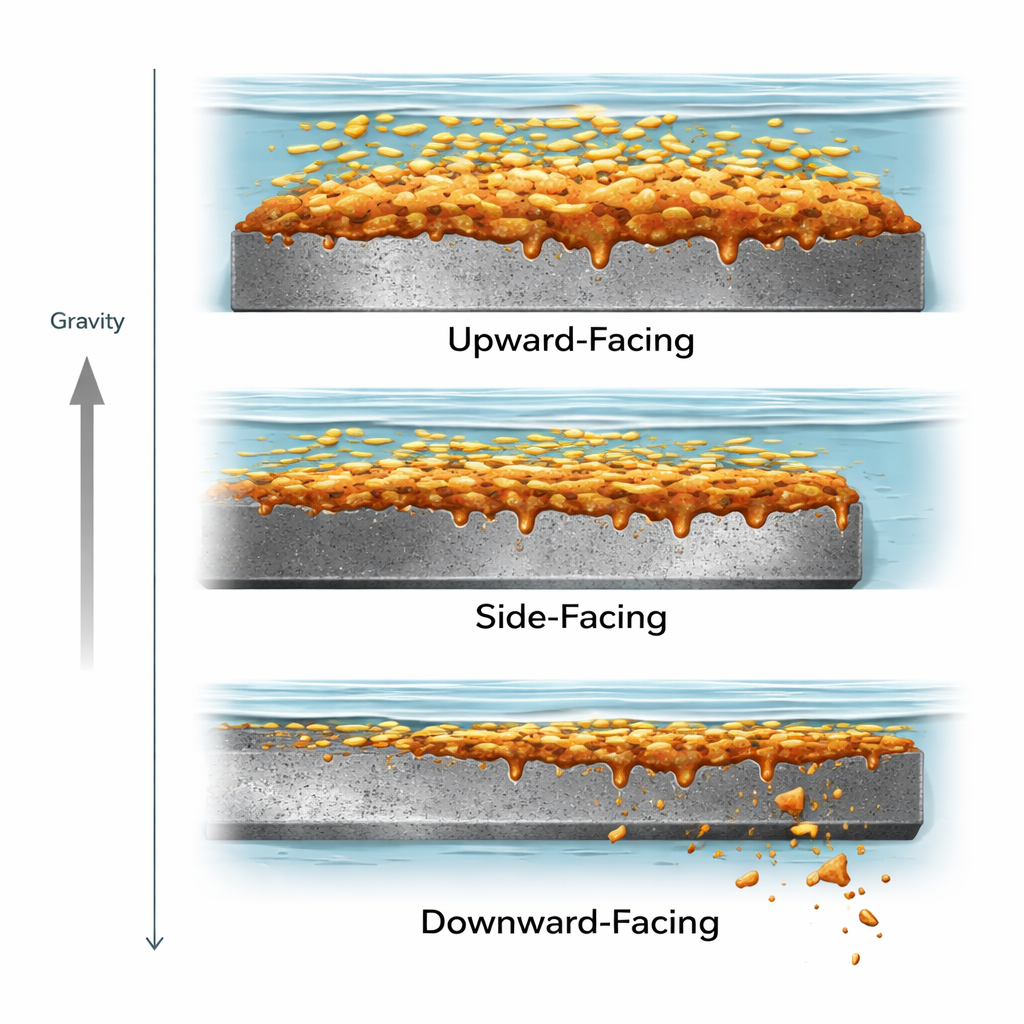
Same Rust Chemistry, Different Severity
Interestingly, the basic rust chemistry did not change with direction. X‑ray diffraction showed that all samples mainly formed iron sulfide, the typical product of sulfate‑reducing bacteria feeding on steel. What varied was not what formed, but how much and how fast. On surfaces where gravity helped bacteria settle and stay, the dense biofilm acted like a living electrode, shuttling electrons from the metal into microbial metabolism more efficiently. Where gravity worked against attachment—as on downward‑facing steel—the film stayed thin and patchy, slowing the overall attack even though the same chemical pathways were at work.
Designing Smarter Protection for Real Pipelines and Tanks
For non‑specialists, the key message is that gravity quietly steers where microbially driven rust concentrates. In the lab, simply flipping a steel piece changed corrosion rates dramatically; in real tanks and horizontal pipelines, that translates into floors and upward‑facing surfaces corroding faster than walls or ceilings. The study suggests that corrosion protection does not need to be uniform: coatings, biocides, and monitoring can be strengthened specifically for bottom regions where bacteria naturally pile up. By accounting for the downward drift of microbes in addition to chemistry, engineers can better predict where failures are most likely to start and extend the safe lifetime of critical steel infrastructure.
Citation: Li, Z., Chen, Y., Zhang, X. et al. The impact of gravitational sedimentation on the sulfate-reducing bacterium biofilms formation that induced biocorrosion of X80 steel. npj Mater Degrad 10, 26 (2026). https://doi.org/10.1038/s41529-026-00739-2
Keywords: microbiologically influenced corrosion, sulfate-reducing bacteria, pipeline steel, biofilms, gravity effects