Clear Sky Science · en
Compositionally graded interfacial microstructure and corrosion behavior of 316 L/B30 multi-material bimetallic structure fabricated by laser powder bed fusion
Why mixing metals matters
From jet engines to offshore wind turbines, modern machines must survive punishing heat, salt, and stress. No single metal can do everything well, so engineers are turning to parts that smoothly blend different alloys in one 3D‑printed piece. This study explores such a hybrid of stainless steel and copper alloy, asking a very practical question: where, exactly, does it start to rust first, and why?
Building a metal sandwich, layer by layer
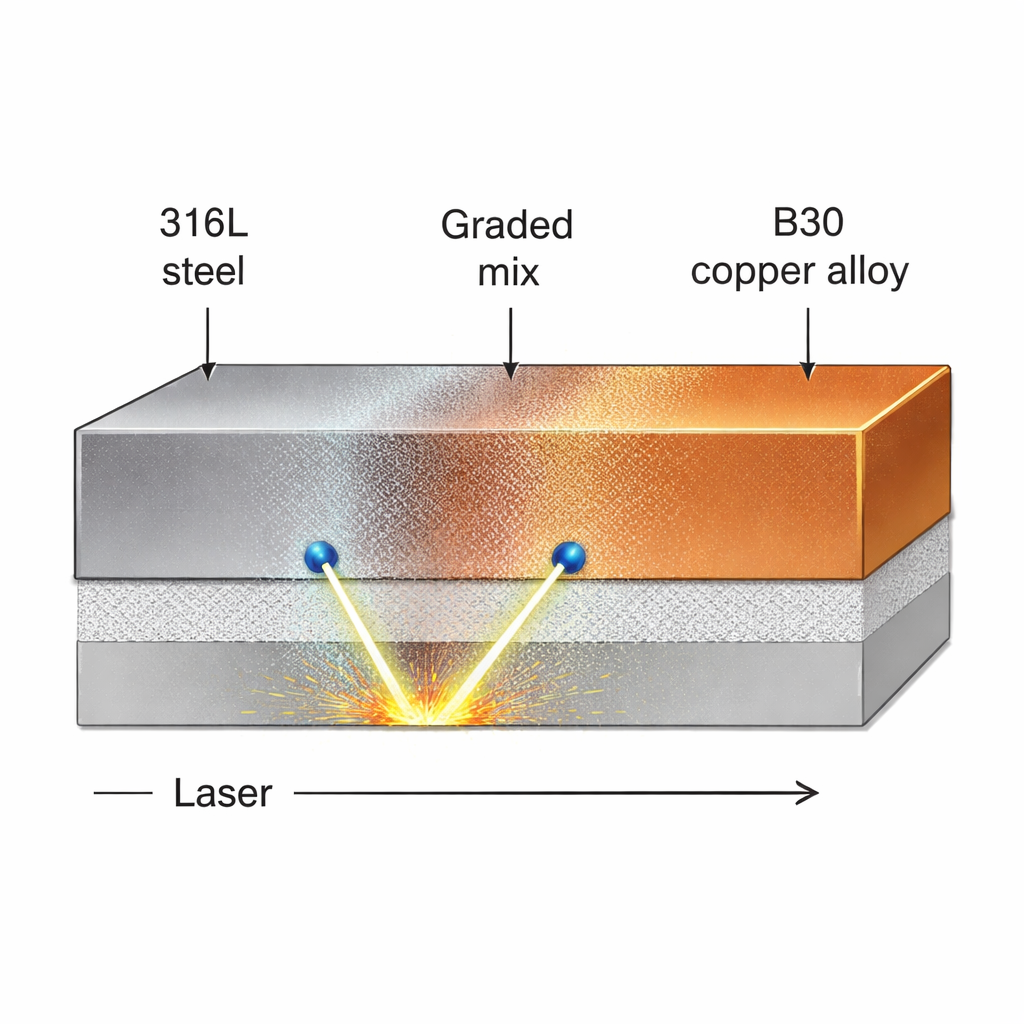
The researchers used laser powder bed fusion, a form of metal 3D printing, to build blocks that transition gradually from 316L stainless steel to a copper‑rich alloy called B30. Instead of an abrupt join, they created a graded middle region where the two powders were mixed in controlled proportions across ten steps. This smoother transition is designed to reduce cracking caused by the very different heating and cooling behavior of steel and copper, while still combining the strength and corrosion resistance of stainless steel with the excellent electrical and thermal conductivity of copper.
Inside the hidden micro‑landscape
Microscopes and X‑ray techniques revealed that the interface between the two metals is not a simple blend, but a finely interwoven network of two main ingredients: iron‑rich areas linked to stainless steel and copper‑rich areas linked to the B30 alloy. These zones form complex, interlocking islands and bands a few micrometers across—far smaller than a human hair. Despite some tiny cracks near the steel side, the bonding across the graded region is mostly sound, meaning the 3D‑printed layers fused together well. Rapid heating and cooling during printing leave behind dense defects and internal stresses, but also freeze in this intricate dual‑phase pattern.
Where corrosion strikes hardest
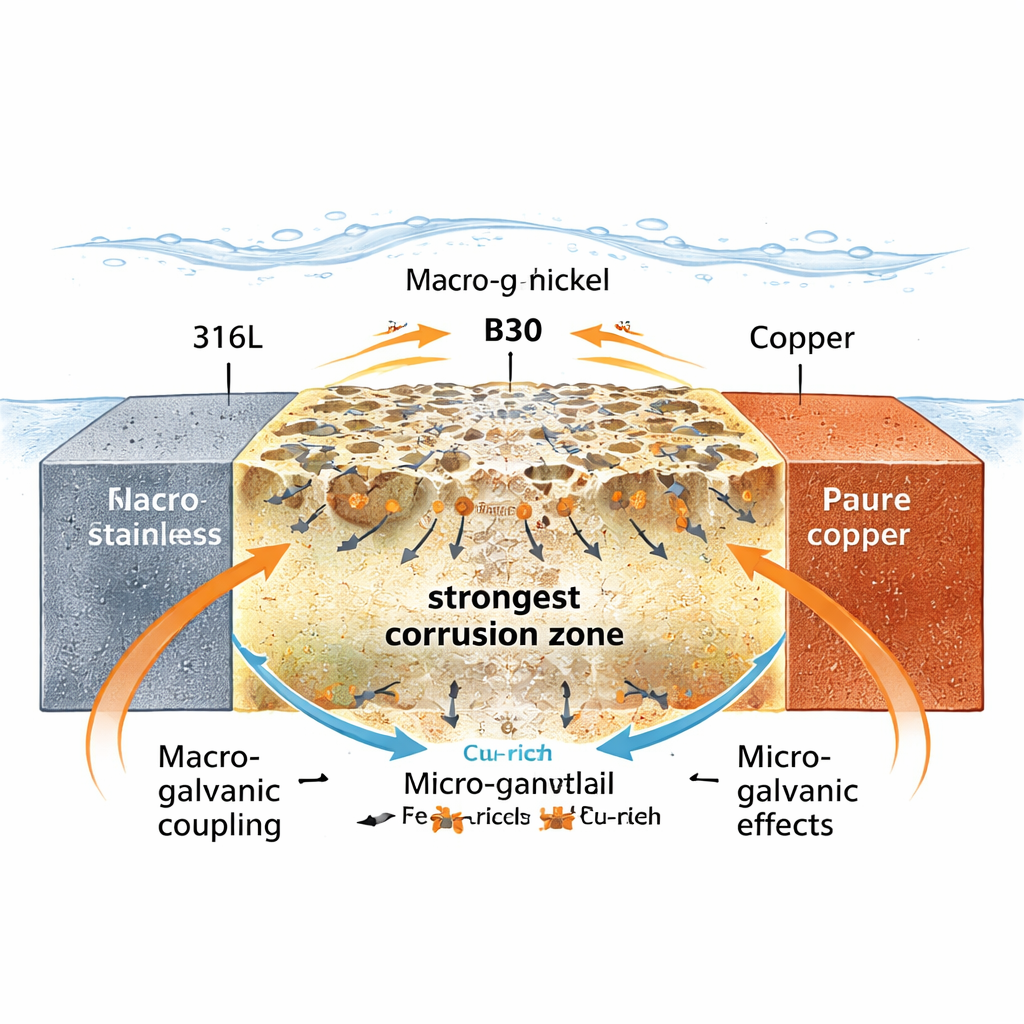
To see how this hybrid metal survives in a salty environment, samples were soaked in a 3.5% salt solution, similar to seawater, for up to a week. The steel‑rich side stayed relatively smooth, protected by a thin, naturally forming film of chromium‑rich oxides. The copper‑rich side corroded more visibly, growing rough and coated with white corrosion products. Most striking, however, was a band in the middle—specifically where the composition contained about 60–70% B30—where pits grew deeper and corrosion layers became much thicker and more complex than anywhere else on the sample.
Big and small electrical batteries in the metal
This vulnerable middle zone owes its behavior to “built‑in batteries” at two scales. On the large scale, different composition bands along the gradient hold slightly different electrical potentials, so when they are connected in saltwater they form macro‑galvanic cells: some regions act as cathodes (protected) while others become anodes (sacrificial). On the small scale, the tiny iron‑rich and copper‑rich islands within each band also differ in potential. Measurements show the iron‑rich zones tend to be more “noble,” so they become local cathodes, while nearby copper‑rich zones dissolve faster as local anodes. Where both phases are continuous and densely interwoven—as in the 60–70% B30 region—these large‑ and small‑scale effects reinforce each other, driving especially intense corrosion along the copper‑rich paths.
What this means for real‑world parts
For engineers designing 3D‑printed multi‑metal components, the study delivers both reassurance and a warning. The gradual transition from stainless steel to copper alloy can be printed reliably and joined well, but corrosion does not spread evenly. Instead, it concentrates in a specific composition window where electrical imbalances are strongest and the two phases are most tightly interconnected. In practical terms, this means designers should either avoid placing critical features in that risky range, or add extra protection—such as coatings or design tweaks—to manage galvanic effects. Understanding exactly where and why the hybrid metal fails in saltwater brings us closer to safer, longer‑lasting high‑performance components.
Citation: Zhang, Z., Zhang, Q., Zhuo, X. et al. Compositionally graded interfacial microstructure and corrosion behavior of 316 L/B30 multi-material bimetallic structure fabricated by laser powder bed fusion. npj Mater Degrad 10, 25 (2026). https://doi.org/10.1038/s41529-026-00738-3
Keywords: laser powder bed fusion, bimetallic corrosion, stainless steel copper, graded materials, additive manufacturing