Clear Sky Science · en
Spiderweb-inspired flextensional transduction enables giant piezoelectric response for monitoring imperceptible biomechanical signals
Listening to the Body’s Quietest Signals
Many of the body’s most important warning signs are almost too soft to hear: tiny changes in blood vessel pressure during brain surgery, or faint ripples in your pulse that foreshadow heart trouble. This study describes a new kind of ultra-sensitive, flexible sensor inspired by the way a spiderweb feels the slightest touch. By cleverly reshaping how force travels through a thin plastic film, the researchers turn barely noticeable mechanical signals into strong electrical pulses that can help doctors monitor patients more safely and comfortably.
Borrowing a Trick from Spiderwebs
Spiders rely on their webs to sense the faintest vibration from trapped prey. When something taps the web, the impact is redirected into stretching along the radial threads, which greatly amplifies the signal. The team mimicked this idea in a “spiderweb-inspired piezoelectric” (SWP) device. At its heart is a piezoelectric plastic film made of PVDF that generates electricity when it is deformed. Instead of pressing the film directly, they embed it in a rigid–soft frame: a soft silicone layer for protection, a rigid T-shaped plastic piece to route incoming force, and a grooved base that suspends the film like a bridge. When a small push is applied from above, this structure bends and stretches the film along its length, greatly boosting the electrical response. 
Turning Gentle Touch into Strong Signals
Using mathematical models and computer simulations, the researchers showed that a gentle downward push on the device is converted into much larger stretching forces along the film. The key design parameter is the bending angle of the suspended strip: small angles lead to strong amplification, so sub-Newton forces (lighter than the weight of an apple) can create large internal tension. Experiments confirmed that the SWP device produces much higher voltages than conventional piezoelectric layouts under the same force. For small forces around a tenth of a newton, it delivers roughly five times more voltage than the standard “direct-press” configuration, reaching a record output of over 160 volts and a high power density while still using a thin, flexible plastic material.
What Happens Inside the Plastic Film
The researchers then asked why stretching the film in this way is so effective. They found that the material’s internal structure changes mainly in the softer, disordered regions between its tiny crystalline lamellae. Under controlled stretching, the molecular chains in these amorphous areas straighten and line up, and their tiny electric dipoles become better aligned. Advanced spectroscopy and X-ray measurements showed that the crystalline parts stay largely the same, but the spacing and orientation of the amorphous layers evolve with strain. As the chains become more ordered, the film’s ability to polarize and respond electrically increases, and its piezoelectric coefficient rises steadily with tension. In other words, the special device geometry not only amplifies the mechanical force but also “trains” the material’s internal dipoles to respond more strongly. 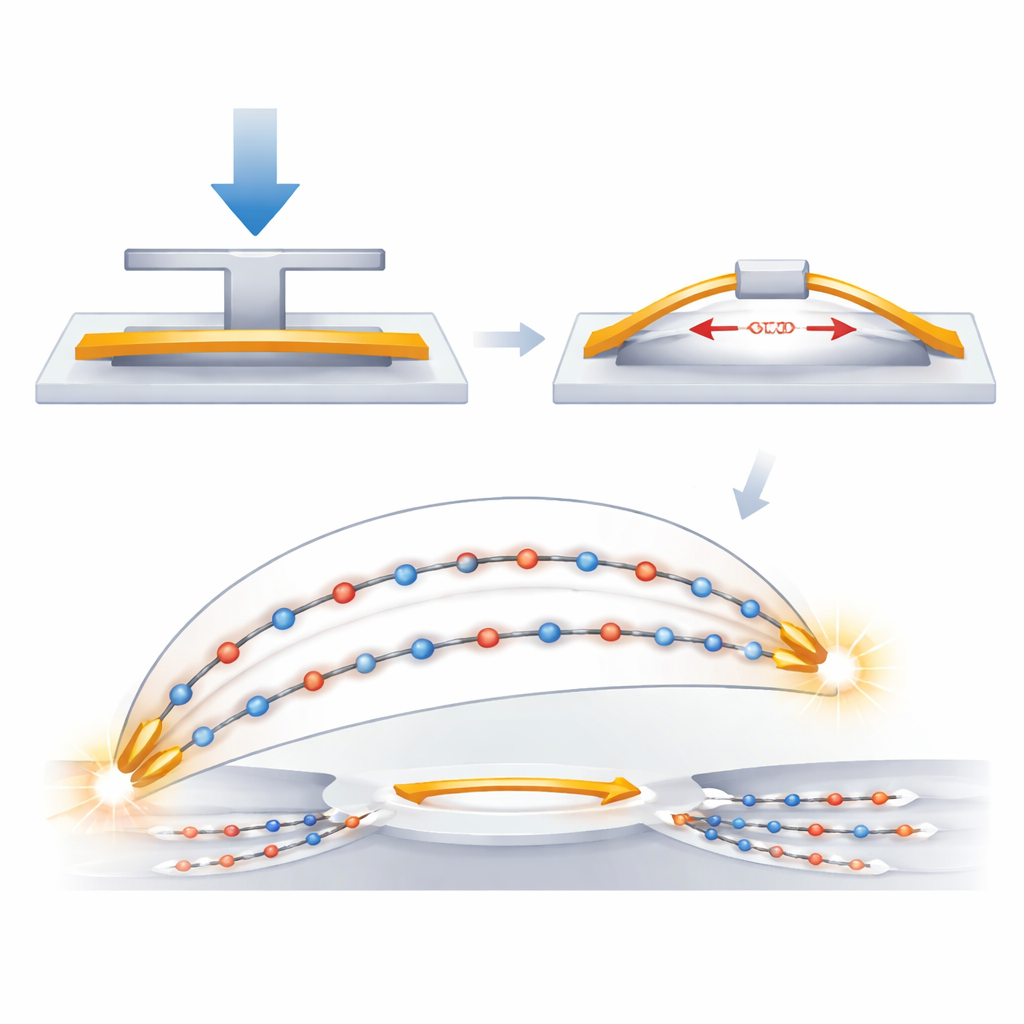
Tuning the Structure for Best Performance
By systematically varying the film’s width, thickness, and length, the team mapped out how geometry controls performance. Simulations and measurements showed that thicker films produce higher voltages because they support larger tensile stresses at the same bend, while the device’s length matters little once the bending angle is fixed. Narrow films can suffer from edge effects that slightly reduce effectiveness, but overall the design can be tailored to balance sensitivity, robustness, and size. The optimized device can detect forces as small as a few thousandths of a newton, works stably over wide frequency ranges, and survives at least 15,000 loading cycles without losing performance. It can even charge small capacitors, pointing to future uses in harvesting biomechanical energy.
From Operating Room to Everyday Health
To show real-world value, the researchers built demonstration systems in two demanding medical settings. First, they attached the SWP sensor to the proximal end of a long guidewire used during minimally invasive treatment of brain aneurysms. Contact forces at the fragile aneurysm wall travel along the wire and are amplified by the device, allowing real-time force monitoring in 3D-printed vascular models—even through tortuous vessel paths and under flowing artificial blood. Second, they used pairs of SWP patches on volunteers’ arms and wrists to record pulse waveforms and compute the pulse transit time between sites. This timing closely tracks blood pressure measured by a standard cuff, enabling continuous, cuff-free estimation before and after exercise, as well as analysis of heartbeat irregularities through variability in pulse intervals.
Why This Matters
By combining a spiderweb-inspired mechanical layout with subtle tuning of molecular orientation inside a plastic film, this work shows how to turn nearly imperceptible biomechanical motions into large, clean electrical signals. The result is a thin, flexible piezoelectric device that can feel forces gentle enough to matter in brain surgery while also capturing detailed pulse information for everyday cardiovascular monitoring. Beyond this specific material, the flextensional design strategy offers a general blueprint for building next-generation sensors that extend our ability to “listen in” on the body’s quietest—and often most critical—signals.
Citation: Liu, S., Chen, M., Song, Z. et al. Spiderweb-inspired flextensional transduction enables giant piezoelectric response for monitoring imperceptible biomechanical signals. npj Flex Electron 10, 41 (2026). https://doi.org/10.1038/s41528-026-00546-4
Keywords: flexible piezoelectric sensor, biomechanical signal monitoring, spiderweb-inspired design, blood pressure sensing, endovascular aneurysm intervention