Clear Sky Science · en
Materials, processing, and structural strategies for encapsulation in stretchable and flexible optoelectronics
Electronics That Can Stretch Like Skin
Imagine a phone screen you can crumple into your pocket, a glowing bandage that tracks your health, or a roll of solar cells that unfurls in space. All of these rely on electronic parts that bend and stretch without breaking. But there is a quiet villain that can kill these devices long before anything snaps: tiny amounts of water and oxygen sneaking in from the air. This article explains how scientists are learning to wrap flexible lights and solar cells in protective "raincoats" that are both tough against moisture and soft enough to bend with the device.
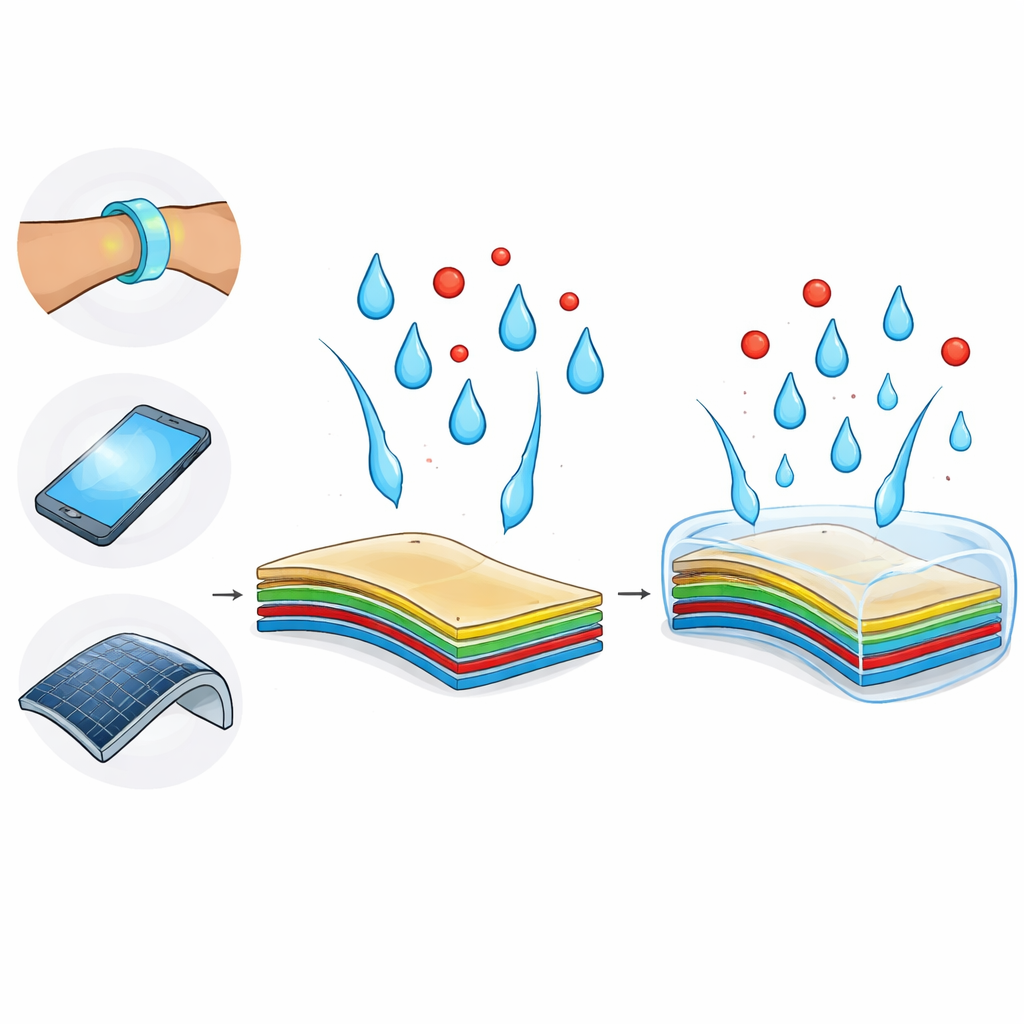
Why Flexible Gadgets Need Special Protection
New optoelectronic devices—things that turn electricity into light or light into electricity—are no longer flat boxes on a desk. They appear as wearable displays, electronic skin, curved car windshields that project data, and rollable solar panels for satellites and the Moon. These systems do not just bend; they stretch, twist, and wrap around curved surfaces. That means every layer inside the device must deform together, rather than relying on a stiff shell. At the same time, many of the most efficient light-emitting and light-harvesting materials are extremely sensitive to moisture and oxygen. Even a droplet’s worth of water vapor leaking through over months can darken a display or ruin a solar cell, so the outer protective layer—the encapsulation—largely determines how long a device survives in the real world.
The Core Trade-Off: Soft vs. Sealed
The authors show that today’s materials fall into three broad families, each with strengths and weaknesses. Soft polymers such as silicone rubbers and parylene plastic are stretchy, transparent, and easy to process, making them ideal for wearable devices that must move with skin. But their internal structure contains a lot of empty space and defects, so water molecules can slip through relatively quickly. Inorganic materials like glassy oxides and some metals, in contrast, are almost airtight: in laboratory tests, they can cut water leakage down to the equivalent of a single drop passing through the area of a soccer field over a month. Unfortunately, these same layers are brittle and tend to crack under even modest strain, suddenly opening fast pathways for moisture. The review argues that truly practical stretchable devices must reconcile this conflict between softness and sealing.
Mixing Materials and Measuring Invisible Leaks
One promising answer is to build hybrids that combine soft and hard components in carefully designed stacks or mixtures. Thin, dense oxide layers can act as main barriers, while polymer layers above and below them absorb strain, stop cracks, and smooth out defects. Other designs disperse plate-like inorganic flakes inside a rubbery matrix so that water droplets must weave around a tortuous maze instead of slipping straight through. The article explains how researchers judge success using the water vapor transmission rate, a single number that captures how much moisture crosses a film each day. Because failures often begin at pinholes or along cracks, scientists use sensitive electrical and optical tests that place highly reactive metals beneath the barrier; any water that sneaks through corrodes the metal, changing its conductivity or appearance and revealing how the barrier performs over time and under bending or stretching.
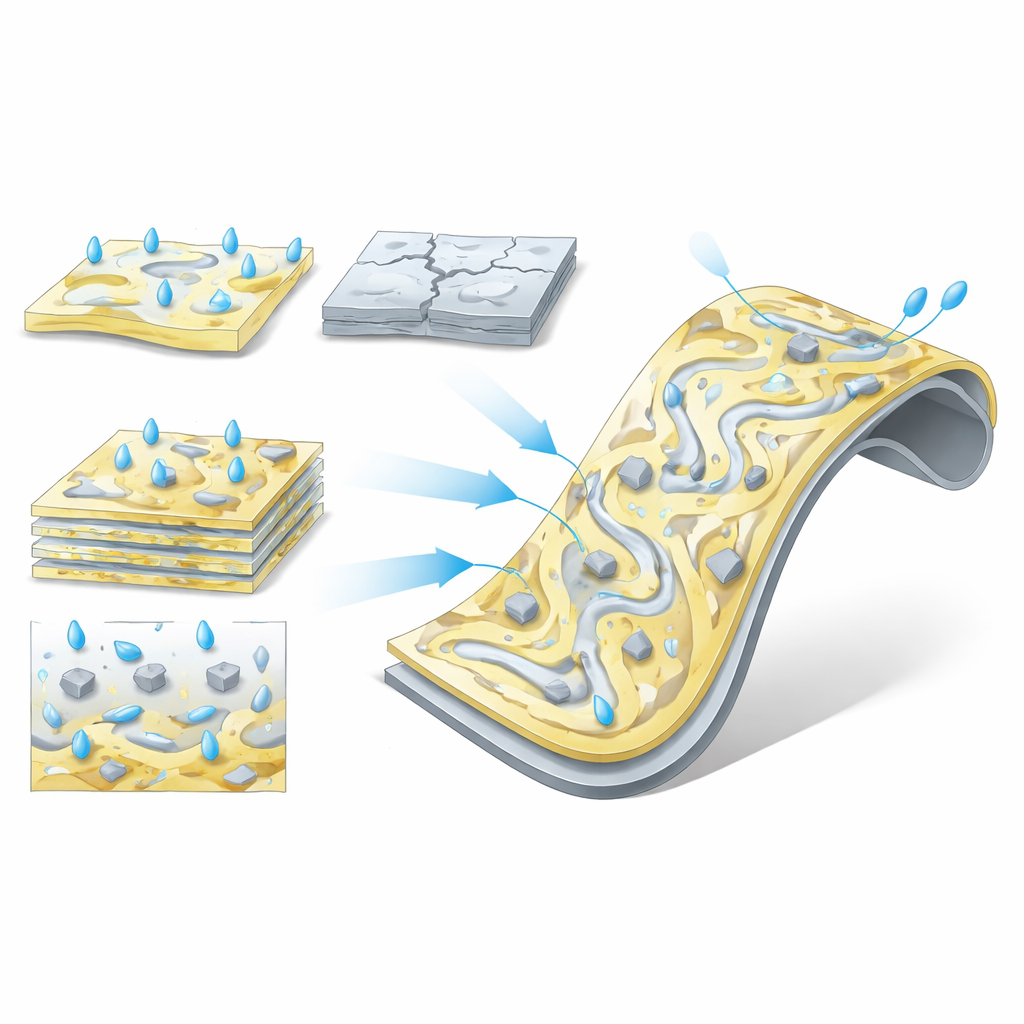
Shaping Films to Move Without Breaking
Beyond what the films are made of, their geometry matters. The review highlights structural tricks that let even brittle materials survive large deformations. One tactic is to pre-stretch a soft substrate, deposit a thin stiff layer, and then release the strain so the surface buckles into regular wrinkles or waves. When the device is later stretched again, those waves gently unfold instead of forcing the stiff layer itself to stretch. Wavy glass-like films and wrinkled plastic coatings can reach strains of around 20 percent while still blocking moisture at levels required for high-end displays. Another strategy is to keep sensitive pixels or solar cells on small rigid "islands" connected by serpentine metal bridges. The bridges absorb most of the motion, while compact hybrid barrier stacks protect the relatively rigid active regions with only modest stretching demands.
Designing for Real Lives, From Skin to Space
Finally, the article places these materials and structures into a wider design framework. For medical implants or electronic skin, barriers must withstand sweat, body fluids, and constant flexing, but also stay thin, light, and comfortable. For space solar panels, moisture is less of a concern than harsh ultraviolet light, atomic oxygen, and wide temperature swings, so radiation-resistant, crack-free laminates are key. The authors argue that future progress will come from co-design: choosing materials, fabrication methods, and mechanical layouts together, guided by realistic measurements of both moisture leakage and mechanical fatigue. Done well, this integrated approach should enable stretchable lights and solar cells that not only look futuristic, but also last long enough to be useful in everyday life.
Citation: Yoo, H., Lee, SH., Kwak, JY. et al. Materials, processing, and structural strategies for encapsulation in stretchable and flexible optoelectronics. npj Flex Electron 10, 42 (2026). https://doi.org/10.1038/s41528-026-00545-5
Keywords: stretchable electronics, flexible displays, moisture barrier, hybrid encapsulation, wearable optoelectronics