Clear Sky Science · en
Breathable nanomesh electrodes with improved water resistance and stretchability for skin impedance monitoring
Why a "breathable sticker" on your skin matters
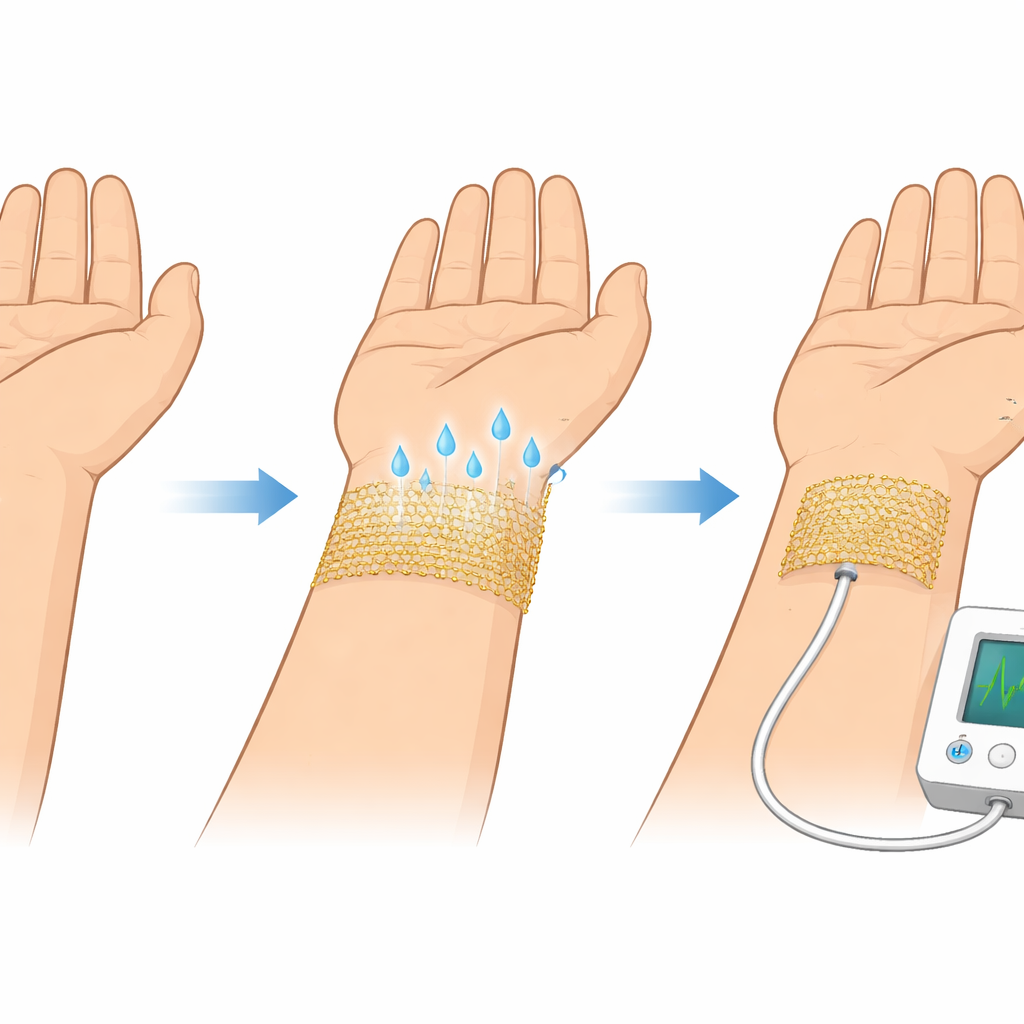
Our skin constantly sends out electrical signals that reflect how well its outer barrier is working and how our body responds to stress. Measuring these signals for hours at a time could help track conditions like eczema, reveal how stressed we are, or monitor recovery during sleep and exercise. Yet today’s skin sensors often feel clammy, peel off with sweat, or break when the skin stretches. This study introduces a new kind of ultra-thin, breathable “nanomesh” electrode that sticks to sweaty, moving skin—especially tricky spots like the palm—while still letting the skin breathe and keeping the measurements stable.
A soft net that lets skin breathe
The researchers built their sensor as a very fine net of plastic fibers, each only a few hundred nanometers thick—thousands of times thinner than a human hair. This net is then coated with an extremely thin layer of gold that carries electrical signals. Because the structure is mostly empty space, air and water vapor can pass through easily, so the skin underneath does not suffocate. The entire electrode is only a few micrometers thick, thin enough to follow the tiny hills and valleys of the outer skin surface like a second, transparent layer.
A smart blend that sticks and survives water
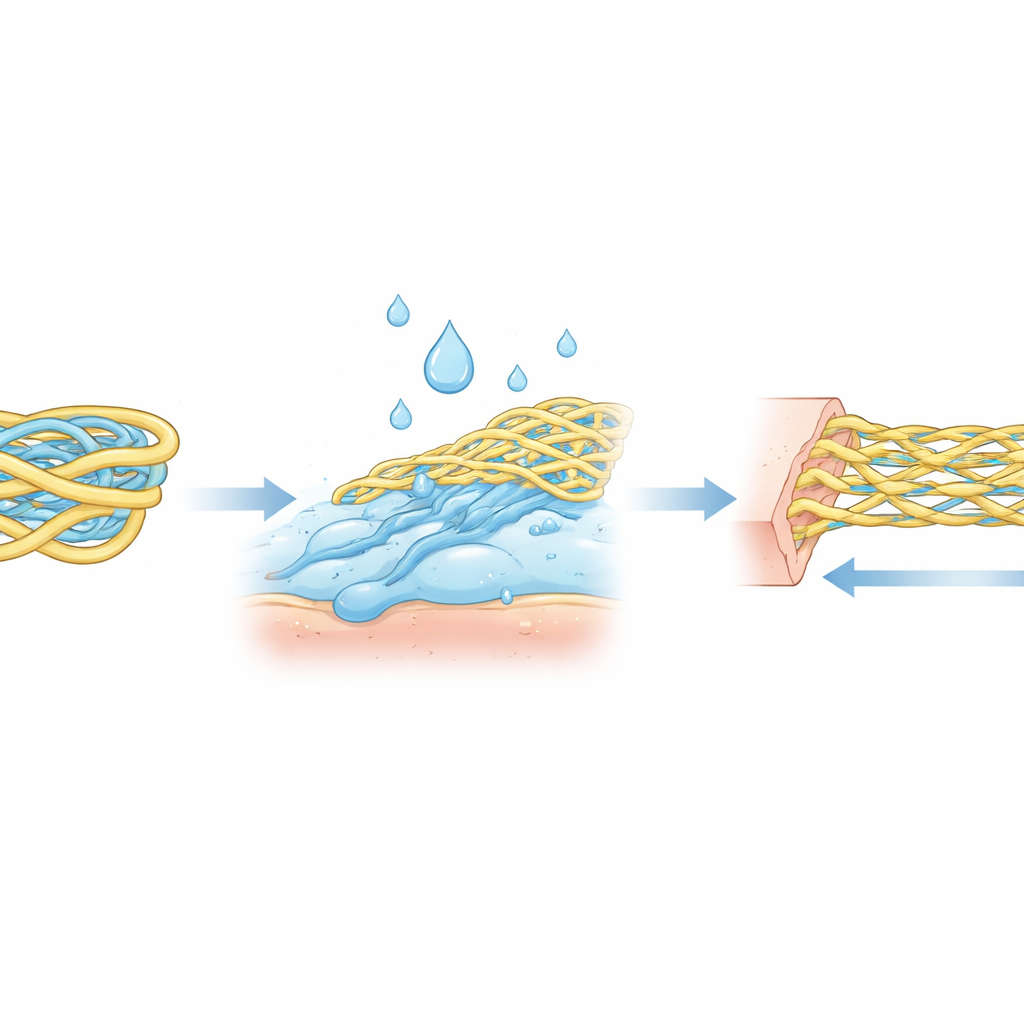
The key advance lies in mixing two different plastics inside each fiber. One, polyvinyl alcohol (PVA), dissolves in water; the other, waterborne polyurethane (WBPU), resists water and stretches well. When the dry nanomesh is placed on the skin and lightly sprayed with water, part of the PVA dissolves and acts like a gentle, temporary glue, helping the mesh hug the skin without any extra tape or gel. At the same time, the WBPU remains as a supporting skeleton. Under the microscope, the fibers show an “island–sea” structure: PVA-rich regions (the islands) are embedded inside a continuous WBPU-rich matrix (the sea). As the PVA dissolves, hollow WBPU tubes are left behind that keep the gold network intact, even when wet.
Built to handle sweat and stretching
To see whether the new mesh can handle real-life wet conditions, the team flowed room-temperature water across the electrodes for a full day. Pure PVA meshes quickly lost their shape and stopped conducting. In contrast, meshes with equal parts PVA and WBPU showed only a tiny increase in electrical resistance—about 2 percent—even after 24 hours of continuous water flow. When they stretched the electrodes on a skin-like material, the pure PVA versions snapped electrically at modest strain, while the blended version stayed connected up to 80 percent stretching and survived 1000 stretch–release cycles with only moderate changes in resistance. These tests show that the WBPU framework acts as a durable scaffold that protects the fragile gold layer from cracking.
Staying reliable on real skin, even on the palm
The ultimate test was long-term use on human skin. The researchers attached pairs of electrodes made from either pure PVA or the optimized half‑and‑half blend to volunteers’ forearms and palms and tracked their electrical resistance for several hours. On both sites—but especially on the sweaty, constantly moving palm—the pure PVA electrodes were unreliable: many climbed above useful resistance levels or broke altogether within a few hours. By contrast, all of the blended electrodes stayed firmly attached and kept low, stable resistance on every trial. In another experiment, both types of electrode successfully detected changes in skin impedance when a plastic film briefly blocked natural evaporation, confirming that the new design preserves the crucial breathability needed to sense subtle moisture shifts in the skin.
What this means for future wearable health patches
For non-experts, the main message is that the authors have found a materials recipe that brings together three features that usually clash: the electrode is stretchy, survives water, and still lets the skin breathe. By carefully tuning how much of each plastic is used, they created a nanomesh that uses one ingredient to stick gently to the skin and the other to hold the structure together under sweat and motion. This makes continuous, comfortable monitoring of skin impedance on difficult places like the palm much more practical. While further work is needed to add robust wiring and wireless electronics, this breathable, water-resistant nanomesh provides a promising foundation for future “electronic bandages” that can quietly track stress, skin health, and other physiological signals over long periods without irritating the skin.
Citation: Mimuro, M., Ebihara, Y., Liang, X. et al. Breathable nanomesh electrodes with improved water resistance and stretchability for skin impedance monitoring. npj Flex Electron 10, 38 (2026). https://doi.org/10.1038/s41528-026-00542-8
Keywords: wearable sensors, skin impedance, flexible electronics, breathable electrodes, stress monitoring