Clear Sky Science · en
Phytic acid-assisted low-temperature carbonization of jute fabric for high-performance flexible pressure sensors
Turning Plant Waste into Smart Touch
Imagine your clothing quietly tracking your pulse, posture, or breathing—without rigid electronics or bulky batteries. This paper describes how everyday plant fiber waste, specifically jute from burlap-like fabrics, can be transformed into ultra-light, flexible pressure sensors that feel almost like cloth. By tweaking how the fibers are heated and coated, the researchers create a sustainable material that can sense everything from a gentle breeze to the bend of your knee. 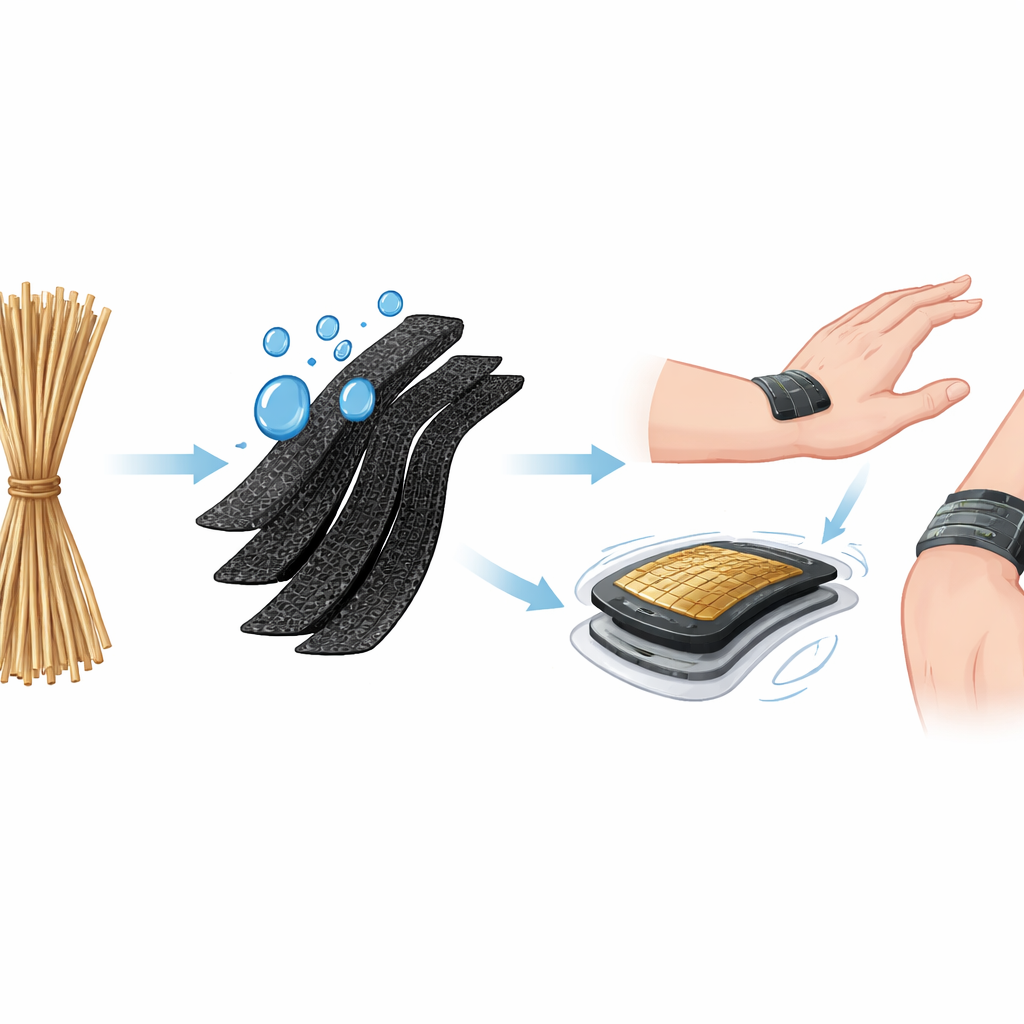
A New Kind of Soft Electronic Skin
Flexible pressure sensors are key to future health wearables, soft robots, and smart gadgets that respond to touch. Many existing sensors rely on costly materials or energy-hungry processes. Here, the team focuses on jute, a cheap, widely available natural fiber rich in cellulose and already used in sacks and ropes. Jute has a built-in porous structure that, if turned into carbon, could carry electrical signals while bending with the body. The challenge is that traditional high-temperature carbonization—essentially baking the fibers into conductive carbon—tends to make them brittle and weak, undermining their usefulness as soft, wearable materials.
Gentle Baking with Help from a Plant-Based Additive
To solve this, the researchers use phytic acid, a phosphorus-rich compound found naturally in seeds and grains, as a sort of helper during heating. After cleaning (“degumming”) the jute so it readily soaks up liquid, they soak it in a phytic acid solution and then heat it in stages under controlled conditions. As the material warms, phytic acid breaks down into acidic species that promote dehydration and the formation of a protective carbon layer at much lower temperatures than usual. This means the fibers can be turned conductive at about 500 °C instead of the typical 700 °C or more, saving energy and avoiding the severe damage that high heat can cause. At the same time, the process leaves the fabric denser and more uniform, with far less shrinkage and cracking than untreated samples.
From Treated Cloth to Flexible Sensor
Once the jute is carbonized with phytic acid’s help, it becomes CPA/DJ—a strong, conductive fabric. The team then combines several layers of this carbonized cloth with thermoplastic polyurethane (TPU), a stretchy plastic, using a solvent-based method that lets TPU form a thin, supporting network around and within the fabric. The result is a feather-light (around 0.12 g per cubic centimeter), bendable pressure sensor patch known as TPU/CPA/DJ. This structure behaves like a sponge made of conductive threads: in its relaxed state, the layers and fibers form a loose, porous network. When pressed, the pores shrink, the layers touch more closely, and the electrical resistance drops in a predictable way. 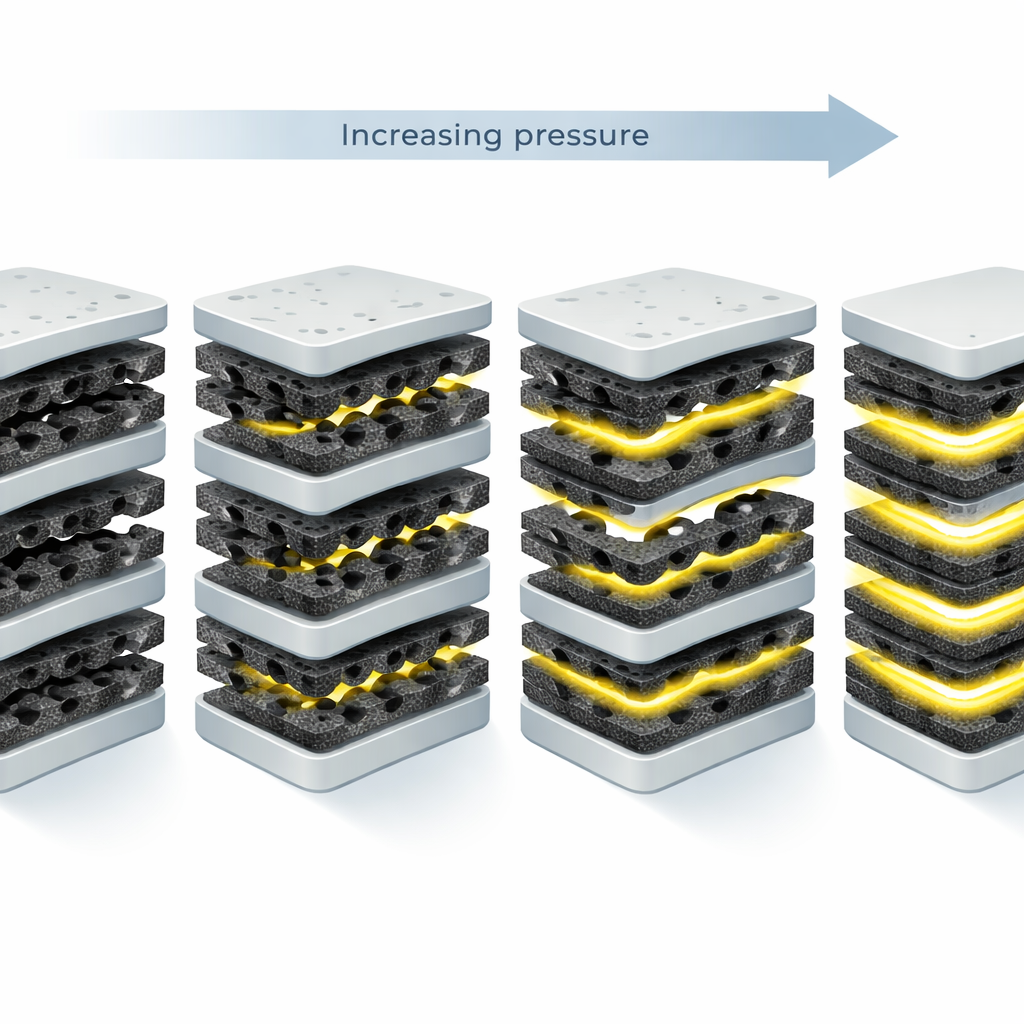
How Well the Soft Sensor Actually Works
The finished sensor shows a combination of traits that are rare to achieve all at once. It is highly sensitive at low pressures, meaning it can detect very gentle forces, yet it continues to function up to 200 kilopascals, a range that covers many everyday motions such as gripping or stepping. Its response is fast—on the order of a few tenths of a second—for both pressing and releasing. It holds up under thousands of repeated loading cycles without losing performance, thanks to the reinforcing TPU. In practical demonstrations, the patch can detect airflow from a small squeeze bulb, the weight of a paper clip or a sheet of paper, and bending of the wrist, elbow, and knee. An array of sensors on fingers can even be used to tap out simple patterns akin to Morse code, hinting at uses in gesture control or silent communication.
Why This Matters for Green Wearable Tech
For non-specialists, the key message is that the authors show a way to turn low-value plant waste into high-value smart materials using a gentler, safer heating process. By introducing a plant-derived additive before carbonization, they cut the required temperature by 200 °C, improve strength more than twentyfold, and still obtain excellent electrical performance. When wrapped in a soft plastic, the carbonized jute becomes a robust, skin-friendly pressure sensor that can track subtle movements and tiny forces. This approach points toward a future in which wearable electronics are not only flexible and accurate, but also built from renewable resources with lower energy costs and less environmental impact.
Citation: Zhu, B.x., Zhao, L.w., Lv, L. et al. Phytic acid-assisted low-temperature carbonization of jute fabric for high-performance flexible pressure sensors. npj Flex Electron 10, 39 (2026). https://doi.org/10.1038/s41528-026-00541-9
Keywords: flexible pressure sensor, carbonized jute, wearable electronics, biomass-derived carbon, phytic acid treatment