Clear Sky Science · en
High output power low temperature polysilicon thin-film transistor boost converters for large-area sensor and actuator applications
Powering the Next Generation of Wearable Tech
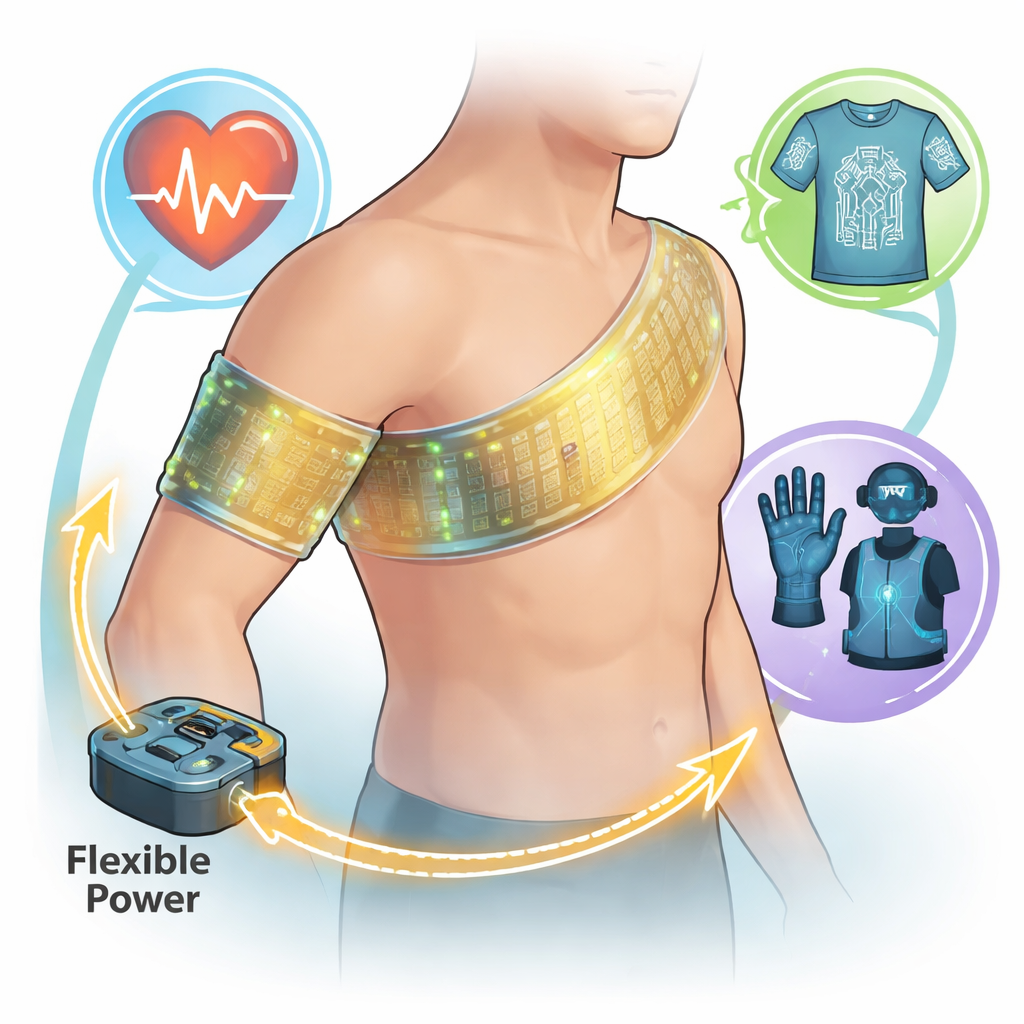
Imagine a skin-like electronic patch that can listen to your heartbeat, feel your movements, or let you “touch” objects in virtual reality—all without bulky batteries or rigid circuit boards. To make such large, comfortable electronic surfaces practical, we need thin, flexible power circuits that can safely deliver watt-level power. This paper explores how to build those power circuits using thin-film transistors, pushing flexible electronics closer to everyday use in health monitoring, smart clothing, and immersive AR/VR gear.
Why Flexible Power Matters
Large fields of sensors and actuators—like electronic skin, smart textiles, or haptic gloves and vests—must cover big areas of the body and often contain thousands of individual elements. Many of these elements, such as ultrasound transducers for organ imaging or haptic feedback, need relatively high voltages or currents. Traditional silicon chips are powerful, but they are rigid and small-area: spreading that power across a shirt, a glove, or a vest would require many hard islands connected together, making the system heavy and uncomfortable. Thin-film transistors, which can be manufactured over large and even flexible surfaces at low cost, offer an attractive alternative—but until now, their power delivery circuits have mostly been limited to micro- and milliwatts, far below what these ambitious applications demand.
Building a Flexible Power “Pump”
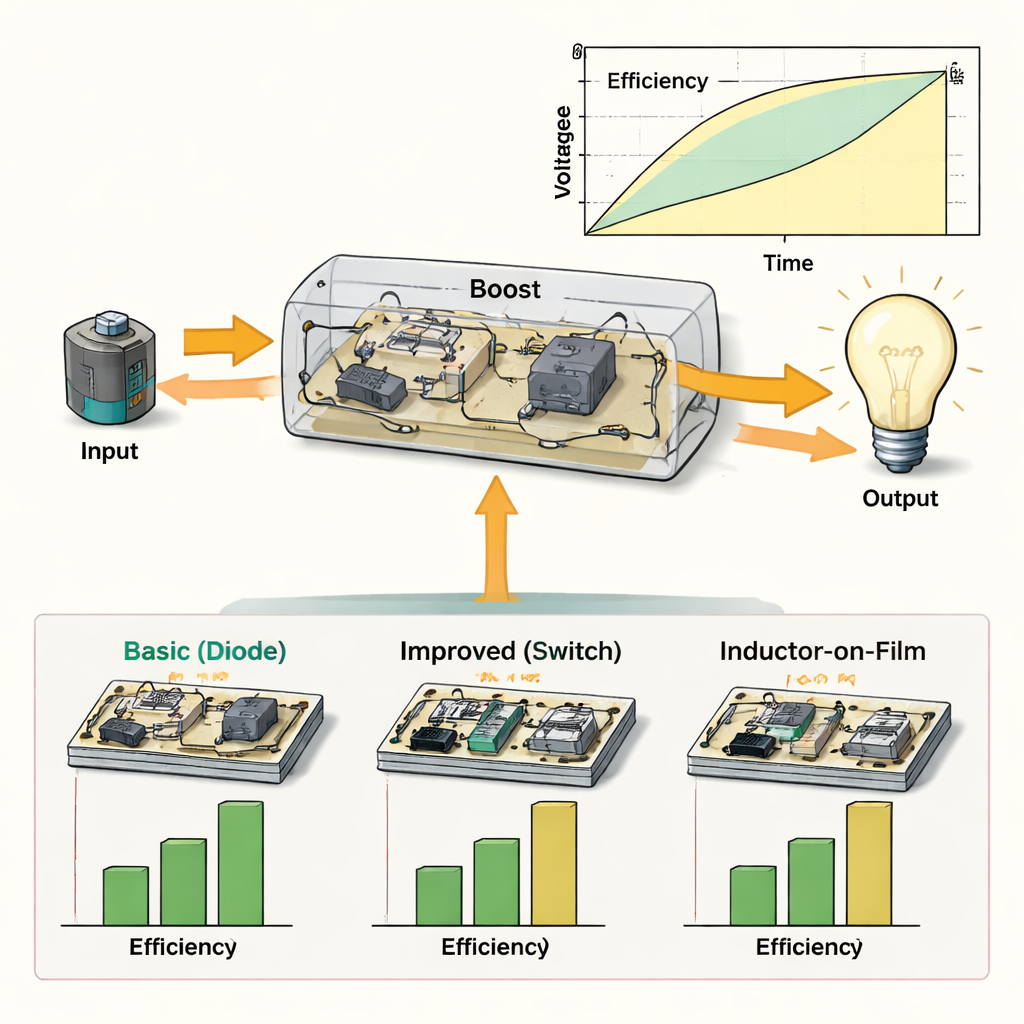
The authors focus on one key building block: the boost converter, a circuit that takes a modest input voltage (here, 3.3 volts) and “boosts” it to a higher level while still supplying substantial current. They implement these circuits in low-temperature polysilicon thin-film technology, which can be processed on glass and later peeled off into a flexible film. Their first design uses a simple “diode-connected” configuration, where one transistor always behaves like a one-way valve. Even after the circuit is delaminated into a bendable form, it can deliver up to about 2 watts of output power, with efficiencies peaking near 59 percent and remaining above roughly 47 percent over a useful range of loads and voltages. This alone is a leap of several orders of magnitude beyond previous thin-film power circuits.
Squeezing More Power into Less Space
To make these power circuits more compact without sacrificing performance, the team takes advantage of a special type of transistor with two gates instead of one. By driving both gates together, they effectively double the control over the channel where current flows, allowing them to shrink the total transistor area needed for a given output current. Comparing single-gate and dual-gate versions of the converter, they show that dual-gate designs can reduce footprint while maintaining similar efficiency and output behavior. This is important for future systems where the power converter must share space with dense sensor and actuator arrays on the same flexible sheet.
From Simple Valves to Smarter Switches
Next, the researchers replace the diode-like transistor with a fully controlled switch, driven by a more sophisticated timing signal. This “switch-connected” converter behaves more like the boost circuits found in conventional power chips. The payoff is a significant improvement: peak efficiency reaches nearly 70 percent while driving 0.4 amperes of current, with output voltages modestly above the input. However, the added switching activity also increases losses at very high operating duty cycles, especially because large thin-film transistors come with sizable built-in capacitances that must be charged and discharged every cycle. The team also shows that seemingly mundane details—like how far the inductor and capacitor sit from the transistors—can noticeably affect performance through hidden resistances and capacitances in the wiring.
Taming Hidden Losses and Proving Reliability
To tackle these hidden losses, the authors build another version in which the inductor, a key energy-storing component, is soldered directly onto the thin-film near the transistors. By shortening the connections, they reduce parasitic resistance and improve both efficiency and output voltage across many operating points. They then run hour-long stress tests on both the diode-based and switch-based converters. Over this time, the output voltage and efficiency drift only a few percent, indicating that the thin-film technology can handle sustained high-power operation. Detailed comparisons with earlier thin-film work and with commercial silicon chips show that, for the first time, flexible thin-film converters can deliver watt-level power with efficiencies in the same ballpark as conventional integrated circuits.
What This Means for Everyday Devices
For a lay reader, the main takeaway is that flexible electronics are learning to do “heavy lifting” in terms of power, not just gentle sensing. By demonstrating boost converters that deliver between about 0.6 and 2.2 watts at up to roughly 70 percent efficiency on flexible thin-film technology, this work closes much of the gap between bendable circuits and rigid silicon power chips. That makes it far more realistic to imagine shirts that monitor your heart, gloves that let you feel virtual textures, or electronic bandages that image organs—all powered by thin, conformable hardware instead of bulky gadgets. While challenges remain, such as adding precise voltage control loops and understanding long-term bending effects, this study lays a solid power-delivery foundation for the next generation of large-area, body-friendly electronics.
Citation: Velazquez Lopez, M., Papadopoulos, N., Coulson, P. et al. High output power low temperature polysilicon thin-film transistor boost converters for large-area sensor and actuator applications. npj Flex Electron 10, 32 (2026). https://doi.org/10.1038/s41528-026-00536-6
Keywords: flexible electronics, thin-film transistors, boost converter, wearable sensors, haptic devices