Clear Sky Science · en
Assemblable thermoelectric Lego blocks for reconfigurable, self-healing, and flexible power generators
Turning Waste Heat into Useful Power
Every day, enormous amounts of heat from car engines, industrial pipes, and even our own bodies simply dissipate into the air. Thermoelectric generators can turn that heat directly into electricity, but today’s devices are rigid, fragile, and nearly impossible to fix once they crack. This research introduces a new approach: small, Lego-like power blocks that can bend, heal after damage, and be reassembled into new shapes, opening the door to power sources that are both tougher and far more adaptable than what we use now.
Building Power from Tiny Blocks
Instead of one large, brittle module, the team designed individual “thermoelectric Lego blocks.” Each block is a self-contained unit that includes a solid thermoelectric leg—the part that converts heat to electricity—sandwiched between soft, conductive pads made from a special polymer filled with silver flakes. These pads act like flexible electrodes and are able to reconnect to each other when pressed together. By snapping many such blocks into arrays, the researchers can create generators of different sizes and layouts, much like building with toy bricks. 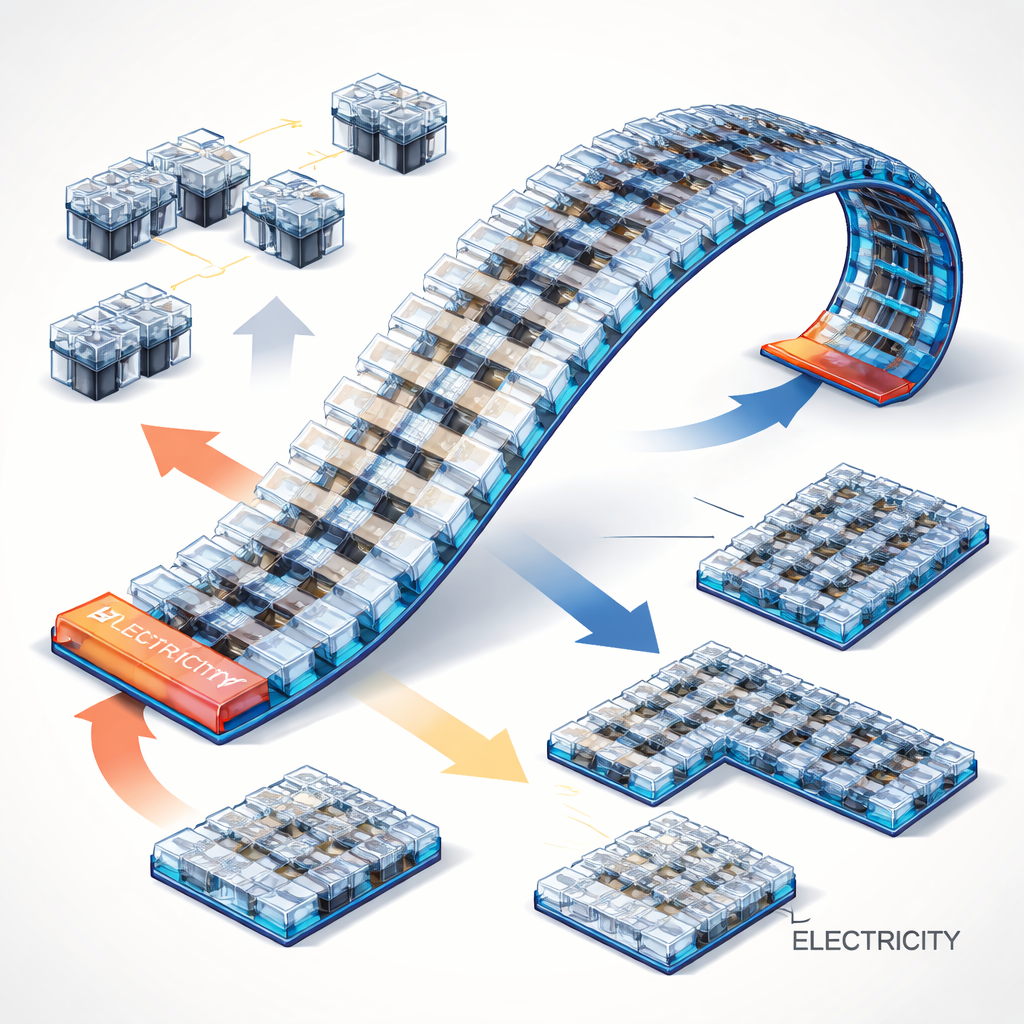
Soft Materials that Conduct and Self-Heal
To make the blocks both flexible and durable, the researchers relied on a silicone-like base material (similar in spirit to common silicone rubber) that had been engineered to form reversible bonds so it can “heal” after being scratched or cut. They mixed in tiny silver flakes so that each soft pad also conducts electricity and heat. Tests showed that this composite kept its structure and performance over many heating and cooling cycles up to around everyday operating temperatures, and could carry substantial electrical current while conducting heat better than the bare polymer. Crucially, when its surface was scratched, the electrical resistance nearly returned to normal within minutes, and even after being fully cut and then rejoined with gentle pressure and moderate warmth, its ability to carry current almost completely recovered.
Printing the Hard Working Cores
The heart of each block is a thermoelectric leg made from bismuth–tellurium-based compounds, long-standing workhorses in low-temperature thermoelectrics. Instead of machining bulky pieces, the team used an extrusion-based 3D printing technique to deposit pastes of finely ground thermoelectric particles. After heat treatment, these printed legs became dense, continuous solids with performance approaching that of conventional bulk materials, while their internal porosity helped keep heat flow low—an advantage for power generation. Measurements of electrical conductivity, heat conduction, and voltage response to temperature differences confirmed that these tiny printed elements could efficiently harvest small temperature gradients around room temperature.
Devices that Bend, Stretch, and Come Apart
Once assembled into simple test generators, the Lego blocks were pushed through demanding mechanical trials. The devices could bend to a tight radius of about 3.4 millimeters and stretch up to 40 percent strain while keeping their electrical resistance and power output nearly unchanged. When the electrodes were scratched, resistance briefly rose and then dropped back close to its starting value as the material healed itself. Even more striking, entire generators were cut into separate blocks, then reattached: the reassembled devices produced almost the same voltage and power as before, differing by only a few percent. This showed that a damaged generator could be restored without replacing all its parts. 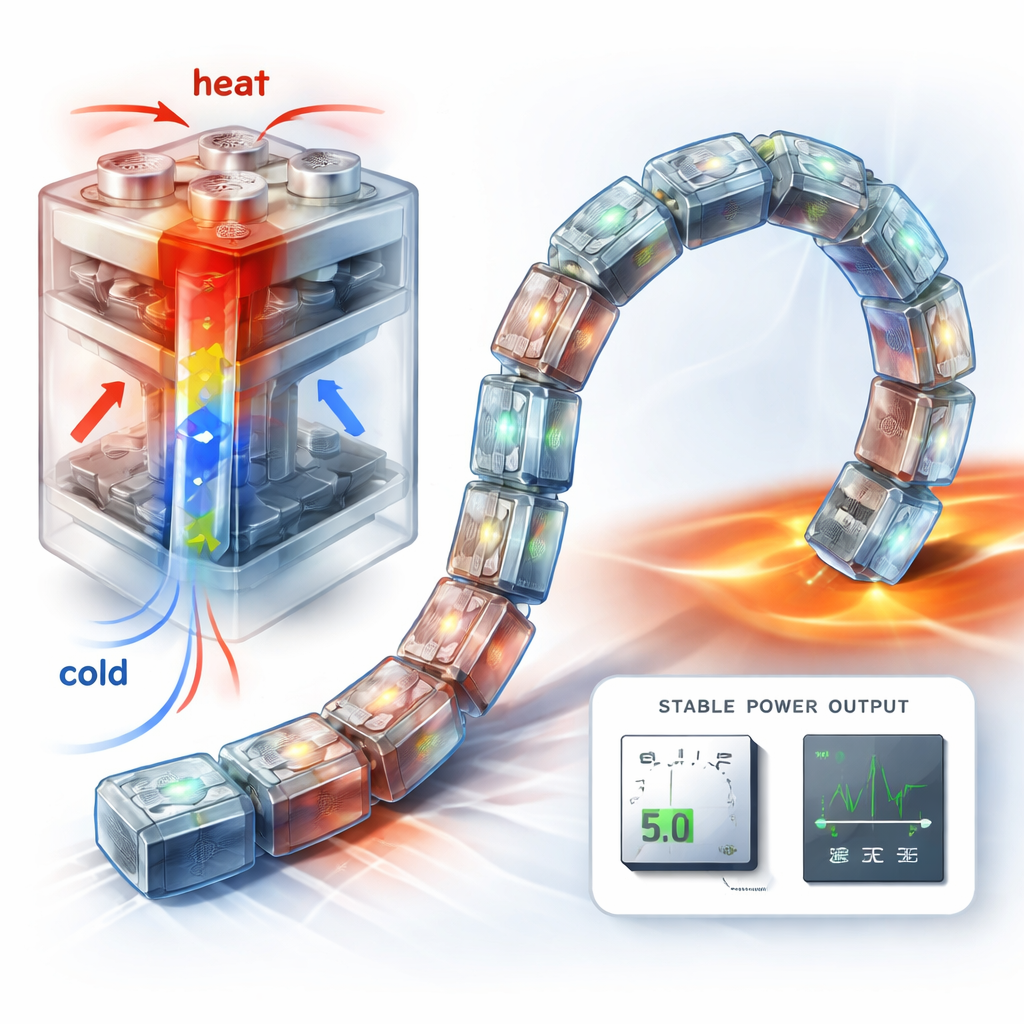
Rebuilding Power Generators Like Toys
Taking advantage of the modular design, the researchers repeatedly deconstructed and rebuilt the same set of blocks into different overall shapes. They made generators with two, four, and six pairs of blocks in simple arrays, and then rearranged them into U-, V-, and W-shaped layouts that could better wrap around curved or complex surfaces. Across these configurations, as long as the electrical series connection was preserved, the total voltage increased predictably with the number of blocks and remained similar when the geometry changed. This means designers could freely reshape a generator to match a pipe, a wearable band, or a custom device without sacrificing performance.
Toward Customizable, Repairable Heat Harvesters
In plain terms, this study shows how turning thermoelectric modules into Lego-like units can solve several long-standing problems at once. The blocks are flexible enough to fit curved surfaces, tough enough to bend and stretch, able to heal after cuts and scratches, and simple to reconfigure into new layouts as needs change. Although each individual generator currently delivers modest power, the approach is scalable: more blocks can be added for more output. These self-healing, reconfigurable building blocks point toward a future in which power generators can be assembled, repaired, and reshaped on demand, rather than thrown away when they crack or no longer fit their original purpose.
Citation: Kim, K., Park, K., Song, J. et al. Assemblable thermoelectric Lego blocks for reconfigurable, self-healing, and flexible power generators. npj Flex Electron 10, 30 (2026). https://doi.org/10.1038/s41528-026-00534-8
Keywords: thermoelectric generator, flexible electronics, self-healing materials, 3D printing, energy harvesting