Clear Sky Science · en
Smart photocapacitive Cu2SnS3 quantum dots-based flexible biointerface for retinal-inspired photoelectrical stimulation
New Ways to Restore Failing Vision
Millions of people lose their sight when the light-sensing cells in the eye slowly die, a condition called retinal degeneration. Once these cells are gone, the eye can no longer turn light into the electrical signals the brain needs to form images. This study explores a new kind of ultra-thin, flexible film that can sit where damaged cells once worked and convert gentle flashes of light into safe electrical cues for nerve cells—offering a potential path toward future “solar-powered” vision implants.
Building a Tiny Artificial Retina Tile
Instead of relying on bulky electronics and wires, the researchers created a stack of light-sensitive materials only a few micrometers thick. At its heart are copper–tin–sulfide quantum dots—nanocrystals less than ten billionths of a meter across—combined with a soft plastic blend often used in organic solar cells. This hybrid layer sits on a transparent, flexible base and is bathed in a salty liquid similar to the fluid in and around the brain. When light shines on the film, it behaves like both a mini solar cell and a tiny capacitor: it turns light into electrical charge and temporarily stores that charge at its surface, exactly where nerve cells can sense it. 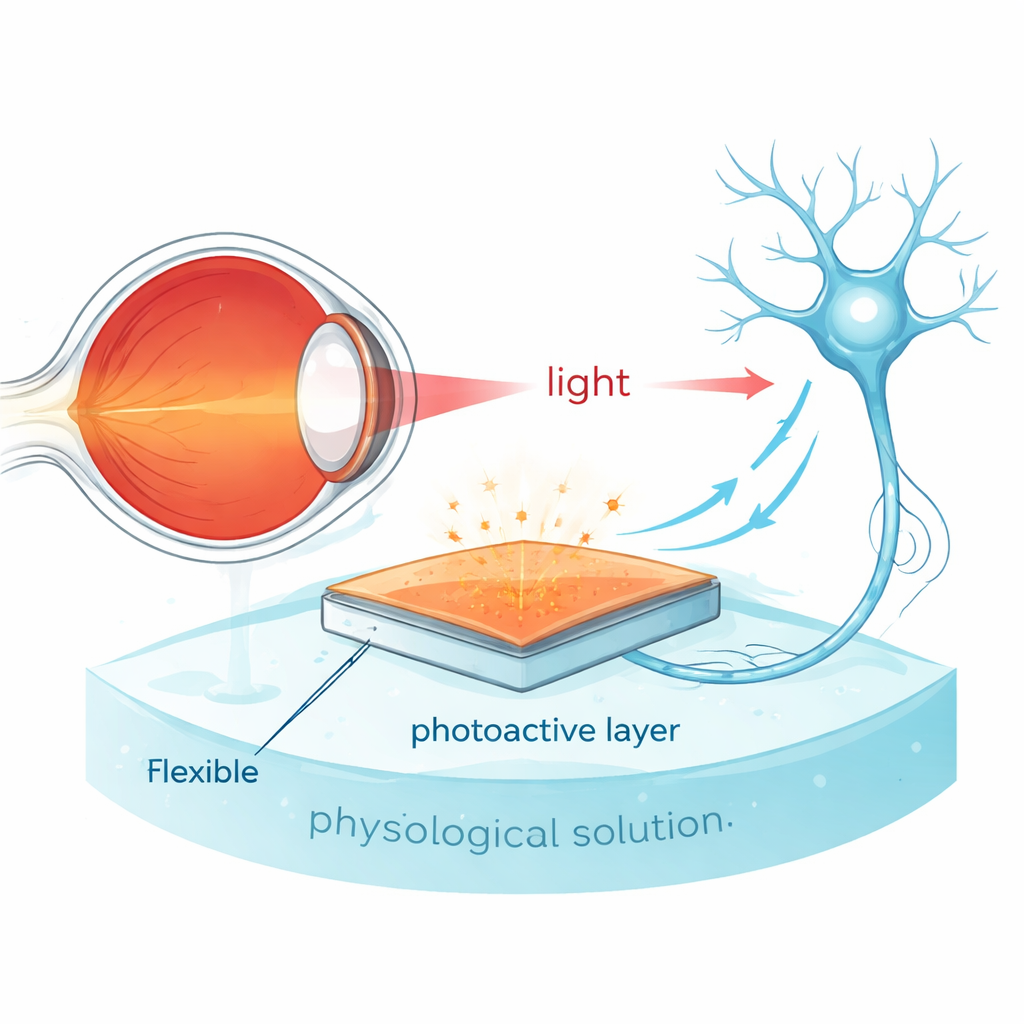
Smart Response to the Colors of Light
The team first fine-tuned the quantum dots so they absorbed visible and near‑infrared light efficiently, with a strong preference for red light—similar to how certain cells in the retina are more sensitive to longer wavelengths. They then measured how the electrical “storage” capacity of the film changed under different colors of light. Red light caused the capacitance to rise roughly sevenfold compared with darkness, while blue light barely changed it. At the same time, the film’s electrical resistance dropped under illumination, confirming that light was freeing charges that moved to the surface and took part in reversible reactions with the surrounding fluid. This wavelength‑dependent, self-adjusting behavior echoes the way biological photoreceptors shift their membrane voltage as light intensity and color change.
From Light Pulses to Electrical Nudges
Next, the researchers tested whether these light-driven charges could be harnessed without any hard wiring, as a future implant would need to operate. They floated the flexible film in an artificial brain fluid and positioned a micro-scale recording pipette in the liquid above it. Short red-light flashes triggered sharp bursts of current—peaking around 4.5 billionths of an ampere at modest light levels—made up mostly of fast capacitive spikes rather than slower, chemistry-driven currents. The charge delivered per pulse exceeded what is typically needed to influence nerve tissue yet stayed safely below thresholds associated with damage or heating. Computer models that treated a nerve cell membrane as a tiny electrical circuit showed that such pulses could briefly shift the cell’s voltage by tens of millivolts, enough to provoke nerve firing while remaining within biologically acceptable limits. 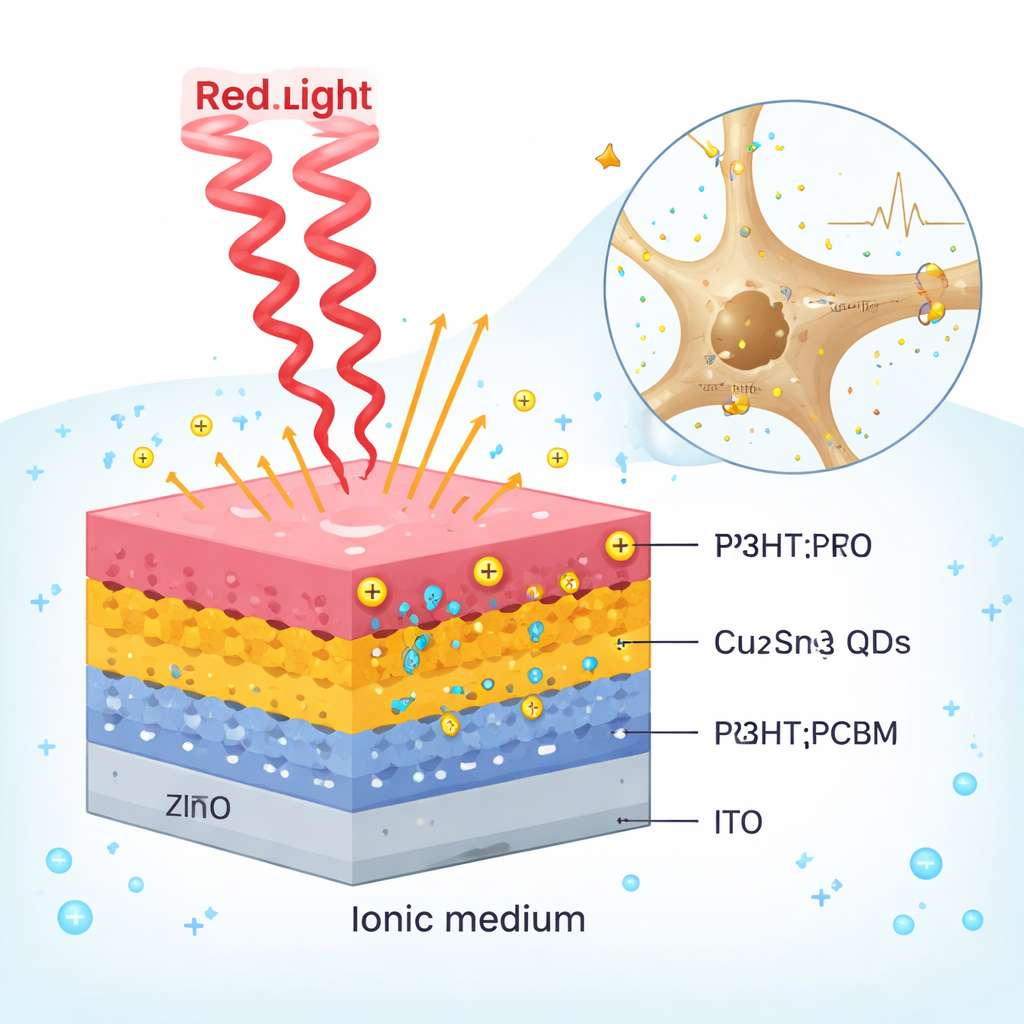
Watching Neurons Light Up
To see whether real brain cells would respond, the team grew primary hippocampal neurons—cells involved in memory and signaling—directly on top of the flexible films. Using a common lab test, they confirmed that about 80 percent of cells survived, indicating low toxicity. The neurons were then loaded with a fluorescent dye that glows more brightly as calcium ions enter the cells, a hallmark of electrical activation. When the researchers applied brief pulses of red or yellow light, the films excited the underlying neurons: over one to two seconds after each light pulse, the fluorescence in many cells rose by about 10 percent, then slowly returned to baseline. The timing and shape of these signals showed that light hitting the film was reliably translated into changes in the neurons’ internal chemistry and electrical state.
Toward Future Wireless Vision Aids
In simple terms, this work demonstrates a soft, bendable “photo-battery” that can sit in biological fluid, charge itself up with red light, and discharge that energy as gentle electrical nudges to nerve cells. By blending solar cell and supercapacitor concepts into a single, non‑toxic quantum-dot film, the researchers created a platform that works at safe light levels, produces fast, reversible signals, and interfaces well with living neurons. While much engineering remains—such as boosting sensitivity, refining layer design, and adapting the technology specifically for retinal ganglion cells—the study brings us closer to wireless, battery‑free implants that could one day help restore useful vision or enable new kinds of light‑driven therapies in the brain and beyond.
Citation: Vanalakar, S.A., Qureshi, M.H., Mohammadiaria, M. et al. Smart photocapacitive Cu2SnS3 quantum dots-based flexible biointerface for retinal-inspired photoelectrical stimulation. npj Flex Electron 10, 28 (2026). https://doi.org/10.1038/s41528-026-00531-x
Keywords: retinal prosthesis, photocapacitor, quantum dots, neuromodulation, flexible bioelectronics