Clear Sky Science · en
3D micropatterning of PEDOT:PSS/Gelatin conductive hydrogels via two-photon lithography for soft bioelectronics
Bringing Electronics Closer to the Brain
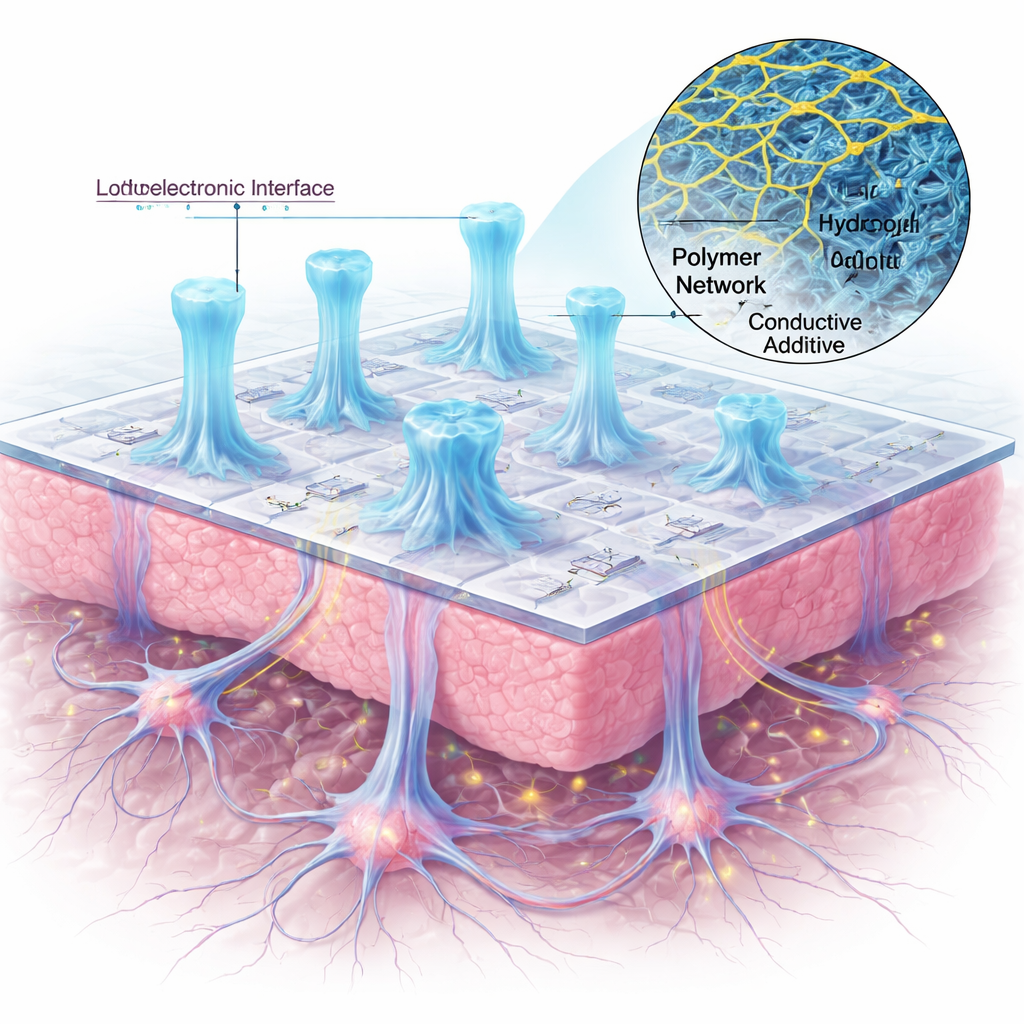
Our brains and hearts are soft, wet tissues, while most electronic devices are hard and rigid. This mismatch makes it difficult to build comfortable, long‑lasting connections between living cells and machines. The research in this paper introduces a new way to 3D‑print ultra‑soft, jelly‑like conductive structures that can sit gently on brain‑like tissue, talk electrically with neurons, and potentially lead to more natural, safer brain–computer interfaces.
Why Soft, Tiny Electrodes Matter
Modern bioelectronic devices can already record and stimulate electrical activity in the brain, heart, and nerves, but they are usually built from stiff metals or rigid plastics. When these hard materials press against soft tissue, they can irritate cells, cause tiny injuries, and gradually lose signal quality. At the same time, real tissues have intricate three‑dimensional landscapes that influence how cells grow, connect, and communicate. To better match nature, scientists want electrode materials that are not only electrically active, but also as soft and finely structured as the tissue they touch. That means creating materials that conduct electricity, let ions and water move freely, and can be sculpted into microscale shapes that resemble the natural support structure around cells.
Building a Soft, Conductive Jelly
The team tackled this challenge by combining two key ingredients. The first is a gelatin‑based hydrogel, derived from collagen, the protein that helps give our tissues structure. In a slightly modified form known as GelMA, this material can be hardened with light into clear, water‑rich gels that are gentle and biocompatible. The second ingredient is PEDOT:PSS, a well‑known polymer used in flexible electronics that can carry both electronic and ionic charges. By blending small amounts of PEDOT:PSS into GelMA, the researchers created a family of conductive hydrogels that behave mechanically like very soft brain tissue—about a thousand times softer than rubber—while still providing a useful electrical pathway. Tests on bulk samples showed that adding the conducting polymer lowered the electrical impedance, meaning signals could pass through more easily, without making the gel stiffer.
Sculpting 3D Micro‑Landscapes with Light
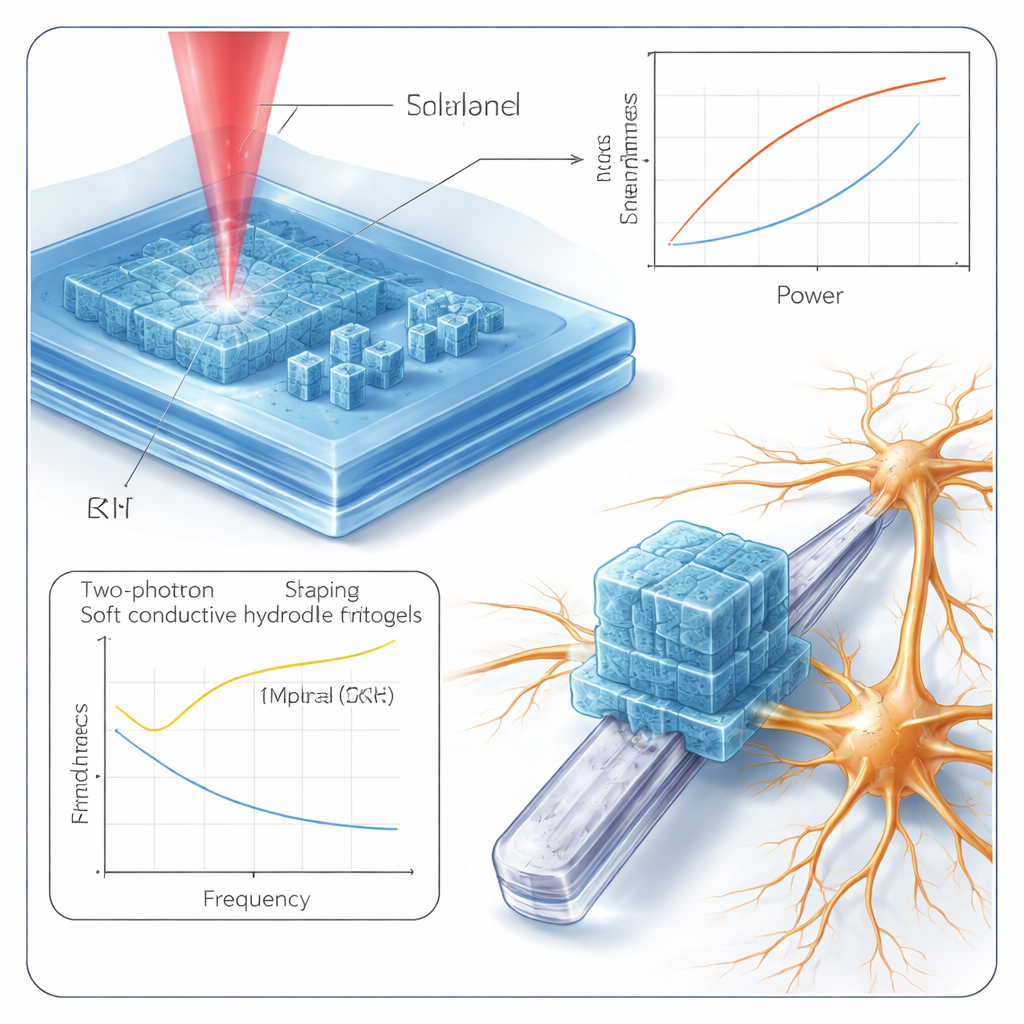
To turn this soft jelly into precise micro‑devices, the scientists used two‑photon lithography, a high‑resolution 3D printing technique where a tightly focused laser beam “writes” tiny solid volumes inside a light‑sensitive material. By carefully tuning laser power and scan speed, they could reliably print structures smaller than a human hair directly from the conductive hydrogel blends. They created cylinders, cubes, sharp‑edged stars, and stylized neuron‑like shapes, and confirmed with microscopes that the printed features closely matched the digital designs in all three dimensions. Importantly, the presence of PEDOT:PSS allowed printing at lower laser energies and reduced swelling in water, helping the shapes keep their intended size and outline. Measurements on individual micro‑blocks showed that they remained extremely soft—on the order of 1 kilopascal, similar to brain tissue—while their electrical conductivity increased with more PEDOT:PSS.
Turning Micro‑Jellies into Working Electrodes
The researchers then tested whether these hydrogel structures could improve real electrode performance. They fabricated transparent microelectrode arrays made from indium tin oxide on quartz and 3D‑printed small conductive hydrogel blocks directly onto the active sites. These 3D coatings dramatically increased the effective surface area and added an electronically conducting path. When the electrodes were immersed in a salt solution that mimics body fluids, the coated sites—especially those containing PEDOT:PSS—showed about a 30 percent drop in impedance at key brain‑signal frequencies compared with bare electrodes. Lower impedance typically means cleaner recordings and more efficient stimulation. Just as crucial, when primary rat neurons and a neuronal cell line were grown on the patterned hydrogels, the cells remained healthy over several days. Microscopy revealed that neurons extended their thin processes along and across the nanofibrous gel surfaces, forming close, intimate contact with the 3D shapes.
What This Could Mean for Future Brain–Machine Links
In simple terms, this work shows how to print tiny, soft, conductive “jelly sculptures” that both electronics and neurons can comfortably share. By blending a body‑friendly gelatin with a mixed ionic‑electronic polymer and shaping it with a laser, the team produced microelectrodes that are mechanically brain‑like, electrically efficient, and welcoming to nerve cells. While the current study focuses on short‑term cultures and basic signal properties, the approach opens the door to next‑generation neural implants and in‑vitro models where devices feel more like tissue than metal, potentially improving comfort, stability, and the clarity of communication between the nervous system and machines.
Citation: Buzio, M., Gini, M., Schneider, T.C. et al. 3D micropatterning of PEDOT:PSS/Gelatin conductive hydrogels via two-photon lithography for soft bioelectronics. npj Flex Electron 10, 19 (2026). https://doi.org/10.1038/s41528-026-00529-5
Keywords: soft bioelectronics, conductive hydrogels, neural interfaces, 3D microfabrication, two-photon lithography