Clear Sky Science · en
A liquid metal droplet rotary paddle motor
A New Kind of Tiny Motor
From electric toothbrushes to jet engines, spinning parts power much of modern life. This research explores a radically different way to make something spin: using a droplet of liquid metal as the heart of a motor. By tapping into natural flows that appear inside the droplet when electricity is applied, the authors build a simple, compact rotary motor that could one day help drive miniature pumps, soft robots, or medical devices inside the body.
Turning Liquid into Motion
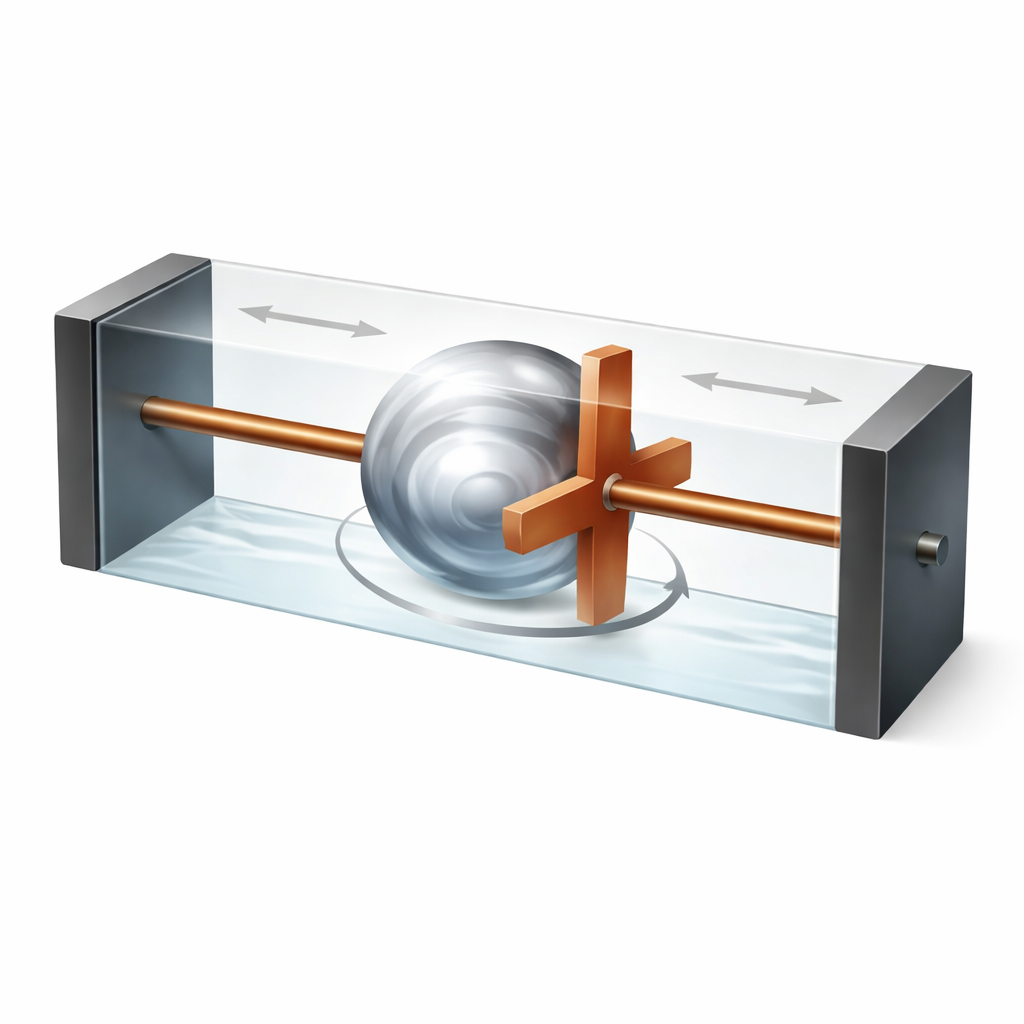
Most familiar motors are full of solid parts: coils, magnets, bearings, and shafts. Here, the central “moving part” is a smooth droplet of a soft, silvery alloy made of gallium and indium, which is liquid near room temperature. The droplet sits in a bath of alkaline salt solution between two electrodes. When a voltage is applied, the surface tension of the droplet becomes uneven, driving fast flows along its surface. These surface flows, in turn, stir up whirlpools inside the droplet. Instead of just letting the droplet slide or wiggle, the researchers insert a tiny copper paddle into it and immobilize the droplet in a shallow recess, so that the internal whirlpools can directly push on the paddle and make it spin.
A Clever Paddle in a Liquid Heart
The copper paddle is shaped like a small cross and passes right through the droplet, acting as the motor’s shaft. One end of the paddle extends outside the liquid so it can connect to the outside world, while narrow slits in the housing prevent the surrounding liquid from leaking. Around the droplet, the device includes a bypass channel that lets the fluid circulate smoothly. This avoids building up fluid on one side, which would disturb the electric field that drives the motion. In effect, the liquid metal droplet behaves like a microscopic waterwheel that never rusts and has no traditional bearings or gears.
Tuning Electricity for Faster Spinning
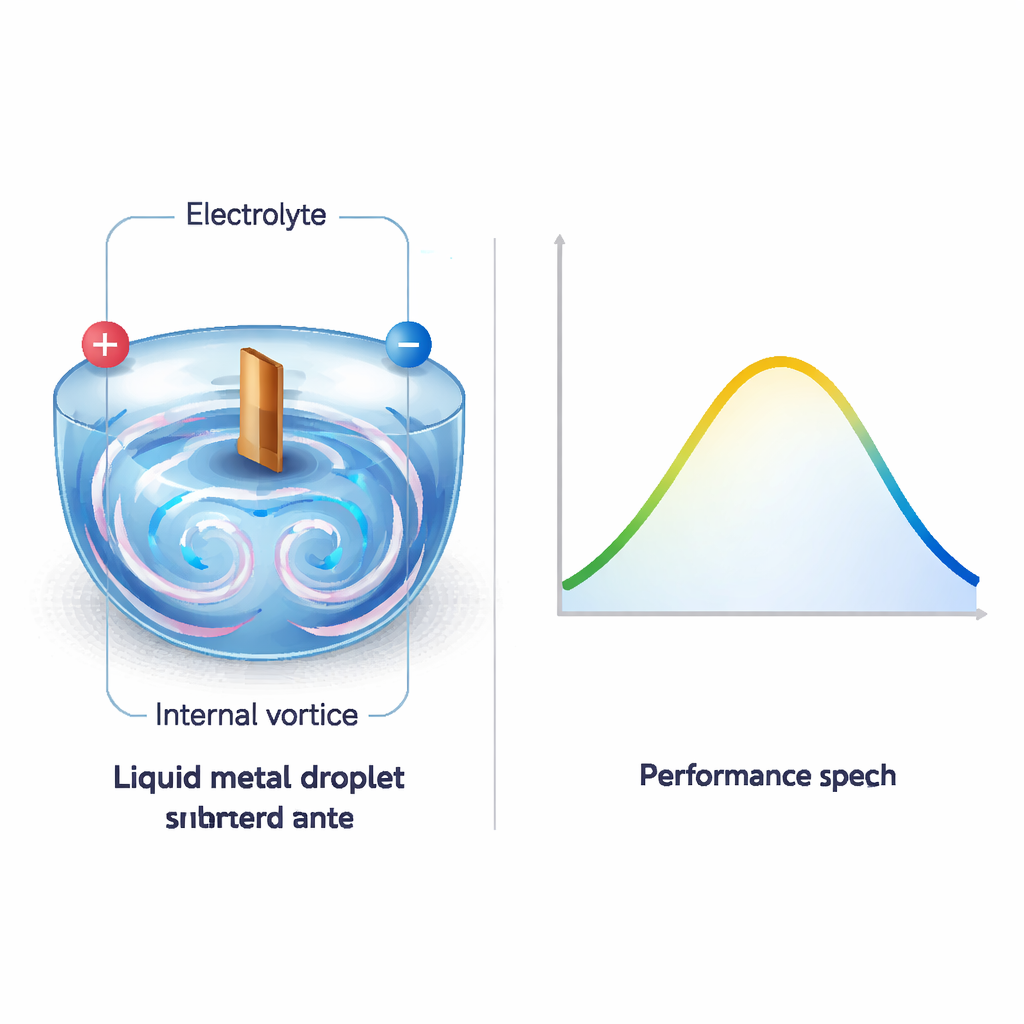
To get strong, efficient motion, the team does not use a steady current. Instead, they switch the voltage on and off very quickly in pulses lasting only a few thousandths of a second. These pulsed signals create vigorous internal flows while giving the droplet brief “rest” periods so its surface can recover from chemical changes that would otherwise slow it down. Under the right pulse timing and voltage, the motor reaches rotational speeds of about 320 revolutions per minute—several times faster than earlier liquid-metal-based motors, which topped out near 60 revolutions per minute. The pulsed approach also cuts power consumption roughly in half compared with a constant voltage.
Finding the Sweet Spot in Design
The researchers systematically explore how geometry and operating conditions affect performance. They find that both the size of the droplet and the exact position of the paddle inside it matter greatly. Droplets that are too small make weak flows; droplets that are too large flatten under gravity and disturb the internal whirlpools. The paddle spins best when it sits in the upper half of a droplet about 3 millimeters across. The spacing of the electrodes is also critical: if they are too close, the electric field becomes uneven and the droplet shifts position, degrading performance. Computer simulations of the electric field, combined with high-speed video of the spinning paddle, help them map out these optimal conditions.
From Lab Demonstration to Future Devices
As a proof of practicality, the team attaches a tiny propeller to the paddle shaft outside the liquid. The motor drives this propeller continuously for more than an hour, with only a gradual drop in speed as the electrolyte slowly evaporates and the droplet shrinks. Although the torque—the twisting force the motor can deliver—is still much lower than that of commercial electric motors, this design shows that liquid metal can reliably turn electrical energy into rotation without complex machinery. With further improvements to reduce energy losses and boost torque, such droplet-based motors could become key components of flexible and miniaturized machines in microfluidics, soft robotics, and biomedical engineering.
Why This Matters
To a non-specialist, this work shows that “motors” need not look like the rigid, metal cylinders in everyday appliances. By exploiting the natural fluid motion inside a liquid metal droplet, the researchers create a compact, self-contained rotary motor with almost no solid moving parts. While it will not replace car engines or factory machines, this new concept opens a path toward tiny, gentle, and adaptable motors that can operate where traditional hardware cannot—inside soft robots, lab-on-a-chip devices, or even within living tissue.
Citation: Fuchs, R., Nor-Azman, NA., Tang, SY. et al. A liquid metal droplet rotary paddle motor. npj Flex Electron 10, 27 (2026). https://doi.org/10.1038/s41528-026-00528-6
Keywords: liquid metal, soft robotics, micro-motors, electrochemical actuation, microfluidics