Clear Sky Science · en
Longitudinal brain-age predictions comprising long-duration spaceflight missions
Why Space Changes Our Brains
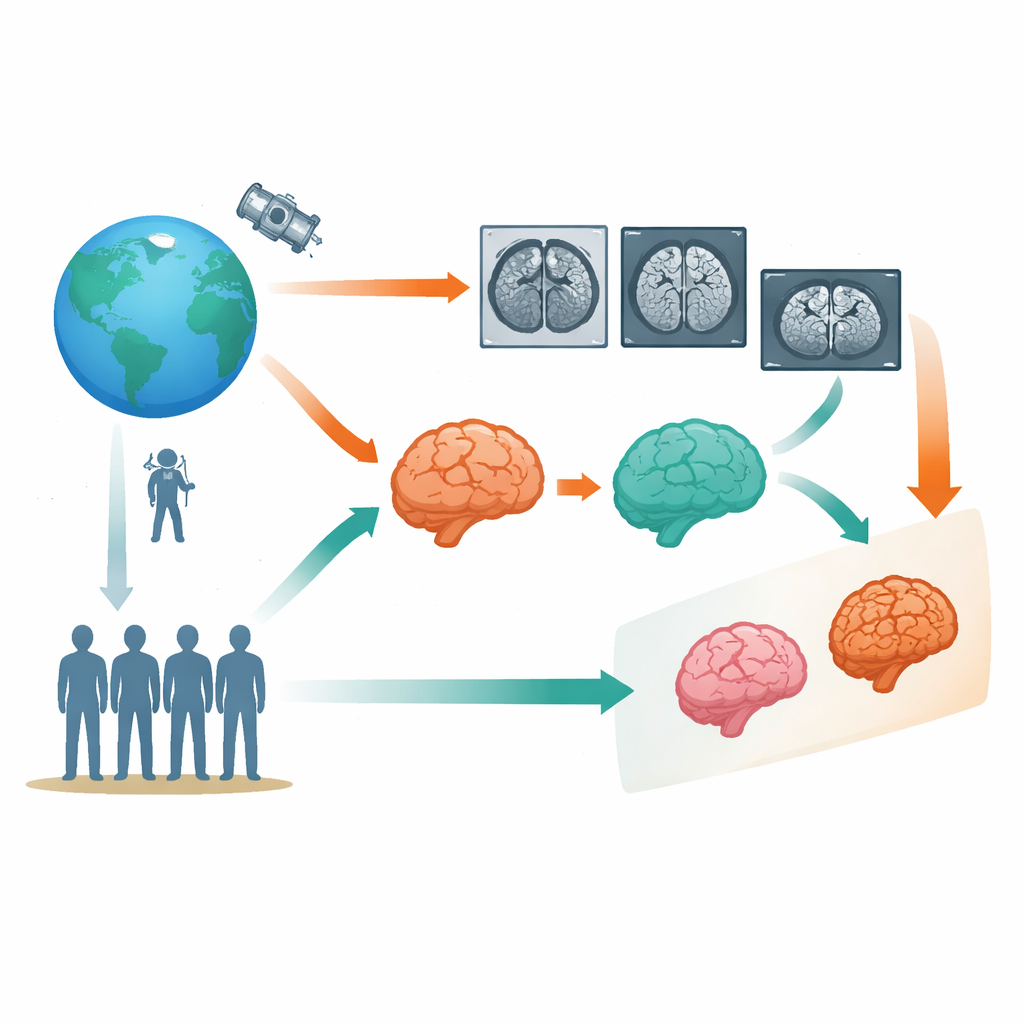
As missions aboard the International Space Station stretch to six months and beyond, a key question looms: what does life in weightlessness do to the human brain over time? This study asks whether months in orbit might nudge the brain to “age” faster, using advanced MRI scans and artificial intelligence to estimate how old a person’s brain looks compared with their actual age. The answer matters not only for astronauts heading to the Moon and Mars, but also for understanding aging and brain health back on Earth.
Looking at the Brain Like a Clock
The researchers used a concept called “brain age,” which treats the brain like a biological clock. By feeding thousands of MRI scans into machine learning models, scientists can train algorithms to recognize patterns that typically appear as people grow older—such as subtle changes in brain tissue and fluid spaces. Once trained, these models can look at a new scan and estimate how old that brain appears. Comparing this estimate to a person’s real age reveals whether their brain seems younger, older, or right on track.
Astronauts, Cosmonauts, and Earthbound Twins
The team analyzed data from two long-duration spaceflight programs: Russian cosmonauts (ROS) and European astronauts (ESA) who spent about six months on the International Space Station. Each spacefarer underwent brain scans before launch, within days after landing, and again roughly half a year later. For comparison, the researchers also scanned carefully matched control volunteers on Earth—similar in age, sex, and education—over roughly the same time spans. Three state-of-the-art machine learning models were used to estimate brain age from structural MRI, with special attention to how stable and accurate these tools were over repeated scans.
Testing the Brain-Age Tools
Before drawing any conclusions about spaceflight, the authors checked whether the brain-age models themselves were reliable. They scanned people twice in a single session, about half an hour apart, to see if the predictions would be nearly identical. All three models passed this test with flying colors: 94–97% of the variation in predictions reflected true differences between individuals, not random noise. However, one deep learning model, despite being very consistent, badly overestimated ages—on average making brains look about 11 years older than they were—likely because it had been trained mostly on much older adults. Since accuracy matters as much as stability, this model was dropped from the main analyses, and the two better-calibrated models were carried forward.
What Happens to Brains After Months in Orbit
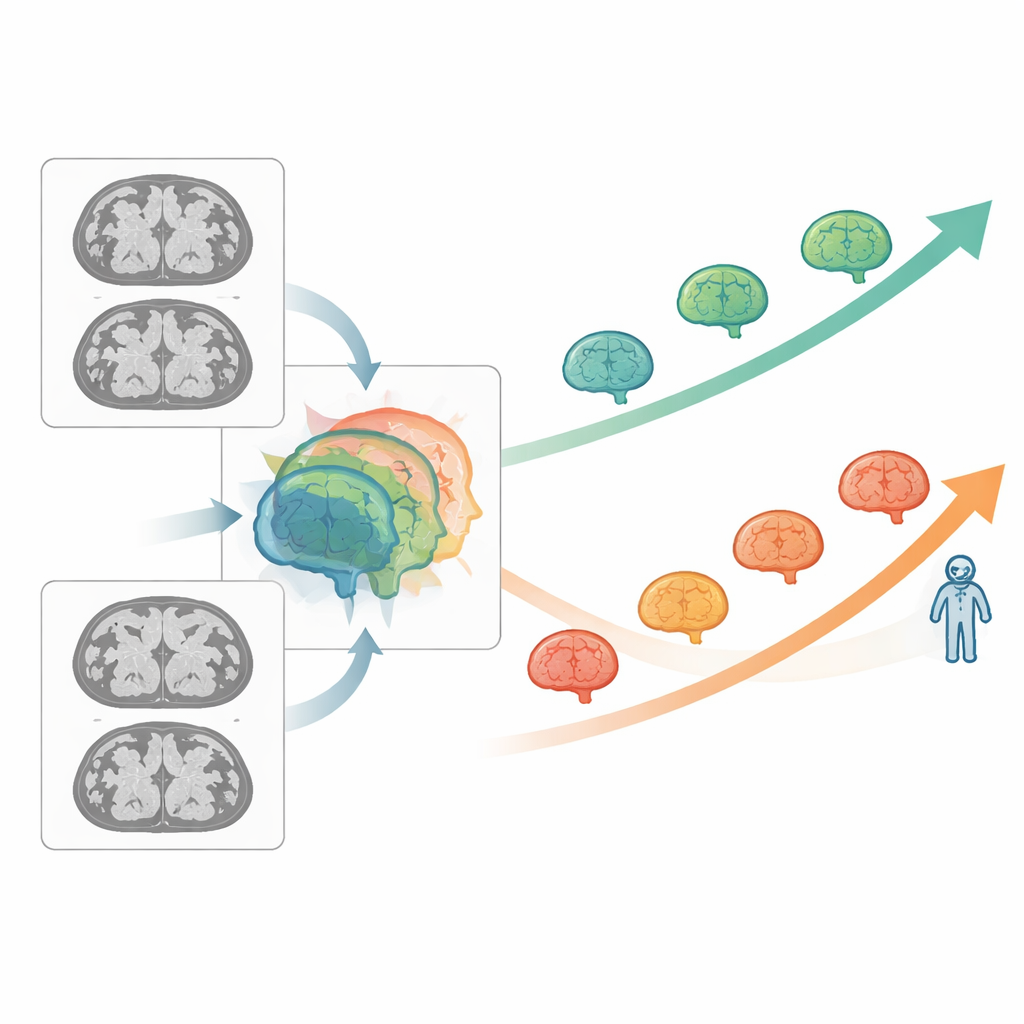
Using the remaining models, the scientists examined how brain age changed before and after flight and over the follow-up period, compared with controls. In Russian cosmonauts, one model suggested that immediately after their missions, their brains appeared slightly older—by less than a year—than before launch, echoing earlier work showing reduced gray matter in certain brain regions and expanded fluid spaces after spaceflight. In the ESA astronaut group, brain-age estimates over time showed a pattern consistent with a somewhat steeper “aging” trend than in their Earthbound peers, although the number of participants was small and the differences did not reach formal statistical significance. Overall, the controls showed either stable or more typical aging patterns, while spacefarers in some analyses appeared to drift toward an older-looking brain profile.
Signals, Not Final Answers
Interpreting these shifts is challenging. Changes in brain age after spaceflight might reflect true accelerated aging, but they could also represent temporary adaptations to microgravity and the stresses of launch and landing that partly reverse over time. The ESA data, for example, hinted that some changes may move back toward baseline at follow-up. The authors stress that their results are preliminary and based on modest sample sizes, but they demonstrate that brain-age prediction is feasible in astronaut studies and that current machine learning tools are reliable enough to track small changes over months. For lay readers, the takeaway is that long-duration space missions appear to leave a measurable fingerprint on the brain that looks, in some respects, like aging, and that we now have sensitive tools to monitor these effects as humans push farther into space.
Citation: Tang, G., Patil, K.R., Hoffstaedter, F. et al. Longitudinal brain-age predictions comprising long-duration spaceflight missions. npj Microgravity 12, 24 (2026). https://doi.org/10.1038/s41526-026-00575-3
Keywords: spaceflight, brain aging, MRI, astronaut health, machine learning