Clear Sky Science · en
Microbial biomining from asteroidal material onboard the international space station
Turning Space Rocks into Useful Resources
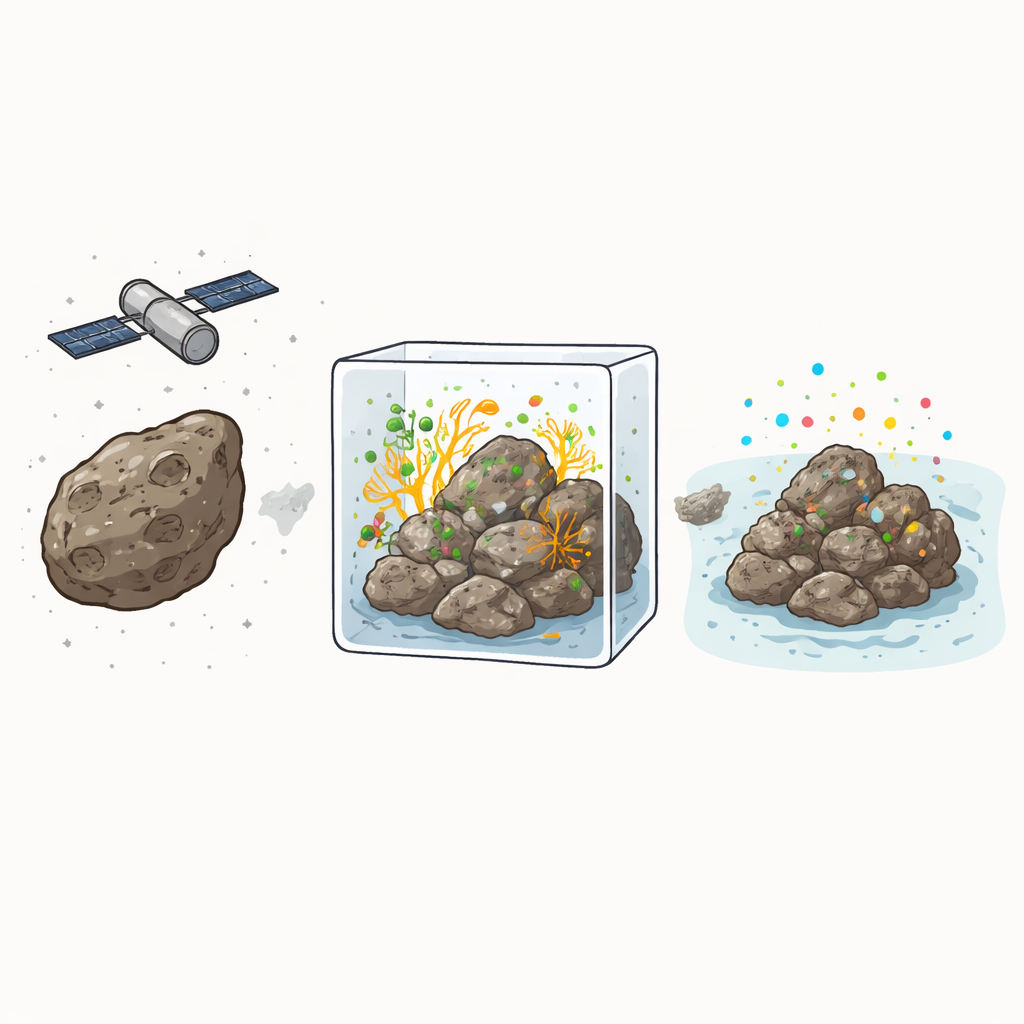
As humans dream of building bases on the Moon, Mars, and beyond, one big question looms: where will we get the raw materials to support life and technology far from Earth? Shipping everything from home is too costly and risky. This study explores a surprising ally for future space settlers—microbes that can slowly “eat” asteroid rock and release valuable metals, even while orbiting Earth on the International Space Station (ISS). Their work hints at how biology could help turn barren space rocks into mines, soils, and chemical factories for off-world communities.
Space Mining with Living Helpers
On Earth, certain bacteria and fungi are already used in “biomining,” a process where microbes break down rock and free metals for industry. The researchers behind this work wanted to know whether similar biology could operate in the strange conditions of space, where gravity is almost absent and fluids behave differently. They focused on a common type of meteorite called an L-chondrite, thought to be similar to material found in many asteroids. These rocks contain a mix of silicate minerals and metals, including elements from the platinum group, which are crucial for electronics, catalysts, and other high‑tech uses.
Designing a Tiny Space Mine
To test biomining in orbit, the team created an experiment called BioAsteroid and flew it to the ISS. Small fragments of a real meteorite were loaded into sealed reactors along with a growth medium and either a bacterium (Sphingomonas desiccabilis), a fungus (Penicillium simplicissimum), both organisms together as a mini‑community, or no microbes at all as a control. Once on the Station, astronauts activated the units so that liquid medium bathed the dry rock and microbes for 19 days in microgravity. Identical hardware and procedures were used back on Earth, so that any differences in metal extraction could be linked to gravity rather than to the design of the setup.
What the Microbes Did to the Meteorite
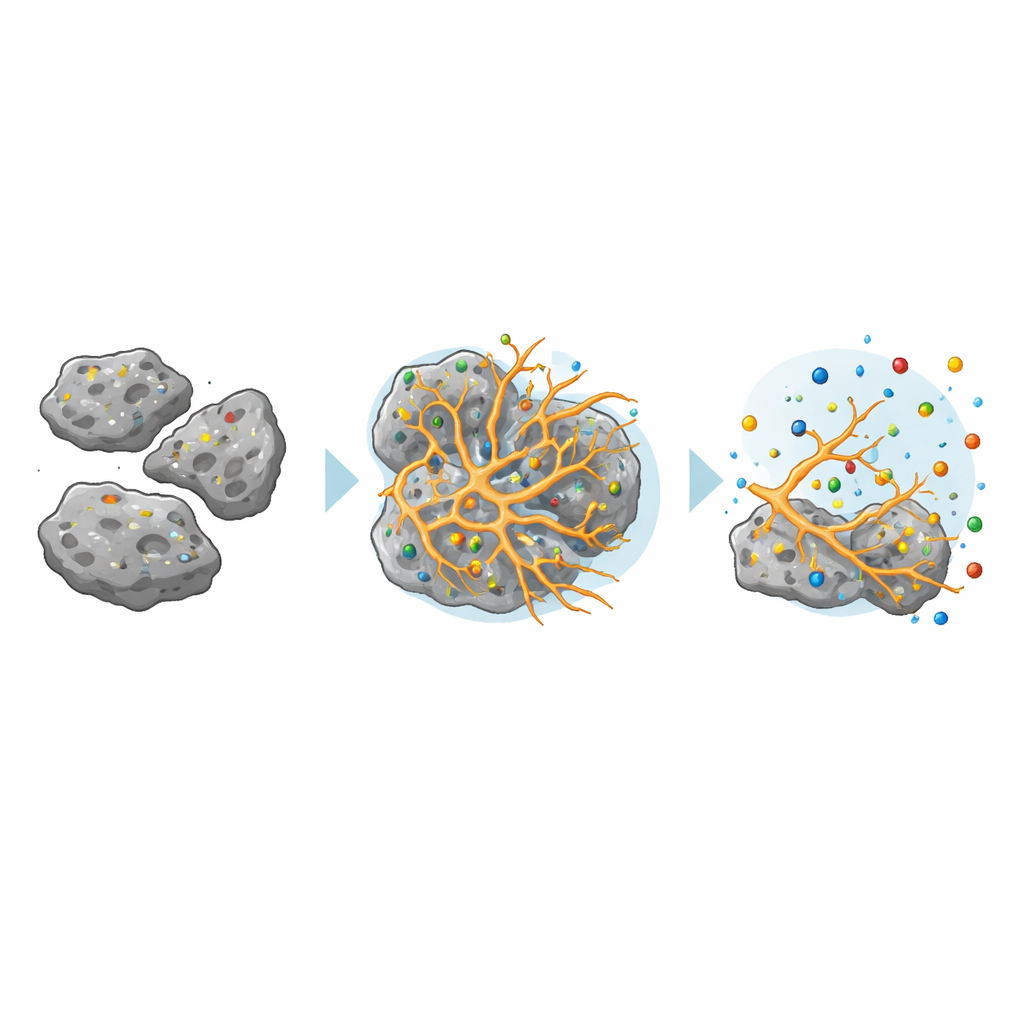
After the incubation, the researchers carefully collected the liquid around the rocks and measured 44 different elements that had leached out, with special attention to three platinum‑group metals: ruthenium, palladium, and platinum. They found that the fungus was the star performer in space. In microgravity, Penicillium simplicissimum greatly boosted the release of palladium—over five times more than in reactors without microbes—and also improved the extraction of ruthenium and platinum. The mixed community behaved mostly like the fungus alone, suggesting that the bacterium added little benefit and might even interfere for some elements. Interestingly, for many metals the non‑biological leaching (without microbes) changed in microgravity—sometimes becoming more effective, sometimes less—while the fungus’s performance stayed relatively stable or improved for specific valuable elements.
How Space Changes Microbial Chemistry
The study went beyond counting metals: it also probed how the microbes’ internal chemistry shifted in space. By analyzing small molecules in the surrounding liquid, the team showed that the fungus in microgravity produced a distinct set of compounds compared with Earth. Certain carboxylic acids and metal‑binding molecules were more abundant in space, and these may help dissolve rock or grab metals once they are released. The bacterium’s chemistry changed as well, but its impact on metal extraction was more modest. Microscopy revealed that both microbes formed biofilms or fungal threads that physically clung to meteorite grains in orbit, directly bridging the gap between living cells and alien rock.
What This Means for Future Space Settlements
For a lay observer, the headline result is simple: a common fungus can help free useful metals from asteroid‑like rock while floating in space. The actual metal yields in this small‑scale test would not make anyone rich—under the study’s conditions, the palladium recovered from a large tank would be worth only a few dollars. But for future astronauts trying to build and repair equipment far from Earth, the value lies in being able to tap whatever resources are already present, even if slowly and imperfectly. This work shows that carefully chosen microbes, paired with the right kind of rock and conditions, can keep working in microgravity and even adapt their chemistry to that environment. In the long run, such biological miners could form part of closed, sustainable systems that turn dead stone into metals, nutrients, and other essentials for life beyond our planet.
Citation: Santomartino, R., Rodriguez Blanco, G., Gudgeon, A. et al. Microbial biomining from asteroidal material onboard the international space station. npj Microgravity 12, 23 (2026). https://doi.org/10.1038/s41526-026-00567-3
Keywords: space biomining, asteroid resources, microgravity experiments, microbial leaching, platinum group metals