Clear Sky Science · en
Submarine medicine as an analog for spaceflight: a review of acute medical care
Bringing the Deep Sea to Deep Space
Imagine living for months sealed inside a metal tube, cut off from sunshine, fresh air, and quick access to a hospital. That is daily life for crews on nuclear submarines—and it will also be the reality for astronauts headed to the Moon and Mars. This review article asks a simple question with big consequences: what can doctors learn from decades of caring for sailors underwater to keep space travelers alive and healthy far from Earth?
Why Submarines Resemble Spaceships
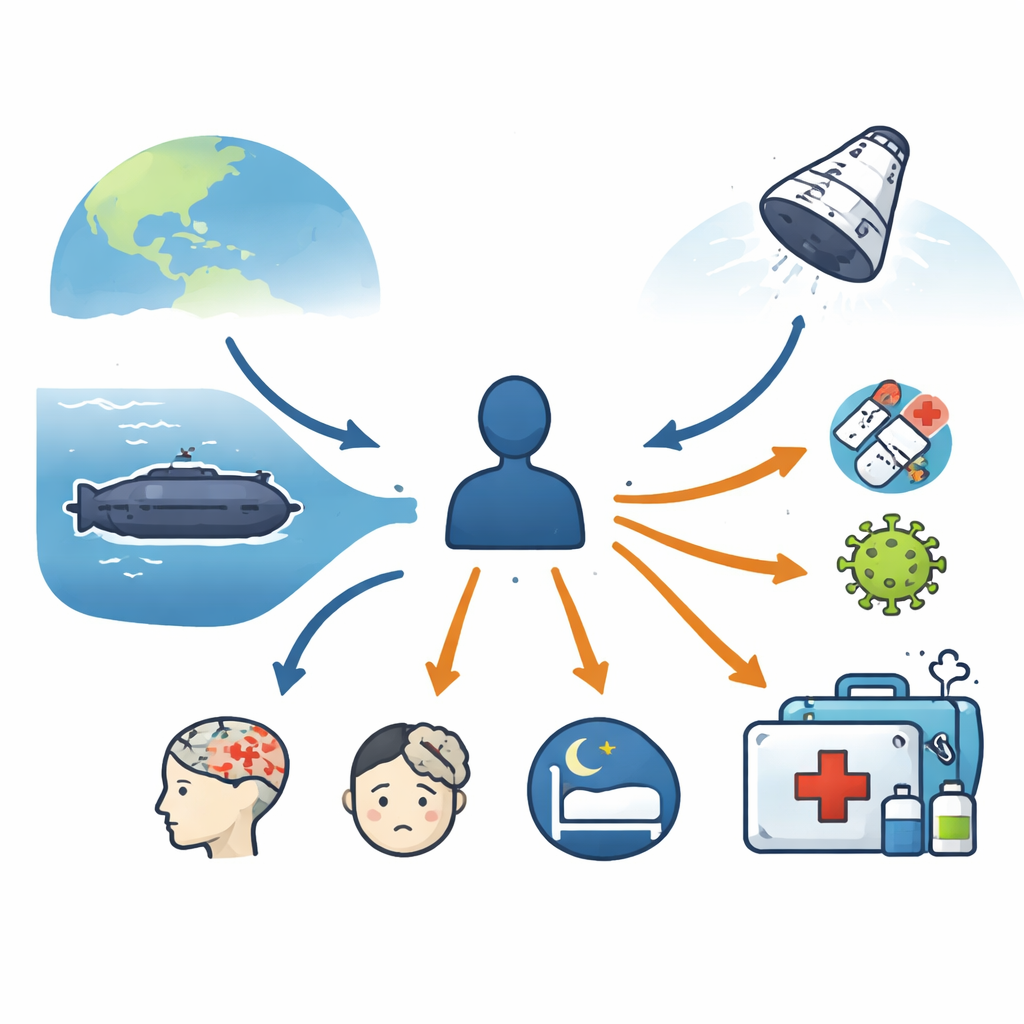
Both submarines and spacecraft are isolated, self-contained worlds where outside help is slow, difficult, or impossible to reach. Crews share tight quarters, breathe recirculated air, and must make do with limited medical staff and equipment. The authors sift through medical records from military submarines to map out what actually goes wrong during long missions—everything from broken bones and infections to stress and sleep problems. By comparing these patterns to known risks in space, they argue that submarine medicine is a powerful real-world testbed for designing medical systems for future lunar and Martian voyages.
Everyday Ailments and Rare Emergencies
Submarine data show that injuries and orthopedic problems are among the most common serious issues, more frequent than psychiatric diagnoses. Respiratory infections—especially colds and sinus problems—often sweep through crews early in a patrol, helped by crowded living spaces and recycled air. Many of these illnesses are mild and handled with painkillers, decongestants, or simply rest, but they still sap performance. Minor troubles like headaches, back pain, skin rashes, and toothaches are extremely common yet often go unreported, revealing a hidden medical burden that official statistics miss. The same pattern is likely in space: day-to-day discomforts rarely make headlines, but they can steadily erode attention, mood, and efficiency on long missions.
When You Cannot Call an Ambulance
Sometimes, problems on submarines become serious enough to justify surfacing and evacuating a sailor—despite the risk of revealing the vessel’s position. Studies show that such events are uncommon but not rare, driven by conditions like appendicitis, severe head injuries, kidney stones, and serious dental or mental health crises. In space, evacuation is far harder; a spacecraft en route to Mars cannot simply turn around and rush home. That reality raises the stakes for early diagnosis, solid treatment plans, and clear decision-support tools that help crews manage emergencies on their own. Even deaths, though very rare on submarines, highlight the need to safely handle human remains in confined habitats—an issue NASA has already begun to tackle for spaceflight.

Doing More with Limited Medical Tools
Underwater, a single highly trained medical technician typically cares for the entire submarine crew and can perform only minor procedures such as draining abscesses or removing small growths. Yet crews still face conditions—like appendicitis, fractures, and severe burns—that would normally demand full surgery. Submarine medicine has responded by mastering non-surgical treatments, for example using antibiotics to control appendicitis, which succeed most of the time but not always. Space agencies, meanwhile, have experimented with focused surgical training for non-surgeons, compact operating facilities, simplified anesthesia, laparoscopy, and even robotic tools. The authors argue that these space-focused innovations could be adapted for submarines, and that navies’ experience with non-physician providers can, in turn, inform medical cross-training for astronauts.
Living Healthy in a Sealed World
Health in these sealed environments depends on far more than pills and scalpels. Submariners struggle with calorie-dense diets and fading supplies of fresh food, low vitamin D from lack of sunlight, and limited space for exercise. They endure disrupted sleep schedules without a natural day–night cycle and often serve on watch patterns that clash with their internal clocks, leading to fatigue and mood changes. Recirculated air can build up carbon dioxide, causing headaches and dulled thinking. Isolation and monotony take a toll on mental health, following a recognizable arc from early anxiety through mid-mission boredom to pre-arrival restlessness. Similar challenges already affect astronauts, and will intensify on multi-year journeys, underscoring the need for better sleep planning, lighting, exercise systems, air control, and meaningful work and recreation to keep minds engaged.
Joining the Lessons of Depth and Distance
By treating submarines as a dress rehearsal for deep-space travel, this review concludes that the most pressing medical needs are not exotic diseases but familiar problems made harder by distance and confinement. Injuries, infections, minor aches, and mental strain will all accumulate as missions grow longer, while true surgical emergencies and rare events, though infrequent, can be mission-defining. The authors suggest building on submarine practice by cross-training more crew in medical and psychological care, strengthening on-board surgical options, tracking everyday self-managed health issues, and improving drug stability for deep space. In doing so, the lessons learned in the silent depths of the oceans can help protect human explorers as they push farther into the silent heights of space.
Citation: Prucka, A.P., Shelhamer, M. & Cordero, R.J.B. Submarine medicine as an analog for spaceflight: a review of acute medical care. npj Microgravity 12, 20 (2026). https://doi.org/10.1038/s41526-026-00566-4
Keywords: submarine medicine, spaceflight health, autonomous medical care, long-duration missions, extreme environments