Clear Sky Science · en
Gravity-dependent rate sensitivity in granular intrusion: microgravity experiments and simulations
Why moving through sand in space matters
Imagine driving a rover across the Moon or pulling a buried cable on Mars: every wheel, leg, or tool has to push through soil made of loose grains. On Earth we know fairly well how sand and gravel push back, but in low gravity those rules can change dramatically. This study explores how hard it is for an object to move through a bed of plastic beads under normal gravity and under near‑weightless conditions, revealing that “space sand” can behave much more like a thick liquid than like the familiar soil under our feet.
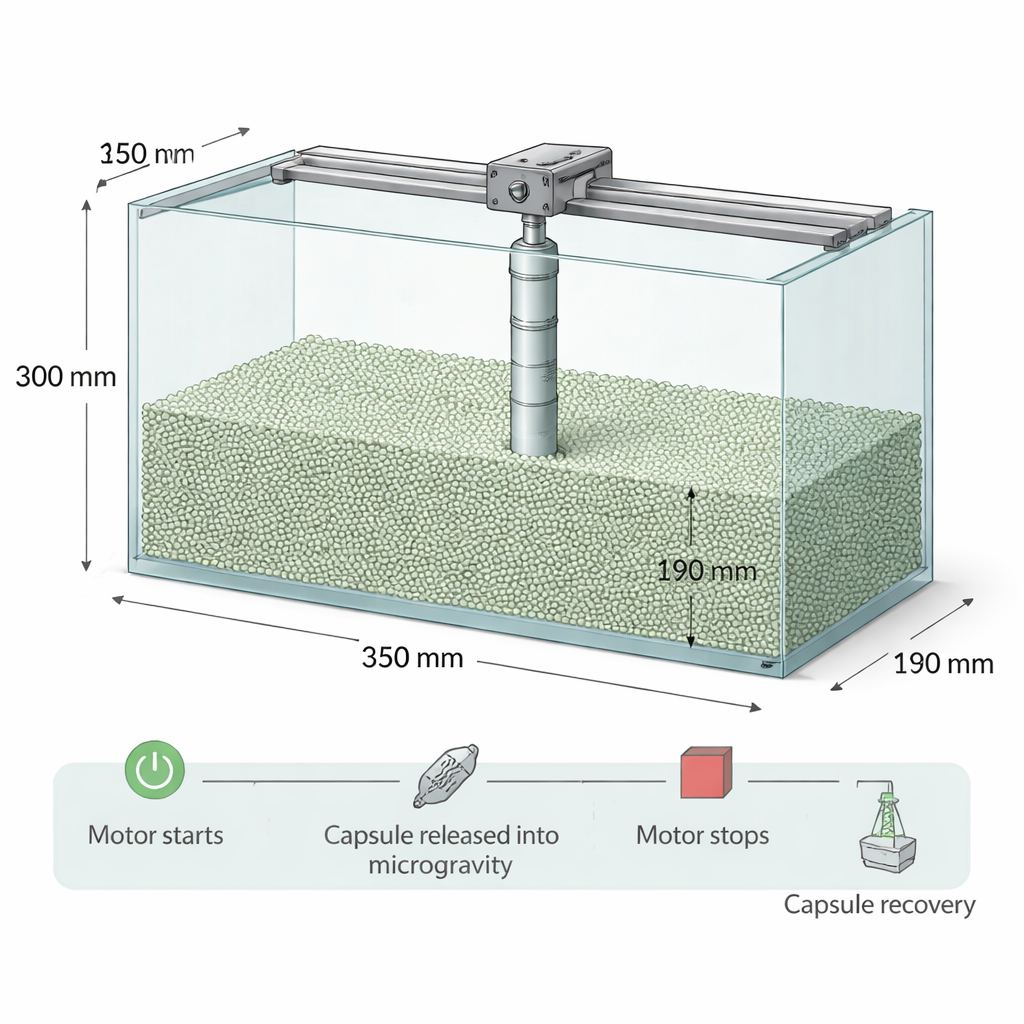
Digging into grains with a falling lab
To test this, the researchers built a clear box filled with small polypropylene beads, standing in for sand. A metal cylinder, instrumented with eight tiny force sensors along its length, hung down into the grains. A motor pulled the cylinder sideways at controlled speeds, a bit like dragging a rod through a sandbox. The key trick was where they ran the experiment: inside a capsule dropped down a 116‑meter tower in Beijing. During each 3.6‑second fall, gravity inside the capsule dropped to about one‑thousandth of Earth’s gravity, letting the team compare measurements made just before the drop (normal gravity) with those taken during the fall (microgravity).
How the grains pushed back
The team measured how strongly the grains resisted the moving cylinder at several depths and speeds ranging from 35 to 100 millimeters per second. Under normal gravity, the total resisting force was fairly large—about 7 to 9 newtons—and changed very little with speed. It did, however, increase nearly linearly with depth, because deeper grains are squeezed more by the weight above them. In microgravity, the picture flipped: the resisting force dropped by roughly two orders of magnitude, to a few hundredths of a newton, but now it grew strongly with speed. As the cylinder moved faster in near‑weightlessness, the grains flowed more vigorously and the resistance increased by a factor of about 2.5 over the tested range.
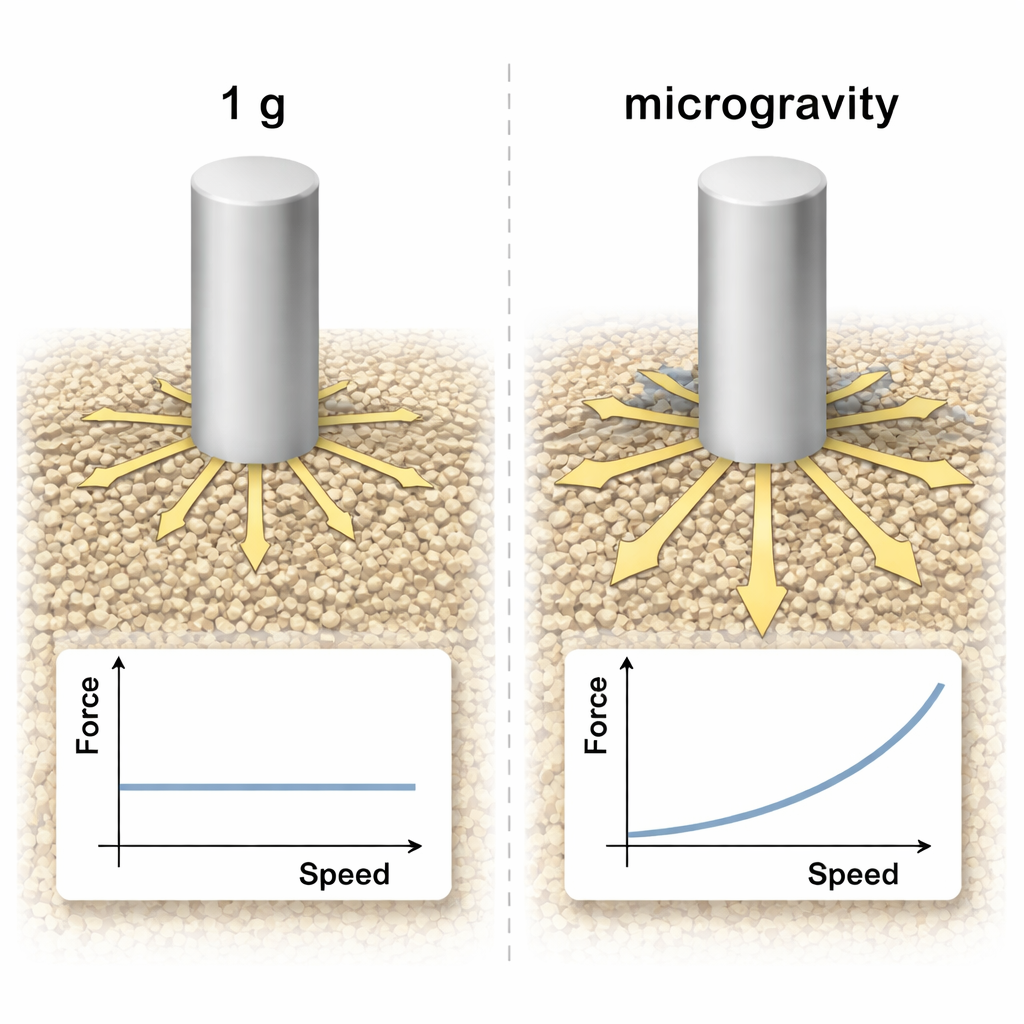
Virtual grains and hidden internal forces
To understand why the response changes so much when gravity is reduced, the researchers also created computer simulations that mirrored the experiment’s geometry. They used a numerical method that treats the grains as a continuous material while tracking large deformations around the moving cylinder. Inside this framework they implemented a rheology model—a set of rules—that splits the internal stress into a “quasi‑static” part, which dominates when grains press strongly on each other, and a “viscous” part, which becomes important when the material flows more easily. The model is governed by an “inertial number,” which compares how quickly grains are sheared to how strongly they are pressed together. In microgravity, with very low internal pressure, this number grows much larger, pushing the material into a more fluid‑like regime.
What happens inside the moving sand
The simulations showed that, in normal gravity, motion around the cylinder remains confined and relatively stiff: grain speeds and shear rates are concentrated close to the intruder, and the quasi‑static component of stress dominates. In microgravity, the disturbed region spreads much farther, grain speeds are higher over a wider zone, and the viscous part of the stress becomes a much larger share of the total. Maps of grain speed, shear rate, and internal pressure confirmed that the bed becomes markedly more “fluid” when its own weight is almost eliminated. Although the simulated forces in microgravity were somewhat lower than those measured in the lab, the overall patterns and the strong dependence on speed matched well, hinting that additional ingredients—such as detailed local rearrangements of grains—could further refine the models.
What this means for worlds beyond Earth
In simple terms, the study shows that when gravity is weak, loose granular materials behave less like a solid pile of sand and more like a slow, thick liquid whose resistance grows with how fast you push through it. On Earth, the weight of overlying grains keeps the material in a mostly solid‑like state, so pushing faster does not change the resisting force very much. In microgravity, the loss of weight allows grains to flow more freely, making speed matter far more. These insights are crucial for predicting how spacecraft, rovers, drills, and buried infrastructure will interact with lunar or Martian soils, and they point to the need for different design rules and soil models for operations in the low‑gravity environments of future space exploration.
Citation: Hou, M., Cheng, X., Yang, S. et al. Gravity-dependent rate sensitivity in granular intrusion: microgravity experiments and simulations. npj Microgravity 12, 19 (2026). https://doi.org/10.1038/s41526-026-00563-7
Keywords: microgravity, granular flow, planetary soil, intrusion forces, lunar and Martian regolith