Clear Sky Science · en
Influence of low gravity on the penetration resistance of lunar regolith
Digging on the Moon Is Harder Than It Looks
As space agencies plan to build bases and mine resources on the Moon, they will need to drill, dig, and anchor equipment in lunar soil. Many engineers have assumed that this digging would be easier than on Earth because lunar gravity is only one-sixth as strong. This study shows that the reality is more complicated: lunar soil can still push back strongly against tools, and that hidden resistance could make future missions much more challenging than expected.
Why We Care About Lunar Soil Strength
Past missions from Apollo to Chang’e have repeatedly run into trouble when trying to drill or collect core samples on the Moon. Tools jammed, corers stopped short, and sample masses fell below expectations, all because the soil resisted penetration more than engineers had planned for. With upcoming missions envisioning permanent bases and local use of lunar materials for building and manufacturing, understanding how the soil behaves under low gravity is no longer a curiosity—it is a design necessity for landers, rovers, and construction equipment.
Creating Moon-Like Gravity in the Lab
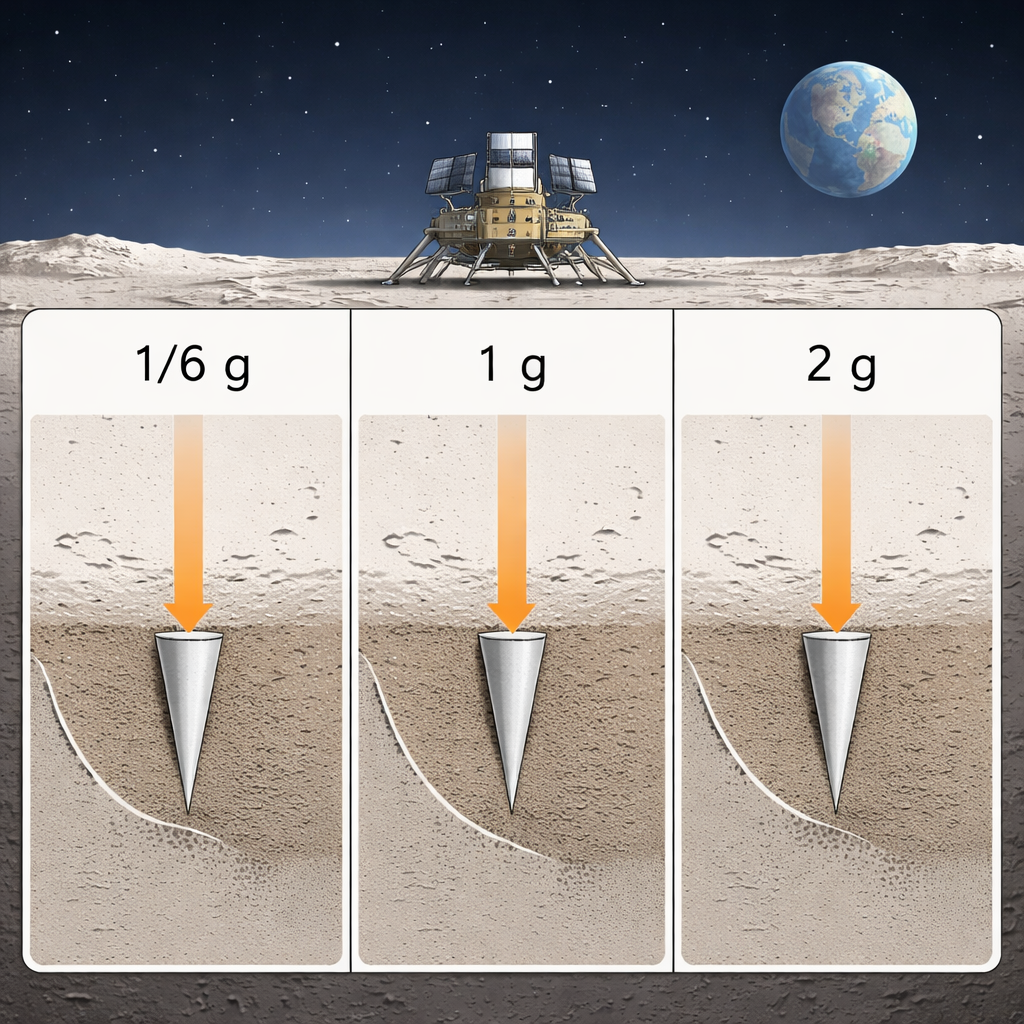
Testing soil under true lunar gravity is surprisingly difficult. Drop towers and special aircraft can briefly mimic low gravity, but only for a few seconds—far too short for slow, realistic drilling. The researchers tackled this problem using a magnetic levitation system that can effectively cancel part of Earth’s gravity for specially prepared magnetic lunar soil simulant. By adjusting magnetic forces, they recreated three conditions in the laboratory: Moon-like gravity (1/6 g), normal Earth gravity (1 g), and a stronger-than-Earth case (2 g). They then pushed a standard cone-shaped probe slowly into the simulated lunar soil at different packing levels, measuring how strongly the soil resisted.
How Soil Still Pushes Back in Weak Gravity
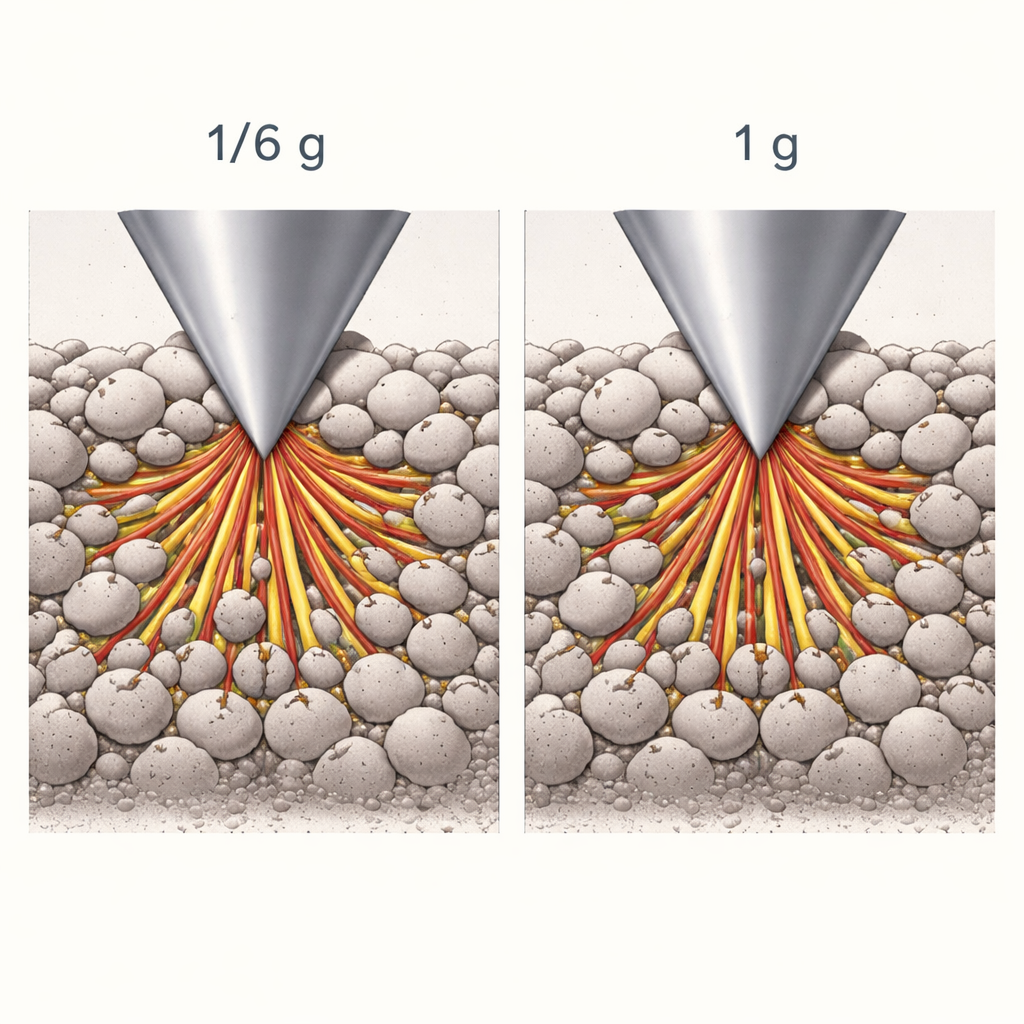
As expected, the basic penetration resistance—the simple push-back force on the cone—became smaller when gravity was reduced. But when the researchers compared this resistance to the weight of the overlying soil, they found something surprising: a “normalized” resistance that actually became larger as gravity decreased, especially when the grains were packed tightly. To understand why, they used computer simulations that track how thousands of individual particles press on one another. These simulations showed networks of strong contacts, called force chains, forming beneath and around the probe. Even under low gravity, rough, irregular grains lock together and create sturdy load paths that can effectively support the tool. Gravity adds extra pressure from above, but the locking and friction between particles do much of the work—and these do not weaken nearly as much as the weight does when gravity drops.
What This Means for Future Moon Machines
Because the particles in real lunar soil are sharp, rough, and densely packed at depth, they are especially good at interlocking and building strong force chains. The study suggests that on the Moon, the resistance faced by a drilling or sampling tool will not fall in proportion to the lower weight of the equipment. In fact, when gravity is cut to one-sixth, the soil may still offer almost the same level of push-back as on Earth in many practical cases. The authors estimate that a rover would need to weigh at least a few hundred kilograms on Earth just to push a cone 15 centimeters into dense lunar regolith—and in reality, even more mass or special anchoring may be needed to keep the vehicle from lifting or slipping.
Takeaway for Lunar Exploration
For non-specialists, the key message is straightforward: low gravity does not guarantee easy digging. The Moon’s soil behaves like a tightly interlocked skeleton of grains that can strongly resist tools, even when the overall weight of the soil is low. Future missions will need smarter designs—such as narrower drills, self-hammering or self-burrowing devices, and better ways to anchor rovers—to overcome this hidden strength of lunar regolith and make safe, reliable construction and resource extraction on the Moon a reality.
Citation: Chen, J., Li, R. & Fu, S. Influence of low gravity on the penetration resistance of lunar regolith. npj Microgravity 12, 18 (2026). https://doi.org/10.1038/s41526-026-00562-8
Keywords: lunar regolith, low gravity drilling, cone penetration tests, moon base construction, soil mechanics in space