Clear Sky Science · en
Label-free blood cell separation for space health monitoring using a portable blast cell biochip
Why a Space-Age Blood Test Matters
As humans plan longer journeys to the Moon and Mars, keeping astronauts healthy far from Earth’s hospitals becomes a pressing challenge. One major concern is blood cancer, particularly acute myeloid leukemia (AML), which can be triggered by the intense radiation in space. This article describes a compact “lab-on-a-chip” device that can quickly sort blood cells without bulky machines or special dyes, offering a path toward simple, real-time blood checks on board spacecraft and in remote clinics on Earth.
A Tiny Spiral That Sorts Blood
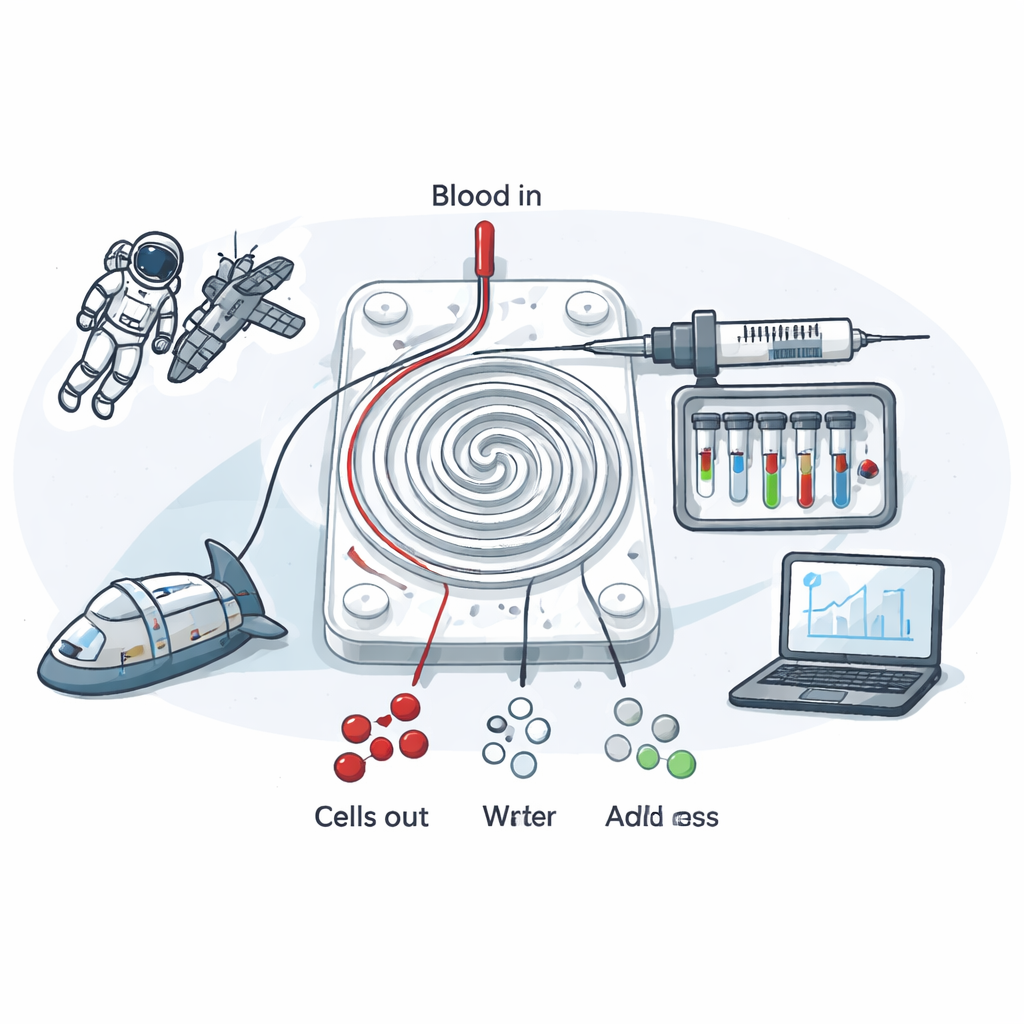
At the heart of the study is a palm‑sized plastic chip patterned with a spiral-shaped channel thinner than a human hair. When a small amount of blood is pushed through this spiral, the flowing liquid generates gentle forces that nudge different cells into different paths depending on their size and stiffness. Red blood cells, ordinary white blood cells, and larger abnormal cells all “choose” different streamlines as they swirl through the curve. Unlike standard hospital machines that rely on fluorescent labels and complex optics, this chip works without added chemicals, making it simpler, cheaper, and easier to automate.
Built for Harsh and Remote Environments
Traditional technologies such as fluorescence-activated cell sorting (FACS) are powerful but large, power-hungry, and require expert operators. That is impractical on a space station, a lunar base, or in small field hospitals. Spiral microfluidic chips, by contrast, are compact, consume little energy, and use only tiny volumes of blood and reagents. They are well suited to the constraints of microgravity and tight spacecraft cabins. The same features make them attractive for rural clinics and emergency settings on Earth, where access to full-scale laboratories is limited but quick, reliable diagnostics are still vital.
Putting the Chip to the Test
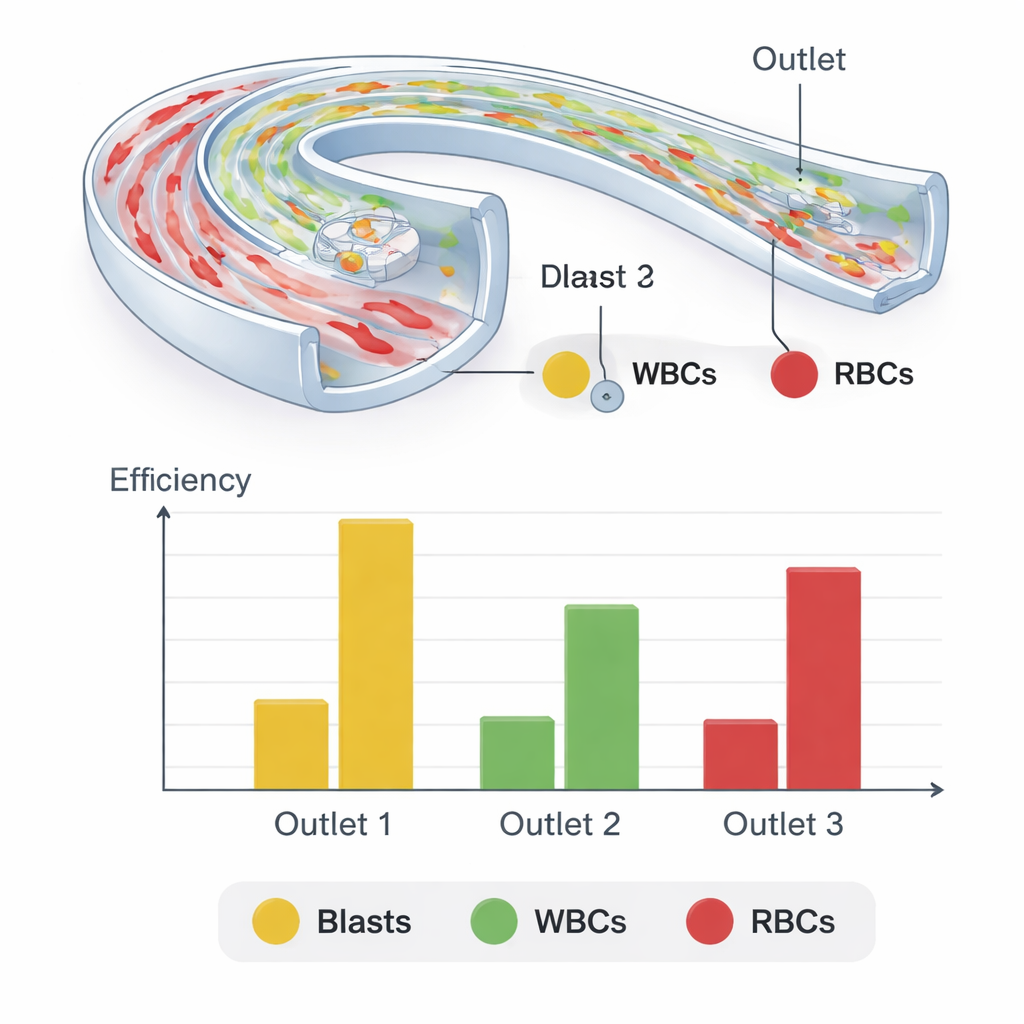
The researchers repurposed a commercial spiral chip, originally designed to sort generic particles, and showed it could cleanly separate real blood cells. Using a version with nine spiral turns and six outlets, they first ran blood from healthy donors. Smaller, flexible red blood cells drifted toward outlets farther from the inlet, while larger white blood cells exited through nearer outlets. The chip captured more than 90% of white cells in the intended outlet and over 80% of red cells in another, all at a modest flow rate that preserved cell integrity. This confirmed that the size-based separation worked reliably without staining or complex preparation.
Hunting Leukemia Cells in a Drop of Blood
The team then moved to a tougher test: blood from patients with acute myeloid leukemia, which contains many large, abnormal “blast” cells. In samples dominated by blasts, the chip concentrated these pathological cells mainly in one outlet, reaching about 83% separation efficiency, comparable to the yield of high-end FACS instruments. Healthy lymphocytes, which are smaller, spread more evenly across outlets, showing that the device could enrich the dangerous cells while leaving the normal ones less disturbed. Computer simulations of the fluid flow and particle paths closely matched the experimental results, differing by less than 1%, reinforcing confidence that the underlying physics is well understood and predictable.
From Lab Bench to Spaceship
To make the approach truly space-ready, the authors outline future steps: shrinking and automating the pumps, integrating smart sensors to analyze the sorted cells directly on-chip, and testing performance in actual microgravity. Even in its current form, the work demonstrates that a relatively simple spiral channel can separate healthy from diseased cells rapidly and without labels. For non-specialists, the key message is that sophisticated cancer-related blood tests may soon come from a disposable chip instead of a room full of equipment, enabling astronauts—and people in remote or resource-poor regions—to have their blood monitored frequently, catching dangerous changes early and improving the chances of timely treatment.
Citation: Mugnano, M., Cerbone, V., Villone, M.M. et al. Label-free blood cell separation for space health monitoring using a portable blast cell biochip. npj Microgravity 12, 17 (2026). https://doi.org/10.1038/s41526-026-00561-9
Keywords: microfluidic blood chip, astronaut health, acute myeloid leukemia, cell separation, space radiation