Clear Sky Science · en
Microgravity-induced constraints on melanin bioproduction: investigating E. coli metabolic responses aboard the international space station
Why Space Factories Need Microbes
As humans plan longer missions to the Moon and Mars, we cannot haul everything from Earth. One promising solution is to turn microbes into tiny "factories" that make materials, medicines, and other essentials on demand. This study asks a deceptively simple question with big consequences: if we reprogram bacteria to make a useful pigment called melanin in space, do they behave the same way they do on Earth—or does microgravity quietly sabotage our microbial factories?
Testing Bacterial Pigment Makers in Orbit
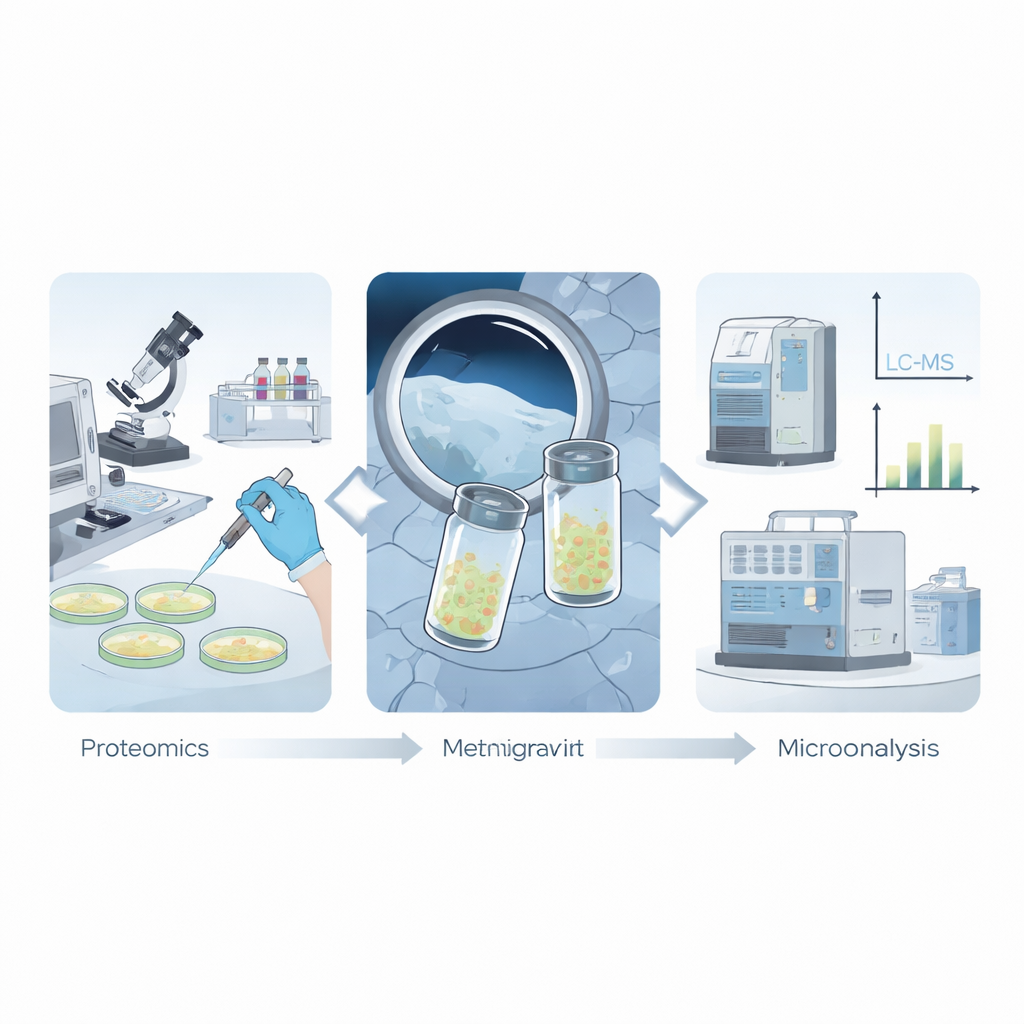
To explore this, researchers engineered the common lab bacterium Escherichia coli to produce melanin, a dark pigment that naturally protects many organisms from radiation and other stresses. Melanin is easy to see and measure, making it a good test product for space biomanufacturing. The team loaded the engineered E. coli onto special petri plates inside sealed hardware canisters designed for flight on the International Space Station (ISS). Identical hardware stayed on the ground as a control. After launch, an astronaut injected growth medium into the plates and incubated them at body temperature for three days before freezing them for return to Earth. Back in the lab, the scientists compared color, chemistry, proteins, and small molecules from the space and ground samples.
Less Color in Space, but the Machinery Still Works
When the plates came home, the difference was visible at a glance. On Earth, the engineered bacteria produced a deep black pigment, while their ISS counterparts were only light brown, showing that melanin production in space was much lower. Yet, when the researchers examined the key enzyme that makes melanin—the protein tyrosinase—they found it was present at similar levels in both groups and still active. Cell extracts from ISS samples rapidly turned black once warmed on Earth. This meant the basic melanin-making machinery inside the bacteria had survived spaceflight and still worked; the problem lay elsewhere in the process.
A Traffic Jam in Nutrients and a Stressed Metabolism
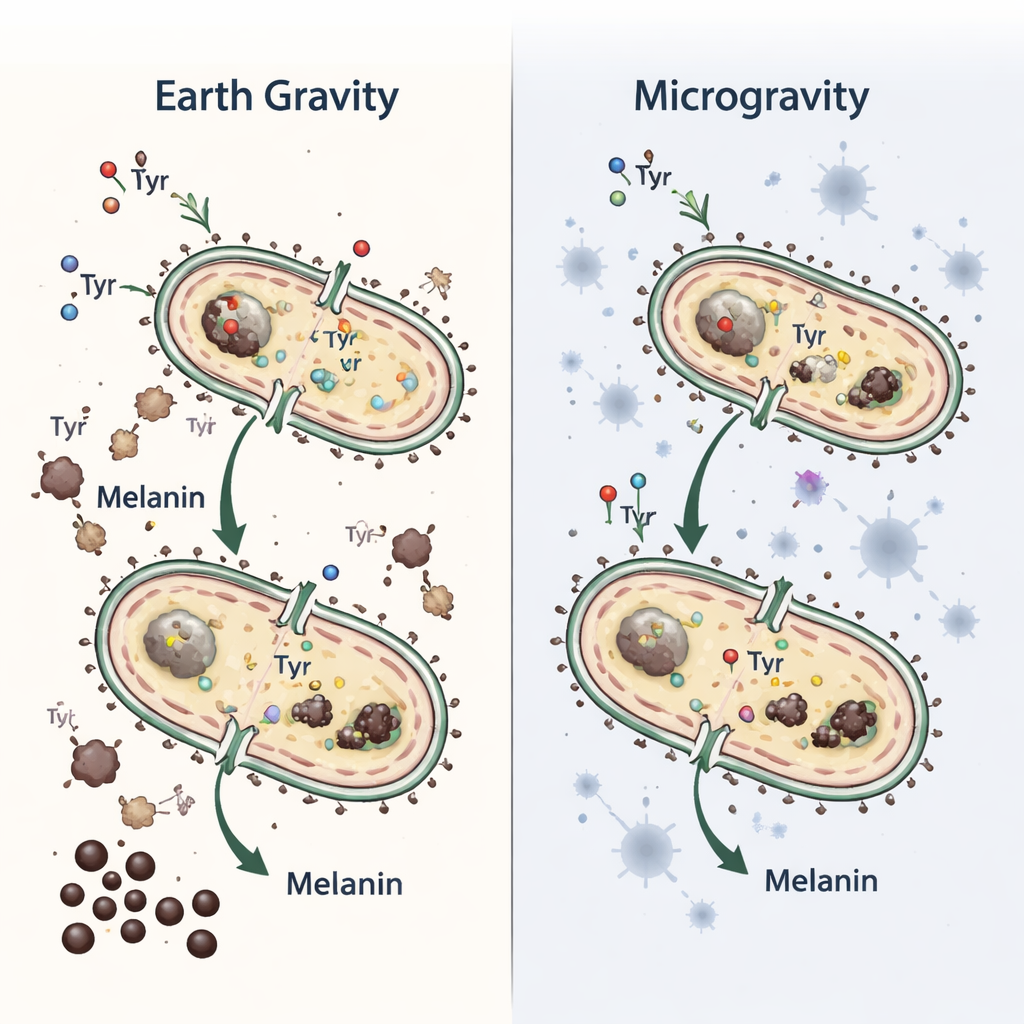
The team then looked at the chemical “traffic” surrounding the cells. Melanin is made from the building block tyrosine, which must cross the cell’s outer layers before the enzyme can act on it. Using an electrochemical technique, they found that ISS cultures had much more unused tyrosine outside the cells than ground cultures. In other words, the enzyme wasn’t starved, but the tyrosine wasn’t getting where it needed to go. Ground-based experiments in a rotating bioreactor that mimics low gravity told a similar story: under simulated microgravity, bacteria produced less melanin in the liquid around them, and much of the pigment stayed trapped in dark cell pellets, as if it could not be exported efficiently.
Spaceflight Pushes Cells into Survival Mode
To understand why transport and pigment release might be disrupted, the researchers turned to large-scale protein and metabolite profiling. In ISS-grown cells, many membrane transport proteins were more abundant, hinting that the bacteria were trying to compensate for poor nutrient movement in microgravity, where fluids do not mix as they do on Earth. At the same time, numerous stress-response proteins linked to low oxygen and damaging reactive molecules were turned up, along with DNA repair factors. Metabolites that signal stress, such as the sugar trehalose, rose, while important protective molecules like glutathione fell. Together, these changes paint a picture of cells under oxidative and nutrient stress that are reallocating resources to survival rather than to making extra pigment.
Rethinking Microbial Factories for Space
For a layperson, the takeaway is that space does not simply slow bacteria down; it changes how they move nutrients, manage energy, and decide what is worth making. Even with the right gene inserted, the engineered E. coli on the ISS produced much less melanin because microgravity and related stresses interfered with tyrosine uptake, pigment export, and the cell’s overall redox balance. The authors conclude that to build reliable "living factories" for long missions, engineers must go beyond designing efficient enzymes. They will also need to improve nutrient transport, manage stress responses, and perhaps use new reactor designs or motile microbes that can stir their own surroundings—so that biology can work as hard for us in orbit as it does on Earth.
Citation: Hennessa, T.M., VanArsdale, E.S., Leary, D. et al. Microgravity-induced constraints on melanin bioproduction: investigating E. coli metabolic responses aboard the international space station. npj Microgravity 12, 16 (2026). https://doi.org/10.1038/s41526-026-00560-w
Keywords: space biomanufacturing, microgravity, engineered bacteria, melanin production, International Space Station