Clear Sky Science · en
Fluid shifts are main drivers for microgravity simulation-induced immune-physiological changes: findings from the VIVALDI studies
Why space changes our bodies
As humans prepare for longer journeys to the Moon and Mars, one big question looms: how does near-weightlessness affect our health, especially our defenses against infection? Real space missions are rare and expensive, so scientists use clever Earth-based stand-ins to mimic weightlessness. This study used one of the most realistic models—called “dry immersion”—to watch how body fluids and the immune system change over just five days in healthy women and men, and to see whether those changes differ by sex.
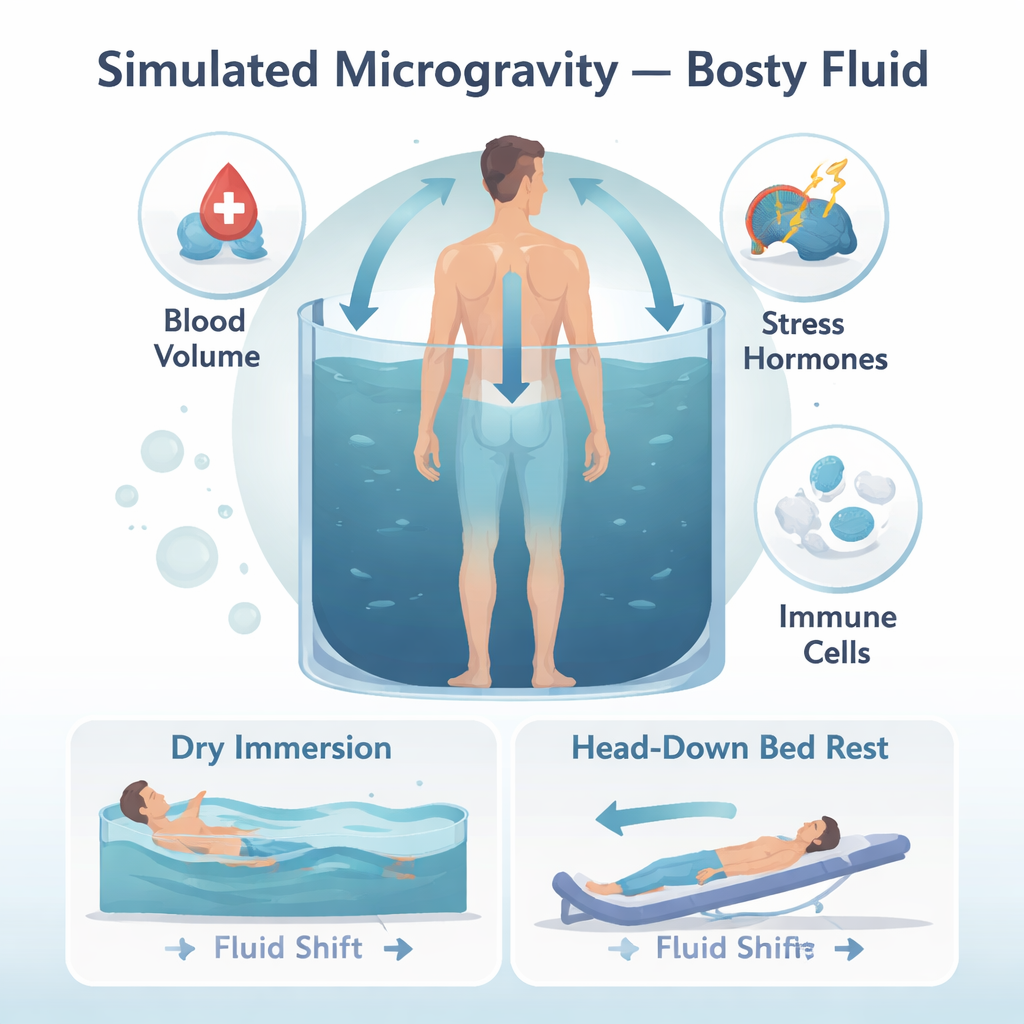
A bathtub that mimics weightlessness
In dry immersion, volunteers lie in a warm water tank, wrapped in a waterproof fabric so they don’t actually get wet. Buoyancy removes almost all pressure from under the body, a bit like floating in midair. This support-free state causes body fluids—blood and other liquids—to shift from the legs toward the chest and head, much as they do in orbit. The VivalDI studies immersed 18 women and 19 men for five continuous days. The researchers measured blood cells, chemical messengers of the immune system, stress hormones, and simple fluid markers before immersion, on days three and five, and again after participants got out and started moving normally.
Immune cells on the move
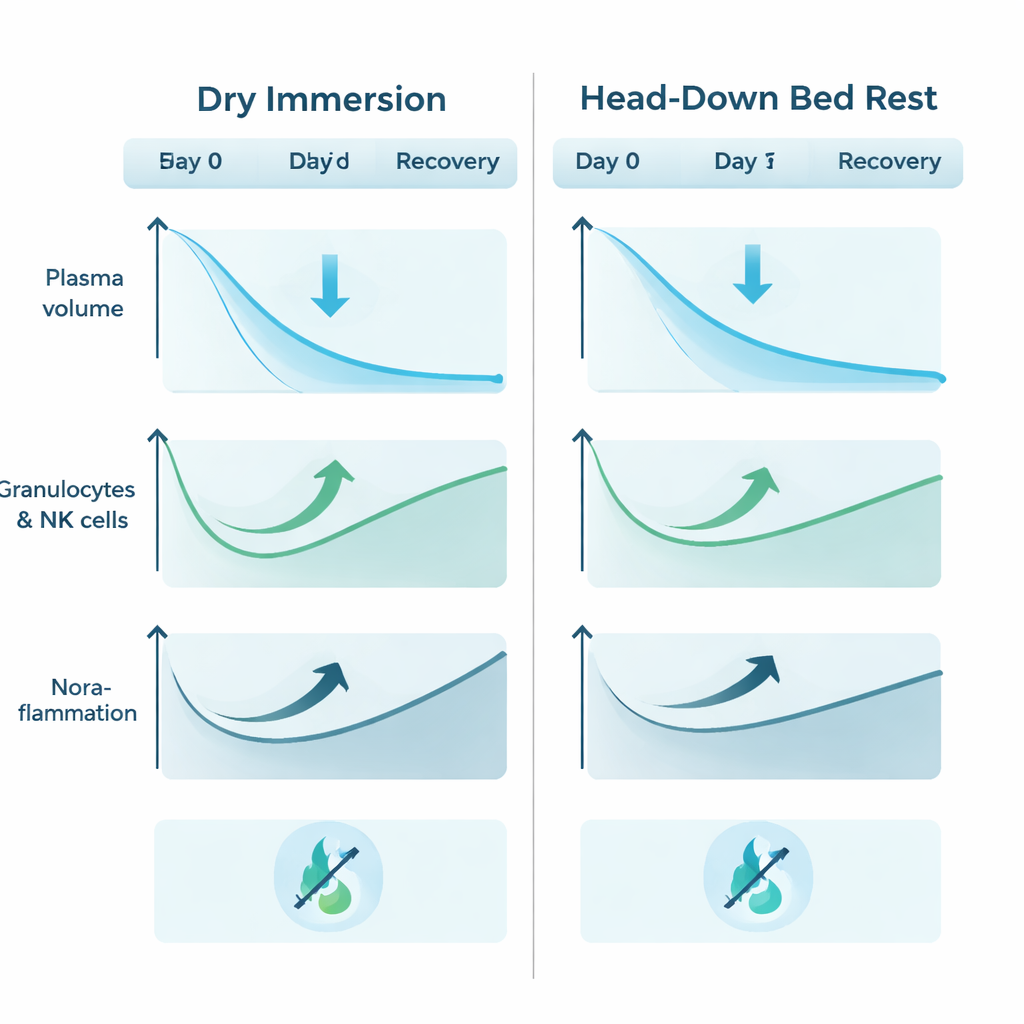
During immersion, the mix of circulating white blood cells shifted in a striking but balanced way. Numbers of granulocytes and natural killer (NK) cells—front-line defenders that respond quickly to threats—rose in both women and men, peaking around the middle or toward the end of the five days. At the same time, T cells, which provide more targeted immune responses, temporarily dipped. Chemical signals associated with inflammation nudged upward but stayed at very low levels, and an overall inflammation marker in the blood remained normal. In short, the immune system clearly reacted to the new environment, but it did not tip into full-blown inflammation.
Stress signals and hidden viruses
The team also looked for signs that the body’s stress systems might be driving these immune changes. Classic stress hormones such as cortisol and two related steroids (DHEA and DHEA-S) stayed within normal ranges. Another stress chemical, noradrenaline, did climb in both sexes—but with a twist. In men, it rose early during immersion and stayed elevated, while in women it stayed low until after immersion, then jumped as they returned to normal standing and walking. To probe how well the immune system was really coping, the researchers measured the shedding of two common “passenger” viruses, Epstein–Barr virus and Torque Teno virus, which often reappear when defenses are weakened. Epstein–Barr showed only small changes, but Torque Teno virus increased in the saliva of about two-thirds of the women, compared with only one in five men, hinting at subtle sex-linked differences that were not yet explained.
Fluid shifts as the main culprit
One of the clearest findings was a substantial drop in plasma volume—the liquid part of blood—in both women and men during immersion, along with a more negative water balance: people drank less, yet kept producing similar amounts of urine. These changes signal that the body was reacting to what it “felt” as fluid overload in the upper body by getting rid of circulating fluid. To test whether these shifts, rather than weightlessness itself, were the main drivers of immune changes, the researchers compared their male volunteers with another group of men who had spent five days in a head-down tilt bed rest, another standard spaceflight analogue. Both groups showed some immune shifts, but the dry-immersion group had stronger changes in fluid volume, bigger rises in granulocytes and NK cells, and higher noradrenaline. Markers of cell activation suggested a mild, reversible “alert” state of the immune system rather than true sickness.
What this means for future space travelers
For non-specialists, the bottom line is reassuring but important. In this short, five-day simulation of microgravity, men and women showed broadly similar immune and stress responses, and no clear harmful sex-specific effects emerged. The data suggest that the quick reshuffling and loss of body fluids—rather than mysterious direct effects of weightlessness—are the main triggers of the immune shifts seen here. Understanding this points engineers and physicians toward practical countermeasures, such as better fluid management and cardiovascular training, to protect crews on long missions. Longer studies and more detailed tests of immune function will be needed, but these findings move us closer to sending diverse crews safely deeper into space.
Citation: Moser, D., Bareille, MP., Ombergen, A.v. et al. Fluid shifts are main drivers for microgravity simulation-induced immune-physiological changes: findings from the VIVALDI studies. npj Microgravity 12, 15 (2026). https://doi.org/10.1038/s41526-025-00555-z
Keywords: spaceflight, microgravity, immune system, dry immersion, fluid shifts