Clear Sky Science · en
Determining the grain orientations of battery materials from electron diffraction patterns using convolutional neural networks
Why tiny crystal angles matter for better batteries
Inside the rechargeable batteries that power phones and electric cars, energy flows through forests of microscopic crystals. How these crystals are tilted and stitched together can make the difference between a long‑lasting, safe battery and one that fades or fails. This study explores a faster, more reliable way to read those tiny crystal orientations using artificial intelligence, offering a path toward designing better battery materials more efficiently.
Seeing order in a maze of crystals
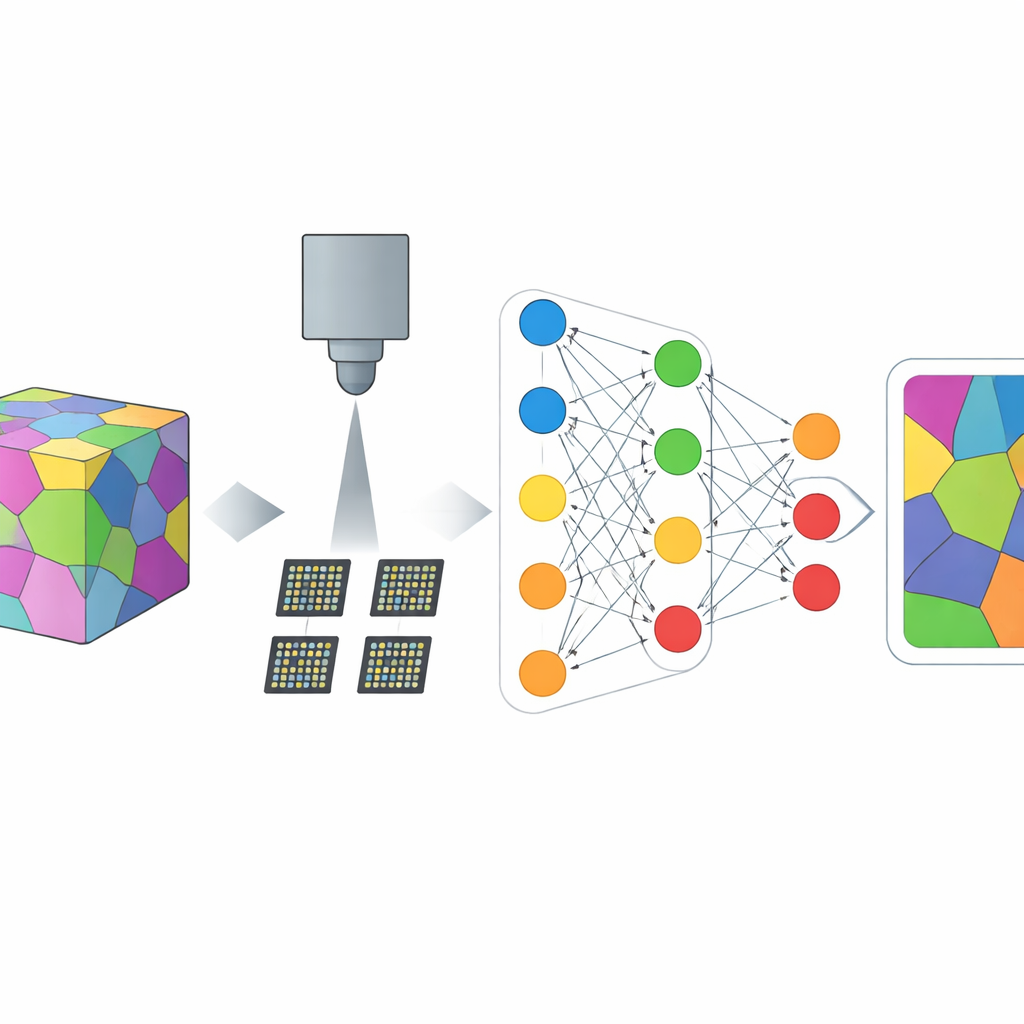
Modern energy devices, such as lithium‑ion batteries and fuel cells, are often made from polycrystalline materials: dense packings of many small grains, each a tiny crystal with its own orientation. The way these grains are aligned and how their boundaries meet strongly affects how ions and electrons move, and thus how well a device performs. Scientists can probe this hidden structure with transmission electron microscopy, which sends an electron beam through an ultra‑thin slice of material. At each point, the electrons scatter into a spot pattern that encodes the crystal’s orientation. By scanning across the sample, they build up a four‑dimensional dataset of positions and patterns that, in principle, can reveal the full internal map of grain orientations.
The bottleneck of traditional pattern matching
Until now, turning those dense datasets into orientation maps has relied on template matching. In that approach, each experimental diffraction pattern is compared against a huge library of simulated patterns, and the best match is taken as the orientation. To keep the library manageable, these reference patterns are usually calculated with simplifying assumptions that ignore subtle, so‑called dynamical effects in the scattering. The method can work well, but it is sensitive to noise, variations in sample thickness, background differences, and calibration choices. It is also slow and computationally hungry, making it hard to use routinely for large areas or for experiments that track how materials change in real time.
Teaching a neural network to read diffraction fingerprints
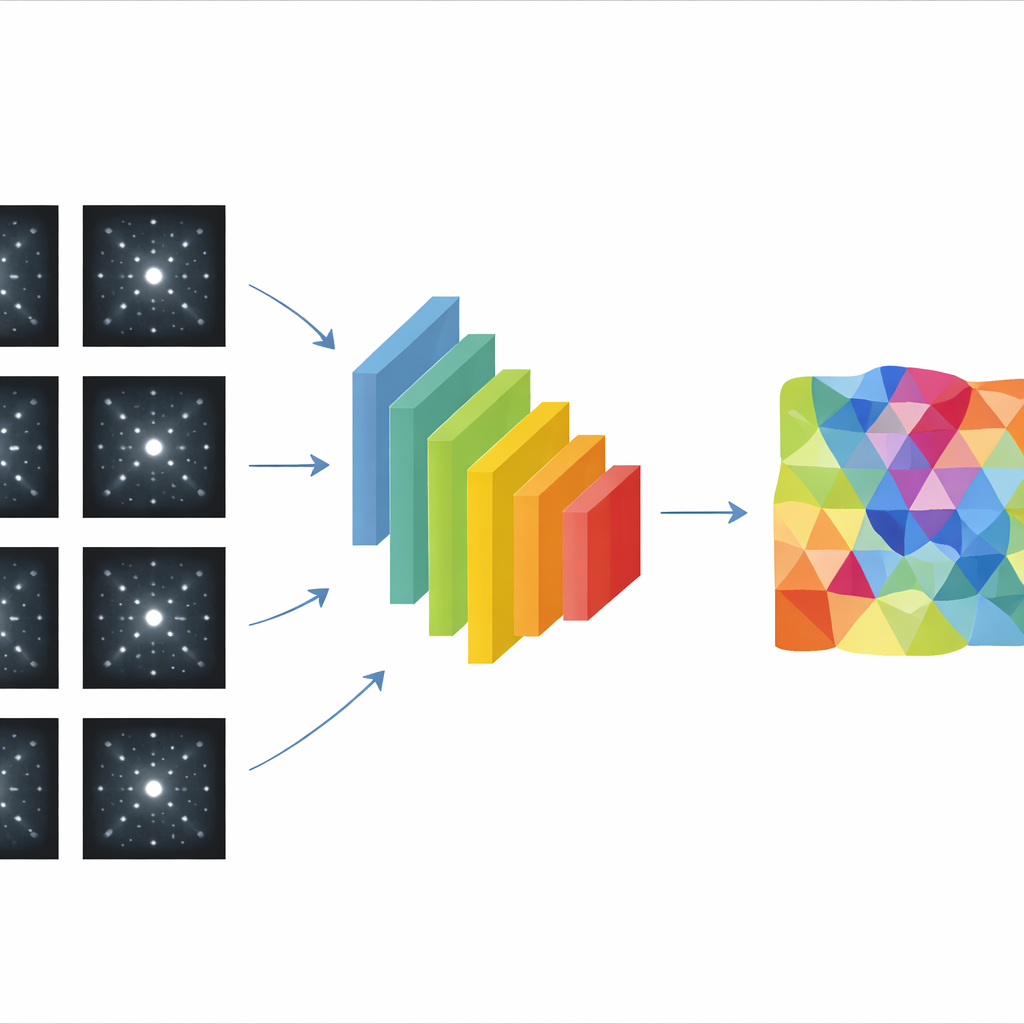
The authors propose replacing explicit pattern matching with convolutional neural networks, a type of artificial intelligence specialized for images. Instead of storing millions of reference patterns directly, the network learns the underlying relationships between diffraction spot intensities and crystal orientation. They focus on LiNiO2, a promising cathode material for lithium‑ion batteries, and create synthetic training data by simulating diffraction patterns across the full range of possible orientations. Crucially, these simulations include dynamical scattering, capturing delicate intensity variations that traditional libraries often neglect. The team tests both “classification” networks, which assign each pattern to one of many discrete orientation classes, and “regression” networks, which attempt to predict the three orientation angles as continuous values.
Pushing accuracy and speed while handling symmetry
By carefully choosing how to sample orientation space, the researchers show that classification networks trained on evenly spaced orientations perform best. On simulated test data, their best model approaches the accuracy of a state‑of‑the‑art commercial template‑matching program, even though the latter sees a perfectly clean, noise‑free ideal case. When evaluated on real diffraction data from LiNiO2 grains, the neural networks generate orientation maps that agree closely with the reference software, while revealing where crystal symmetries make certain orientations hard to distinguish. Because the networks were trained on fully dynamical simulations, they can exploit tiny intensity differences that standard, simplified simulations miss, allowing them to tell apart orientations that would otherwise look almost identical.
From overnight calculations to near real‑time insight
One of the most striking findings is speed. For a dataset of 40,000 diffraction patterns, the traditional template‑matching workflow required nearly two hours of computation on a powerful workstation, plus substantial manual effort to tune filters and calibration settings. Once trained, the neural networks processed the same dataset in under two minutes—more than a 95% reduction in analysis time—without the need for hand‑crafted preprocessing. This shift moves most of the computational cost into a one‑time training phase and opens the door to using orientation mapping in high‑throughput studies and in experiments that watch battery materials evolve during charging and discharging.
What this means for future battery research
For non‑specialists, the core message is that the authors have turned a slow, expert‑driven imaging step into an automated, fast, and accurate tool. By teaching neural networks to read the diffraction fingerprints of LiNiO2 grains, they show that artificial intelligence can capture subtle physics while dramatically accelerating analysis. This approach can be adapted to other materials and extended to predict additional properties, such as local thickness or the presence of disordered regions. Ultimately, such tools may help researchers rapidly screen new battery chemistries and follow how their internal crystal landscapes change over time, shortening the path from fundamental experiments to better, more reliable energy‑storage technologies.
Citation: Scheunert, J., Ahmed, S., Demuth, T. et al. Determining the grain orientations of battery materials from electron diffraction patterns using convolutional neural networks. npj Comput Mater 12, 115 (2026). https://doi.org/10.1038/s41524-026-02002-3
Keywords: battery materials, electron diffraction, neural networks, grain orientation, transmission electron microscopy