Clear Sky Science · en
Debye-Callaway model simulator: an interactive slider-based program for fitting theoretical and experimental lattice thermal conductivity
Turning Waste Heat into Useful Power
Every day, cars, factories, and power plants throw away vast amounts of heat. Thermoelectric materials promise to capture some of that lost energy and turn it directly into electricity. But to work well, these materials must carry electrical current easily while blocking heat flow through their crystal lattice. This article describes a new way to understand and tune how heat moves inside such materials, using an interactive computer tool that makes a formerly specialist-only theory accessible to almost any researcher.
Why Blocking Heat Is So Hard
In solid materials, heat is largely carried by tiny vibrations of the atoms, often pictured as waves or particles called phonons. To build better thermoelectrics, scientists try to slow these phonons down without harming electrical transport. They do this by deliberately introducing different kinds of imperfections—such as extra atoms, missing atoms, nanoscale inclusions, and grain boundaries—that scatter phonons like rocks and bends scatter water in a stream. The challenge is that many kinds of defects often exist at once, and they interact in complex ways. As a result, it is very difficult to tell which defects are doing the most to cut heat flow and which are having only a minor effect.
A Classic Theory with a Modern Makeover
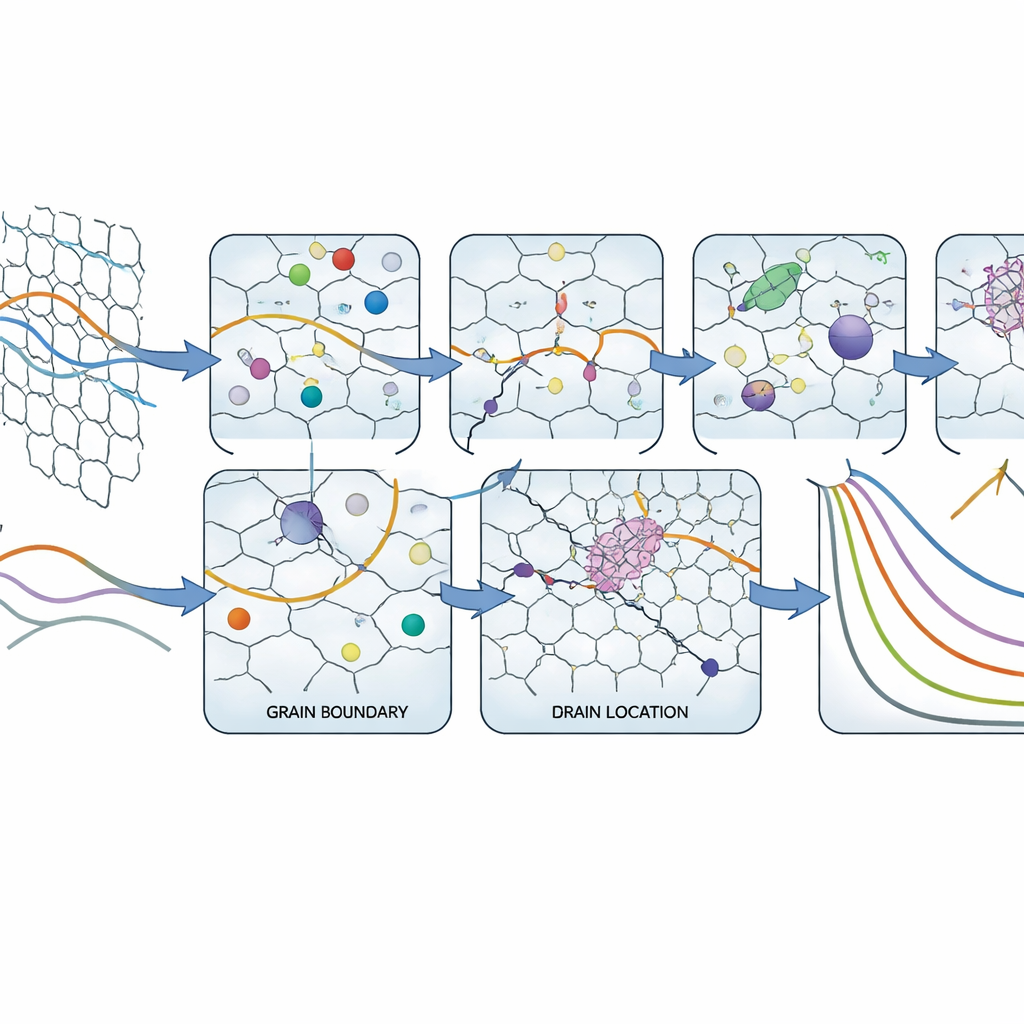
For decades, a powerful mathematical framework called the Debye–Callaway model has offered a way to calculate how different scattering processes combine to set the lattice thermal conductivity—the part of heat flow due purely to atomic vibrations. The model can handle nine major scattering mechanisms, including normal phonon collisions, more disruptive Umklapp events, scattering from grain boundaries, point defects, nanoinclusions, vacancies, dislocations, and interactions between phonons and electrons. In principle, this gives a detailed map linking microstructure to heat transport. In practice, the equations are complicated, require many input parameters, and demand programming skills and careful numerical fitting. This has limited routine use of the model, especially in experimental labs focused more on making and measuring materials than on coding.
Hands-On Heat Flow: The Slider-Based Simulator
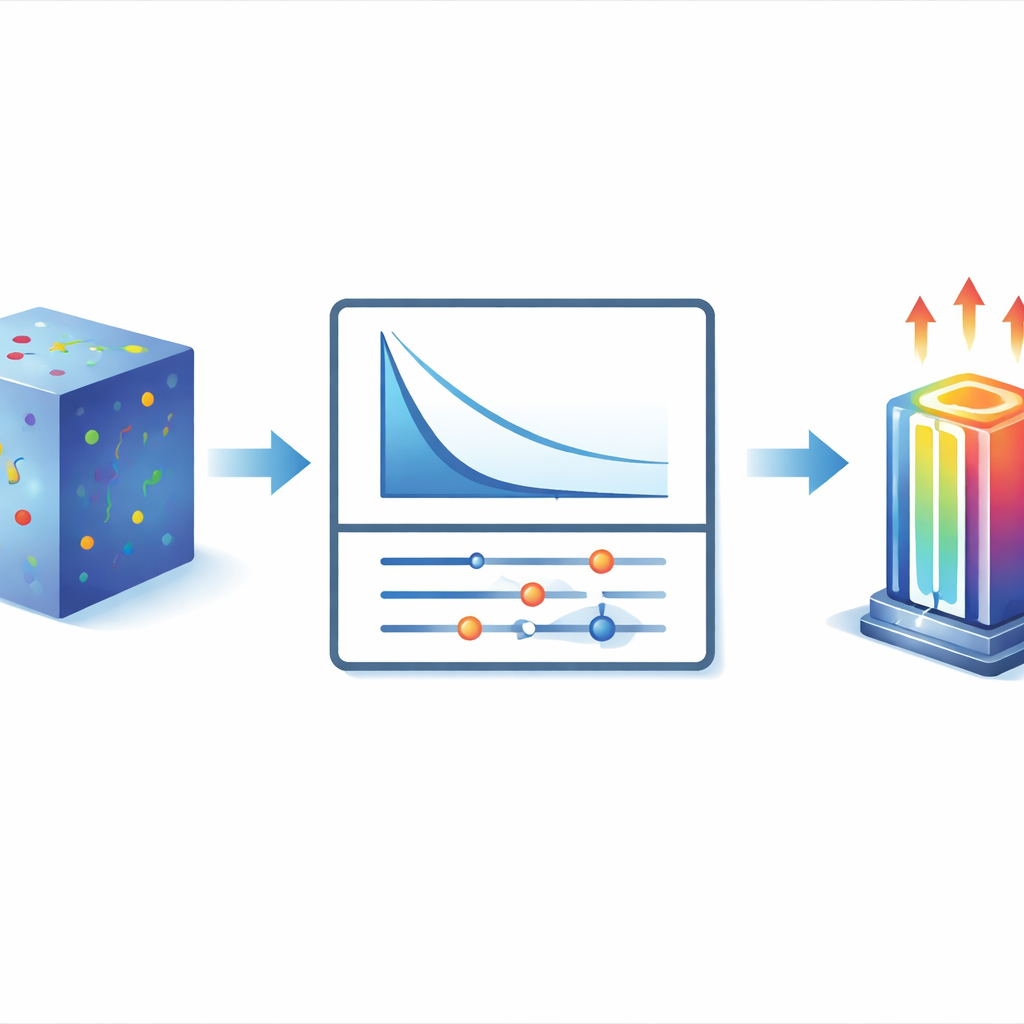
To bridge that gap, the authors created a standalone, slider-driven Debye–Callaway simulator. Users paste in their measured temperature and thermal conductivity data, enter known material properties such as grain size, sound velocity, and defect concentrations, and then explore how theory matches experiment in real time. Each scattering mechanism has an associated set of controls: checkboxes to turn it on or off, textboxes for measured quantities, and sliders for a small number of fitting parameters that represent the strength of each type of phonon scattering. As the sliders move, the calculated conductivity curve updates instantly on screen and is compared directly to experimental points. Built-in safeguards prevent unphysical inputs, while an automatic fitting routine searches for parameter combinations that best match the data and reports a statistical goodness-of-fit.
Seeing Inside Complex Materials
The power of this approach is demonstrated on three important thermoelectric families: GeTe, SnTe, and NbFeSb. In each case, the program helps untangle how different microscopic features—such as removed vacancies, added alloying atoms, nanoscale precipitates, or reduced grain size—contribute to the overall drop in lattice thermal conductivity. For GeTe-based samples, the tool shows that eliminating certain native vacancies would actually increase heat flow unless compensated by strong scattering from newly introduced alloy atoms and enhanced anharmonic vibrations. In SnTe alloys, it reveals that earlier studies had likely overestimated the strength of strain-related scattering, and that nanoinclusions play a much larger role than previously appreciated. For NbFeSb half-Heusler alloys, the simulator quantifies how much of the heat-flow reduction comes from extra point defects, how much from smaller grains, and how much from subtle changes in phonon–phonon interactions.
Building a Design Map for Future Materials
By packaging a complex theory into an intuitive visual tool, this work turns abstract phonon-scattering concepts into something researchers can explore directly and systematically. Scientists can now estimate the relative impact of different defects, identify hidden modelling errors, and even predict how much additional heat suppression might be achieved by adjusting grain size or defect content before doing new experiments. Over time, fitting many datasets with this simulator can populate a shared "defect strength" library that links specific microstructural features to their thermal effects. For a lay reader, the bottom line is simple: this software helps engineers design smarter thermoelectric materials that waste less energy as heat, bringing practical heat-to-electricity technologies a step closer to widespread use.
Citation: Kahiu, J.N., Lee, H.S. Debye-Callaway model simulator: an interactive slider-based program for fitting theoretical and experimental lattice thermal conductivity. npj Comput Mater 12, 118 (2026). https://doi.org/10.1038/s41524-026-01992-4
Keywords: thermoelectric materials, lattice thermal conductivity, phonon scattering, Debye–Callaway model, defect engineering