Clear Sky Science · en
Layer-dependent and gate-tunable Chern numbers in 2D kagome ferromagnet Yb2(C6H4)3 with a large band gap
Why this tiny crystal could change electronics
Modern electronics waste a surprising amount of energy as heat when electric current bumps into resistance inside wires and chips. Physicists have been hunting for materials where current can flow along the edges with virtually no loss, even without a bulky magnet attached. This article explores a newly proposed two‑dimensional crystal, built from ytterbium and organic rings in a kagome (triangle‑and‑hexagon) pattern, that could host such lossless edge currents at relatively high temperatures and, crucially, lets engineers dial in how many independent edge “lanes” are available simply by stacking layers and applying an electric field.
A flat playground for special edge currents
The authors focus on a single atomic sheet of a metal‑organic compound called Yb2(C6H4)3. In this sheet, ytterbium atoms sit at the centers of triangles made from carbon rings, forming a repeating web of corner‑sharing triangles known as a kagome lattice. Using advanced computer simulations, they first show that this sheet is not just a mathematical toy: its atoms vibrate in stable patterns, it holds together at room temperature in molecular‑dynamics tests, and forming it from its ingredients is energetically favorable. These checks suggest that, although it has not yet been made in the lab, the material should be chemically and structurally realistic. 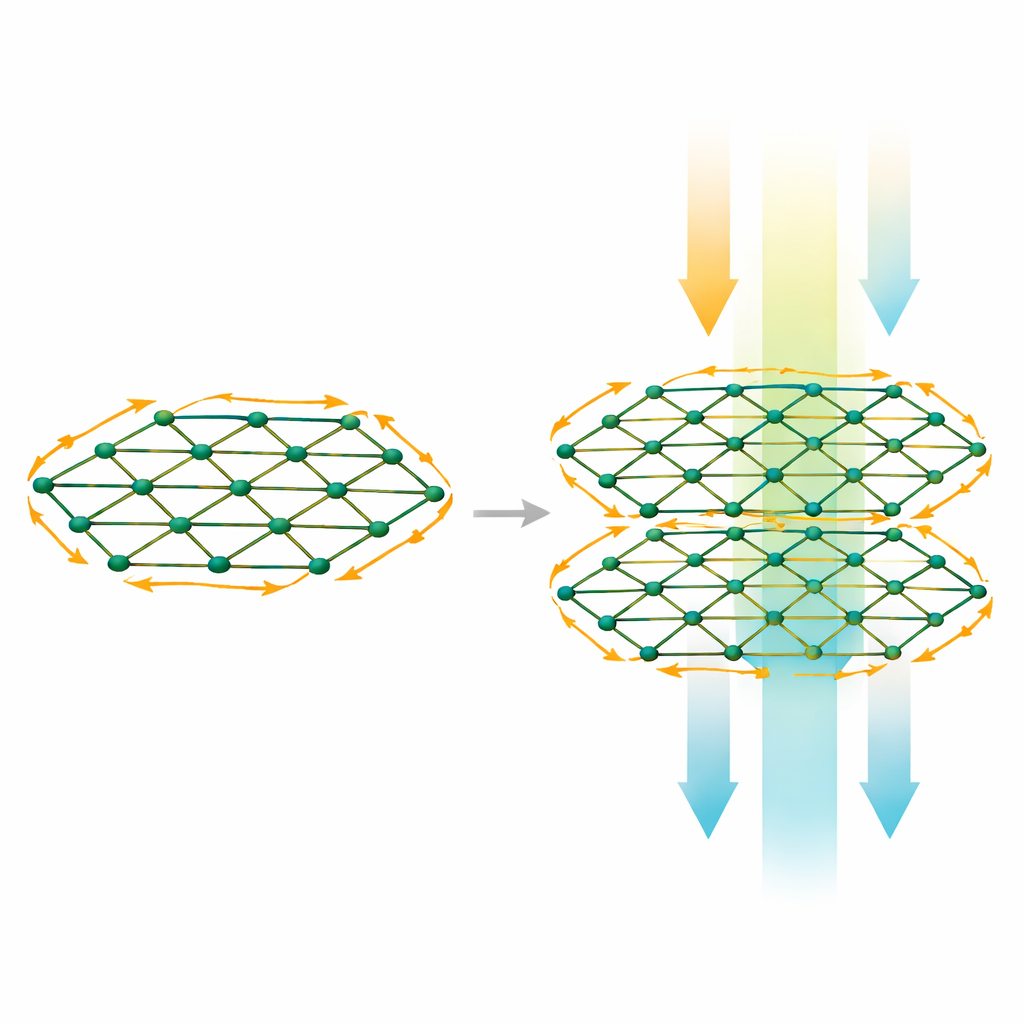
Magnetism opens a protected highway
In this monolayer, the electrons prefer to align their tiny magnetic moments in the same out‑of‑plane direction, making the whole sheet ferromagnetic. Without taking spin‑orbit coupling into account, the calculated electronic bands show spin‑polarized crossings at special points in momentum space, a hallmark of kagome systems. When spin‑orbit coupling is switched on, these crossings gap out, leaving a relatively large energy gap of about 0.1 electron volts. That may sound small, but for this class of materials it is sizable, implying the special edge behavior could persist up to around one hundred kelvin. By analyzing how the electronic wavefunctions twist through momentum space, and by building a simplified model that reproduces the full quantum‑mechanical results, the authors find that the monolayer carries a non‑trivial topological index known as a Chern number equal to one. This guarantees a single one‑way conducting channel along each edge, confirmed by calculations that explicitly show a lone chiral edge band bridging the gap between filled and empty states.
Adding layers to multiply edge lanes
The study then turns to what happens when two such sheets are stacked. Several stacking patterns are possible, but energy comparisons single out an “AB” arrangement as the most favorable. In this bilayer, the two sheets remain ferromagnetic and align in the same direction, with only slight buckling and a modest separation between them. Calculations of vibrational modes on a supportive boron nitride substrate indicate that the structure is dynamically stable. Electrically, the bilayer again shows kagome‑like band crossings that open into a gap once spin‑orbit coupling is included, this time somewhat smaller but still substantial. Crucially, the combined topology of the two layers now yields a Chern number of two. In physical terms, that means there are two parallel one‑way channels at each edge, as seen in the edge‑state spectra where a pair of chiral bands traverse the gap with the same direction of motion. The fact that the layers’ contributions simply add suggests that stacking more layers could further increase the number of edge lanes without destroying them.
Turning a knob with an electric field
Beyond stacking, the authors explore a more practical control knob: a voltage applied perpendicular to the bilayer, mimicking a gate electrode in a transistor. This out‑of‑plane electric field makes the two layers slightly inequivalent, shifting their electronic energies relative to each other. By encoding this shift into a tight‑binding model built from localized Wannier orbitals, and validating it against full quantum‑mechanical calculations, they track how the bands evolve as the field grows. At a critical field value, the gap briefly closes and reopens, signaling a topological phase transition. After this transition, the calculated Chern number jumps from two to three, meaning a third chiral edge channel has appeared. Edge‑state calculations indeed reveal three one‑way bands in the gap, all moving in the same direction. 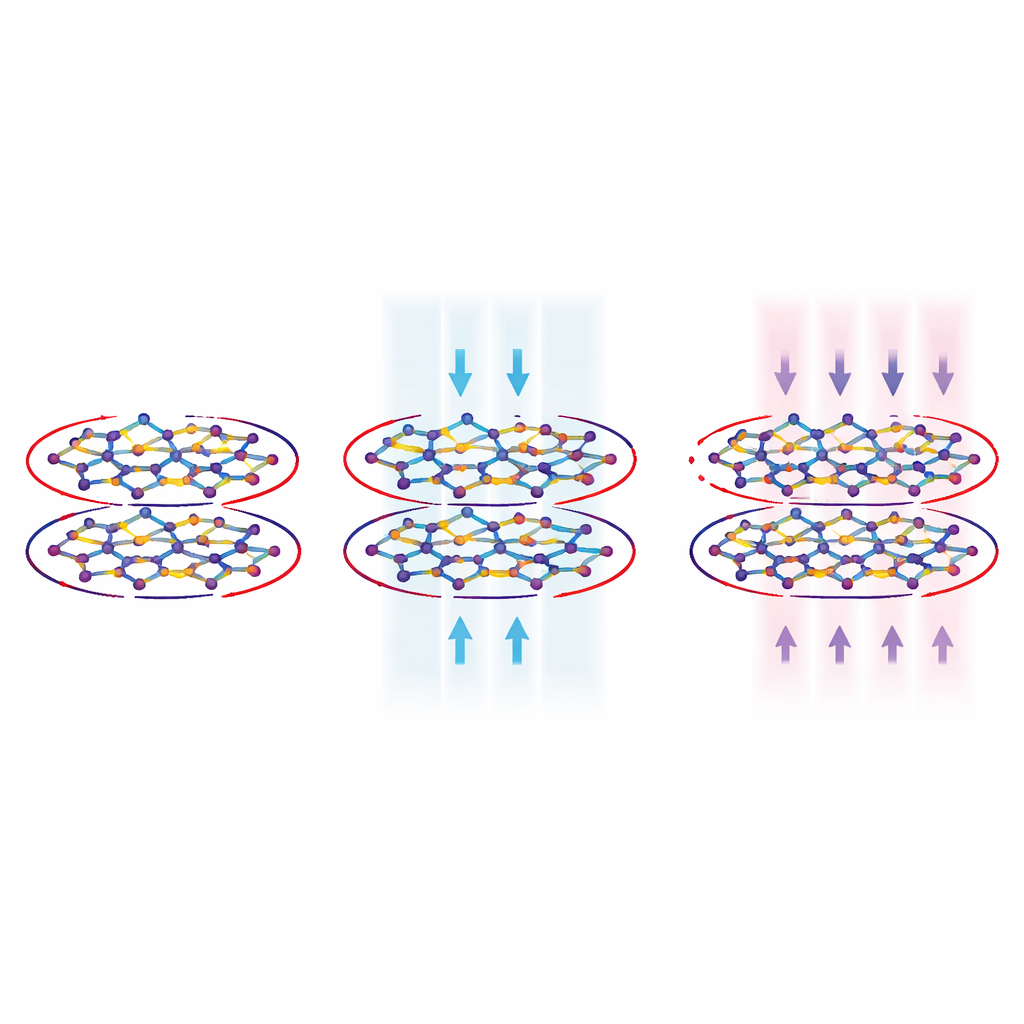
What this means for future devices
Taken together, these results paint Yb2(C6H4)3 as a promising candidate for next‑generation “topological” electronics. A single layer already supports a robust, loss‑resistant edge current protected by its quantum geometry. Stacking layers increases the number of independent edge lanes, potentially boosting how much current can flow without extra heating, while an ordinary gate voltage can switch the number of lanes in a bilayer from two to three on demand. Although the work so far is theoretical and awaits experimental confirmation, it outlines a practical recipe: use a stable kagome‑patterned magnetic sheet with strong spin‑orbit effects, stack it into few‑layer films, and use electric gating to reconfigure edge conduction. If realized in the lab, such materials could provide compact, low‑power components where information is carried by topologically protected edge currents rather than by conventional resistive wires.
Citation: Guo, J., Nie, S. & Prinz, F.B. Layer-dependent and gate-tunable Chern numbers in 2D kagome ferromagnet Yb2(C6H4)3 with a large band gap. npj Comput Mater 12, 111 (2026). https://doi.org/10.1038/s41524-026-01991-5
Keywords: quantum anomalous Hall effect, kagome materials, topological electronics, chiral edge states, electric field tuning