Clear Sky Science · en
Promising ferroelectric metal EuAuBi with switchable giant shift current
Why a Metal That Remembers Is Exciting
Imagine a metal that not only conducts electricity, like copper in a wire, but also “remembers” which way its internal electric dipoles point, much like bits in a computer memory. This paper reports exactly such a possibility in a compound called EuAuBi. Using advanced computer simulations, the authors argue that EuAuBi behaves as a rare kind of material known as a ferroelectric metal and at the same time can generate unusually strong electric currents when illuminated by light—features that could reshape low‑power electronics and light‑based devices.
A Crystal With a Built‑In Electric Push
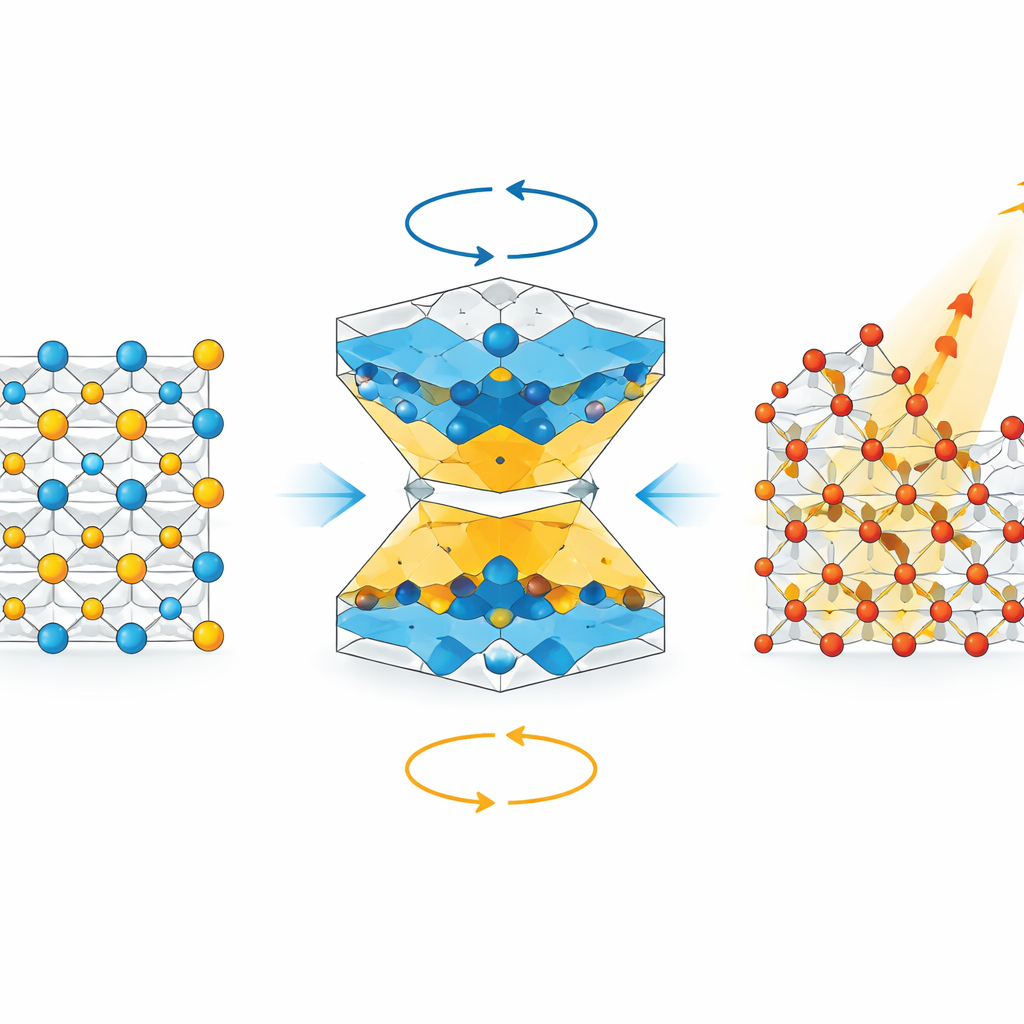
At the heart of the work is the idea of spontaneous polarization—an internal electric push that exists even with no external voltage applied. In ordinary ferroelectrics, this polarization can be flipped by an electric field, letting them serve as non‑volatile memory elements. Metals, however, usually cannot host this behavior because their mobile electrons screen away electric fields. EuAuBi appears to break this rule. The researchers show that slight vertical displacements of gold and bismuth atoms within its hexagonal crystal structure make the material lose its mirror‑like symmetry and develop a strong electric polarization pointing along one crystal axis. This built‑in polarization is calculated to be far larger than that of the only previously confirmed ferroelectric metal, suggesting a robust “electric personality” despite the material’s metallic nature.
Switching States Without Breaking the Metal
For a memory‑like material to be useful, its internal polarization must be switchable without excessive energy cost. The team explores how EuAuBi can transform between two mirror‑image states with opposite polarization. They track the energy landscape along a path that moves atoms from one state to the other, finding a double‑well profile with a moderate barrier in between. This barrier is much smaller than that of classic ferroelectric insulators, implying that a realistic electric field could flip the polarization while the material remains metallic. Calculations of the lattice vibrations show that an unstable “soft” motion of gold and bismuth atoms is responsible for the transition, confirming that the polar behavior is rooted in a specific collective shift of atoms rather than in subtle electronic effects alone.
Keeping Charge Flow and Polarization Decoupled
A key challenge for any ferroelectric metal is preventing the mobile charge carriers from destroying the polarization that gives the material its special properties. The authors examine which atoms provide the conducting electrons and which drive the polarization. They find that the electrons responsible for current mainly live on europium and bismuth orbitals, while the polarization is largely tied to shifts of the gold atoms. This spatial and orbital separation weakens the interaction between conduction electrons and the polar motion. Detailed calculations of the electron‑phonon coupling—a measure of how strongly electrons respond to atomic vibrations—show that the vibration linked to the ferroelectric distortion contributes only a small fraction of the overall coupling. Together, these results support a “decoupled electron” scenario in which the material behaves like a good metal without short‑circuiting its ferroelectric character.
Light‑Driven Currents as a Fingerprint
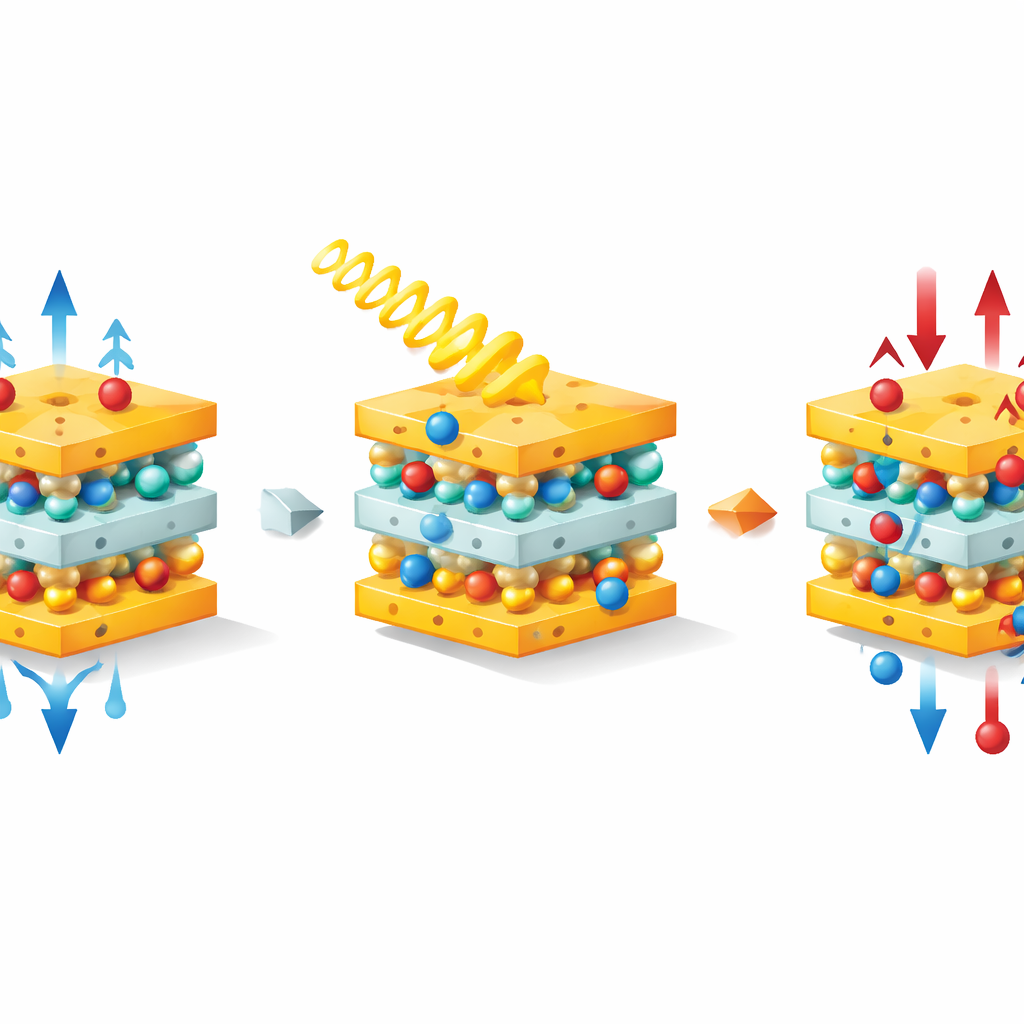
Beyond its unusual ground state, EuAuBi shows a striking response to light. Because its crystal lacks a center of symmetry, shining polarized light on it can generate a direct current without any external voltage, an effect known as the bulk photovoltaic effect. The team calculates a particular component of this response, called the shift current, and finds it to be exceptionally large—several times stronger than in well‑known ferroelectric solar materials. Crucially, the direction of this light‑induced current reverses when the polarization flips. The authors propose a device concept in which a thin EuAuBi layer is sandwiched between insulating films and controlled by a gate voltage. As the gate toggles the polarization back and forth, the measured photocurrent should trace out a hysteresis loop, directly revealing that the polarization is truly switchable in a metallic system.
What This Means for Future Devices
Put simply, this study suggests that EuAuBi is a metal that can be electrically switched between two stable internal states while also producing unusually strong light‑driven currents that change sign with that switch. For non‑experts, this means a single material could act as both a fast conductor and a built‑in memory element, and could even be read out optically via its photocurrent. Beyond EuAuBi itself, the work offers clear guidelines—strong polarization, modest switching energy, low carrier density, and weak coupling between electrons and the polar motion—for finding or designing other ferroelectric metals. Such materials could open pathways to compact, low‑power memory, novel optoelectronic components, and new ways to control quantum states using both electricity and light.
Citation: Tan, G., Zou, J. & Xu, G. Promising ferroelectric metal EuAuBi with switchable giant shift current. npj Comput Mater 12, 109 (2026). https://doi.org/10.1038/s41524-026-01990-6
Keywords: ferroelectric metals, EuAuBi, bulk photovoltaic effect, shift current, polarization switching