Clear Sky Science · en
A general optimization framework for mapping local transition-state networks
Why this matters for future materials
From better batteries to ultra‑efficient computer memory, many modern technologies hinge on how atoms and tiny magnetic whirls rearrange themselves. These rearrangements follow hidden “roads” across an energy landscape that we cannot see directly. This paper introduces a new computational framework, called MOTO, that can automatically chart those roads around a given state of a material. By doing so, it helps researchers understand how structures form, move, and disappear—knowledge that can guide the design of catalysts, magnetic devices, and other advanced materials.
Seeing the landscape beneath matter
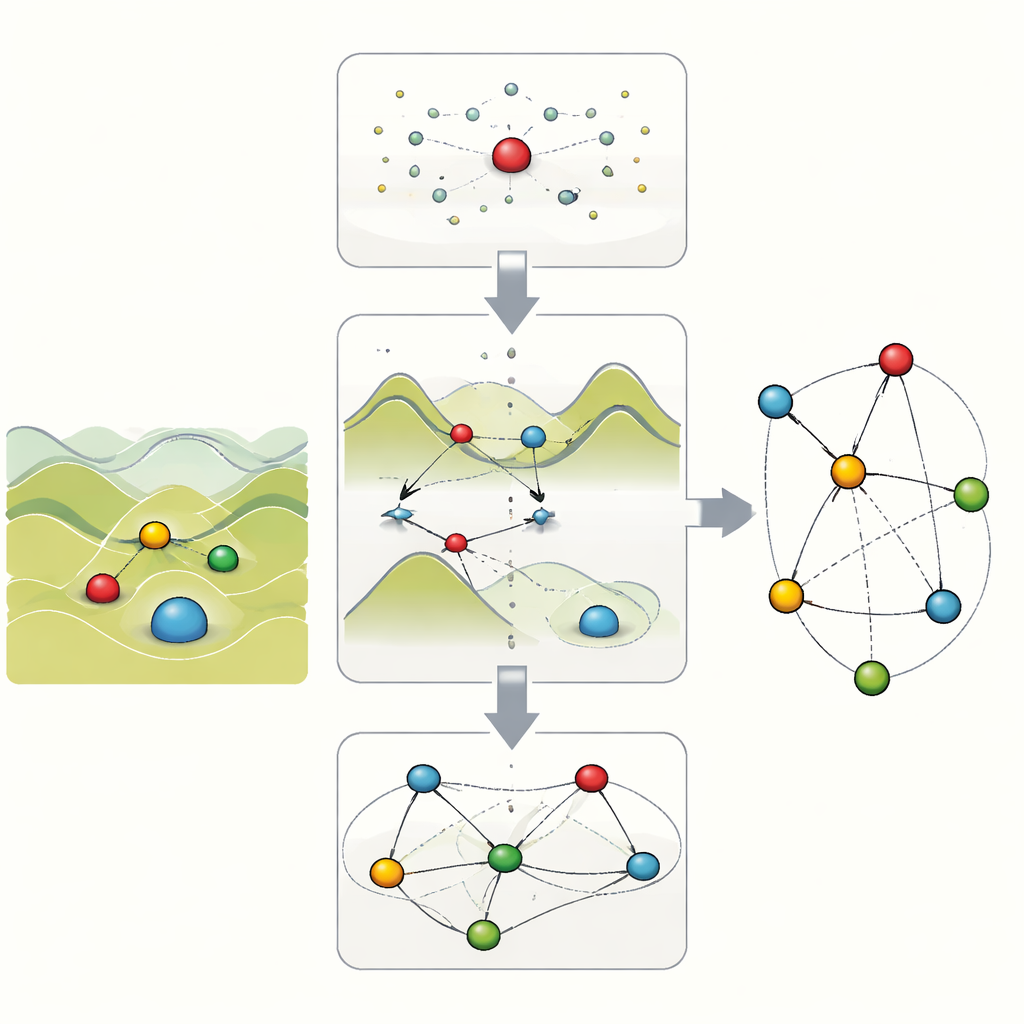
At the microscopic scale, a material’s behavior is governed by an energy landscape full of valleys and mountain passes. Valleys represent stable arrangements of atoms or spins, while the lowest passes between valleys are transition states that control how the system moves from one arrangement to another. Existing tools either require you to specify a starting and ending valley in advance, or they search locally from a single point and only find a few nearby passes. That makes it hard to build a complete picture of the possible transitions in complex systems like catalytic surfaces or topological magnetic textures.
A three-step way to explore nearby paths
The authors propose MOTO—a three-layer optimization framework—that systematically maps the local network of transitions around any chosen valley. In the first layer, a “multi-objective explorer” generates many small, targeted nudges of the system, shaped so they obey basic physical limits (for example, atoms cannot overlap and certain topological properties are preserved). These nudges are chosen to be as diverse as possible, while also making it easier for the method to later identify the crucial direction in which the energy surface curves most gently up toward a nearby pass.
Climbing passes and confirming connections
In the second layer, MOTO focuses on each promising starting point and estimates the direction of least resistance out of the valley—the softest uphill direction in the energy landscape. Instead of building and storing a huge matrix that describes the full curvature of the landscape, it uses compact “Hessian–vector products” that can be computed efficiently on modern graphics processors. This step allows the method to climb directly toward a one-pass saddle point while keeping memory use and run time low, even for systems with millions of interacting spins. In the third layer, MOTO gently pushes the system downhill on either side of each saddle it finds, revealing which valleys are connected by that pass and adding them to a growing map of nearby states and routes.
From magnetic whirls to moving atoms
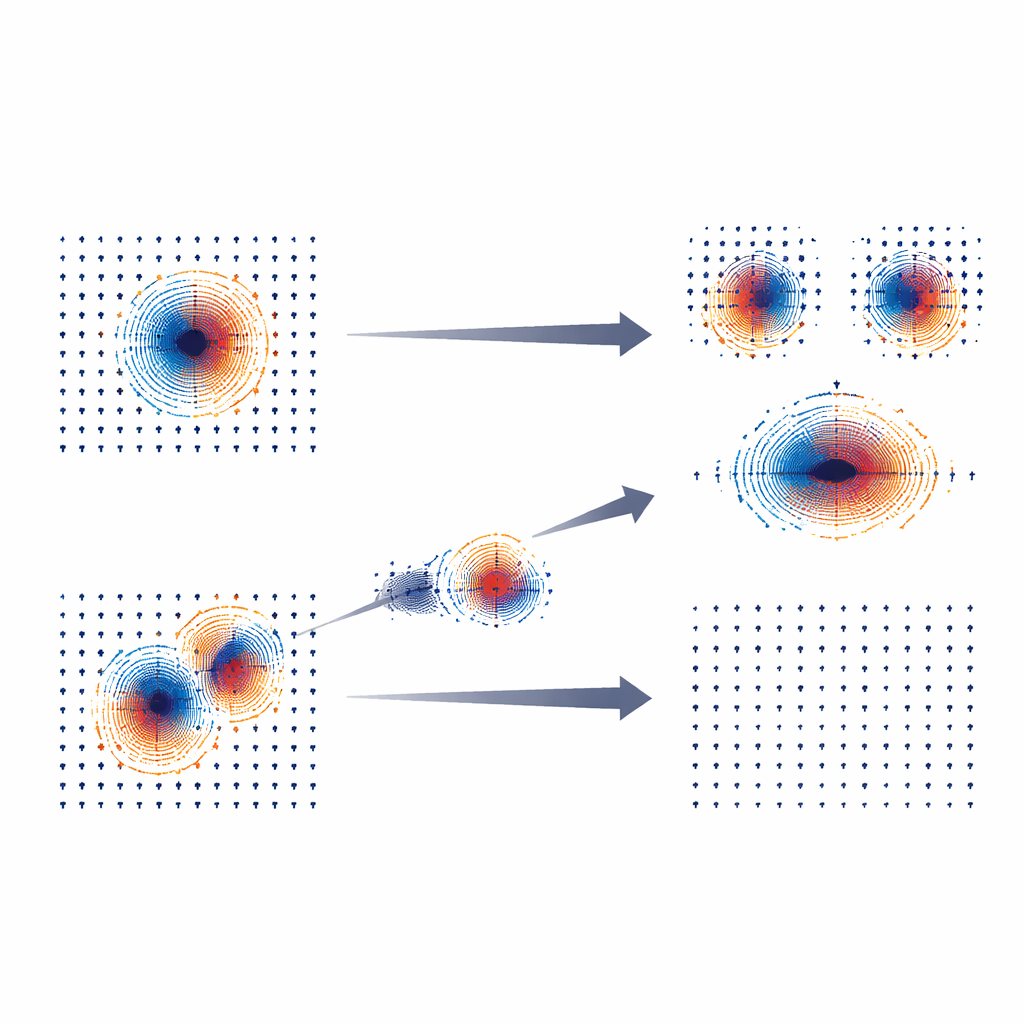
To demonstrate what MOTO can do, the authors apply it first to a detailed model of a thin magnetic film that hosts skyrmions—nanometer-scale swirling spin structures that are promising for data storage. Starting from a single skyrmion or antiskyrmion, MOTO uncovers a rich web of nearby transition states involving partial whirl patterns called merons and antimerons at the system’s edges. These processes enable duplication of skyrmions, their annihilation, and the creation of “chiral droplets,” and together they provide as many as 32 distinct pathways between complex multi-skyrmion states. In a second test, the same framework—without changing its core logic—is applied to a classic surface-diffusion problem: a seven-atom nickel cluster moving on a nickel surface. Here, MOTO automatically rediscovers well-known atomic rearrangements such as edge hops, corner moves, and coordinated multi-atom shifts, again assembling a detailed local network of states and barriers.
What this means going forward
For non-specialists, the key message is that MOTO offers a general, efficient way to reveal how a complex system can move from one nearby arrangement to another, without handcrafting paths or guessing all the important transitions in advance. It turns a single snapshot of a material into a local road map of possible changes and their energetic costs. Because the method only requires that the energy can be differentiated and that curvature along selected directions can be computed, it can be extended beyond magnetic textures and atomic surfaces to many other systems, including electronic structure calculations and even machine-learning models. This makes MOTO a versatile new tool for uncovering hidden mechanisms that drive material behavior and for guiding the design of next-generation technologies.
Citation: Xu, Q., Delin, A. A general optimization framework for mapping local transition-state networks. npj Comput Mater 12, 112 (2026). https://doi.org/10.1038/s41524-026-01985-3
Keywords: energy landscapes, transition states, skyrmions, computational materials, atomic diffusion