Clear Sky Science · en
Environment-adaptive machine-learned force fields for materials under extreme conditions: hafnium and hafnium dioxide polymorphs
Why this matters for future materials
From nuclear reactors to smartphone chips, many modern technologies rely on materials that must survive crushing pressures, searing heat, and sudden shock. Yet simulating how atoms behave under such extreme conditions has been painfully slow, limiting our ability to design tougher, more reliable materials on a computer. This paper unveils a new way to build fast, adaptable machine-learning models that can accurately track how hafnium metal and its oxide change, melt, and even fracture under some of the harshest conditions imaginable.
Teaching computers to feel atomic forces
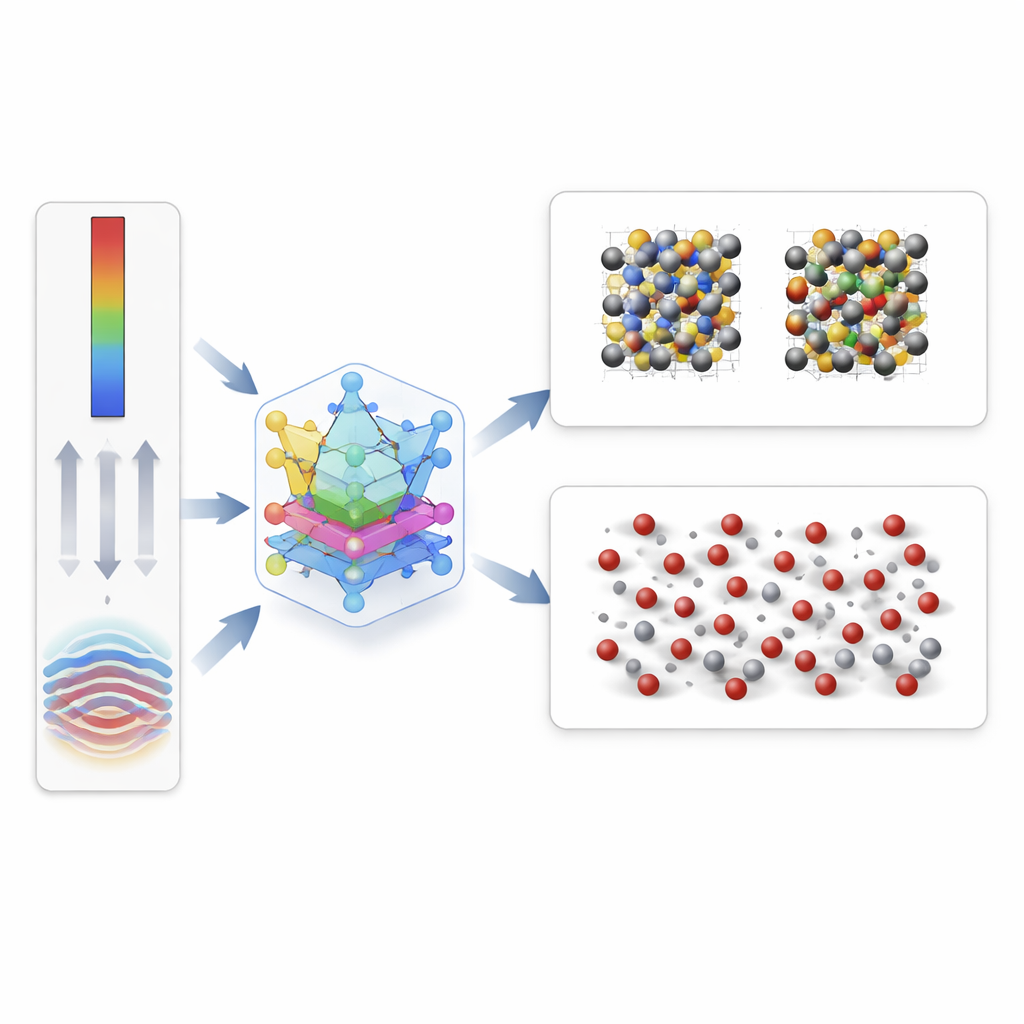
At the heart of this work is a new class of “environment-adaptive” machine-learned force fields. These are mathematical models that tell a simulation how strongly atoms push and pull on one another. Traditional quantum mechanical methods are extremely accurate but too costly to run for large systems or long times. Simpler models are fast but often fail when temperatures, pressures, or structures change too much from the conditions they were built for. The authors tackle this gap by designing force fields that can adjust to different local atomic surroundings, keeping quantum-level accuracy while remaining fast enough for large-scale molecular dynamics.
Capturing many kinds of atomic neighborhoods
To make this possible, the team uses compact numerical fingerprints called proper orthogonal descriptors that describe the arrangement of atoms around each atom, including complex many-body interactions. They then group similar atomic environments into clusters and let the force field smoothly adapt its behavior depending on which cluster an atom most closely resembles. This “environment-adaptive” step dramatically increases the flexibility of the model without a large cost in computing time. Alongside this, the authors create a diverse training set of atomic snapshots using a clever blend of Latin Hypercube Sampling and Monte Carlo “rattling,” which systematically explores different densities, distortions, and phases without having to run expensive quantum molecular dynamics for each one.
Putting hafnium and hafnium oxide to the test
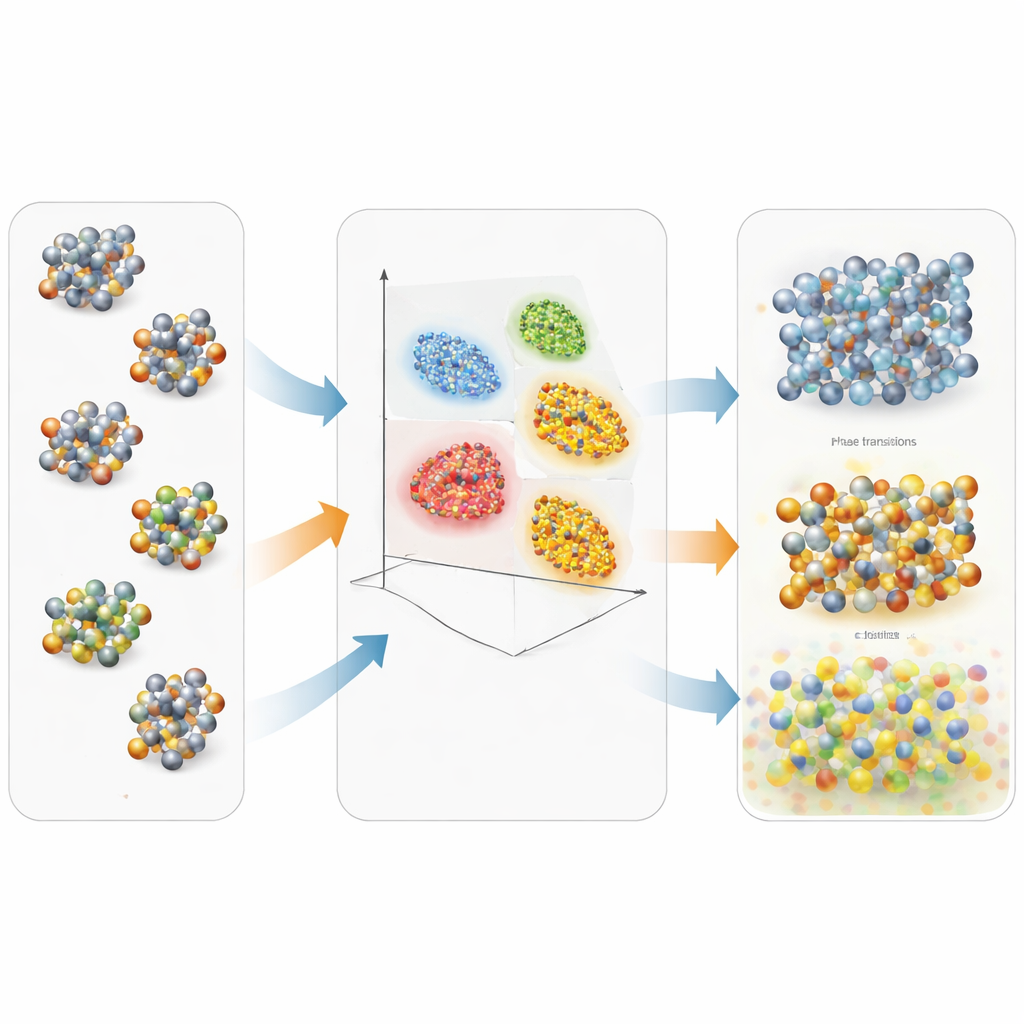
Hafnium and its dioxide are ideal proving grounds: they are technologically important in nuclear control rods, ultra-high-temperature ceramics, and advanced electronics, and they pass through several solid phases before melting. The new models accurately reproduce how hafnium’s crystal structure shifts under pressure (from its usual hexagonal form to more compact arrangements) and how it transforms from one solid phase to another as it is heated and finally melted. For hafnium dioxide, the force fields correctly capture the sequence of phase changes—from a monoclinic ground state to tetragonal, then cubic, and finally to liquid—at temperatures that match experimental ranges and quantum calculations. They also reproduce subtle vibrational properties (phonon dispersions) that signal whether a crystal structure is mechanically stable.
Following atoms into shock and beyond
One of the most striking demonstrations is in the realm of shock physics, where materials are suddenly compressed by impact to extreme pressures and temperatures. Using their machine-learned force fields, the authors compute the shock Hugoniot of hafnium—the curve that links pressure, density, and energy along shock paths—up to about one million degrees and a trillion pascals. The results agree closely with both laboratory shock measurements and high-end quantum simulations. In large-scale simulations of a shock wave slamming through hafnium, the model captures the formation of a sharp compression front, subsequent release, the growth of tiny voids, and final spall fracture, even though such conditions push far beyond the data originally used to train the model.
Looking ahead to smarter material design
Overall, this study shows that carefully designed, environment-adaptive machine-learning force fields can reliably follow atoms across a vast landscape of structures, temperatures, and pressures, without sacrificing speed. For hafnium and hafnium dioxide, they reproduce known phase diagrams, vibrational behavior, melting, and shock response with high fidelity, opening the door to routine simulations of devices and components operating under extreme environments. More broadly, the same framework can be applied to other complex materials, helping researchers explore new alloys, ceramics, and functional oxides on the computer before they are ever made in the lab.
Citation: Sema, D., Nguyen, N.C., Wyant, S. et al. Environment-adaptive machine-learned force fields for materials under extreme conditions: hafnium and hafnium dioxide polymorphs. npj Comput Mater 12, 117 (2026). https://doi.org/10.1038/s41524-026-01984-4
Keywords: machine-learned interatomic potentials, hafnium, hafnium dioxide, extreme conditions, molecular dynamics