Clear Sky Science · en
Computational design of materials for nuclear reactors
Powering the Digital Age Safely
As our world leans ever more on energy-hungry technologies and data centers, the need for clean, reliable, around‑the‑clock electricity is growing sharply. Nuclear fission reactors are one of the few energy sources that can deliver huge amounts of power continuously without emitting carbon. Yet their future hinges on a quiet hero most people never see: the materials that must endure intense heat, radiation, and corrosive environments for years. This article explains how advanced computer modeling is reshaping the way we invent and approve those materials, with the potential to make new reactors safer, cheaper, and faster to build.
The Many Jobs Inside a Reactor
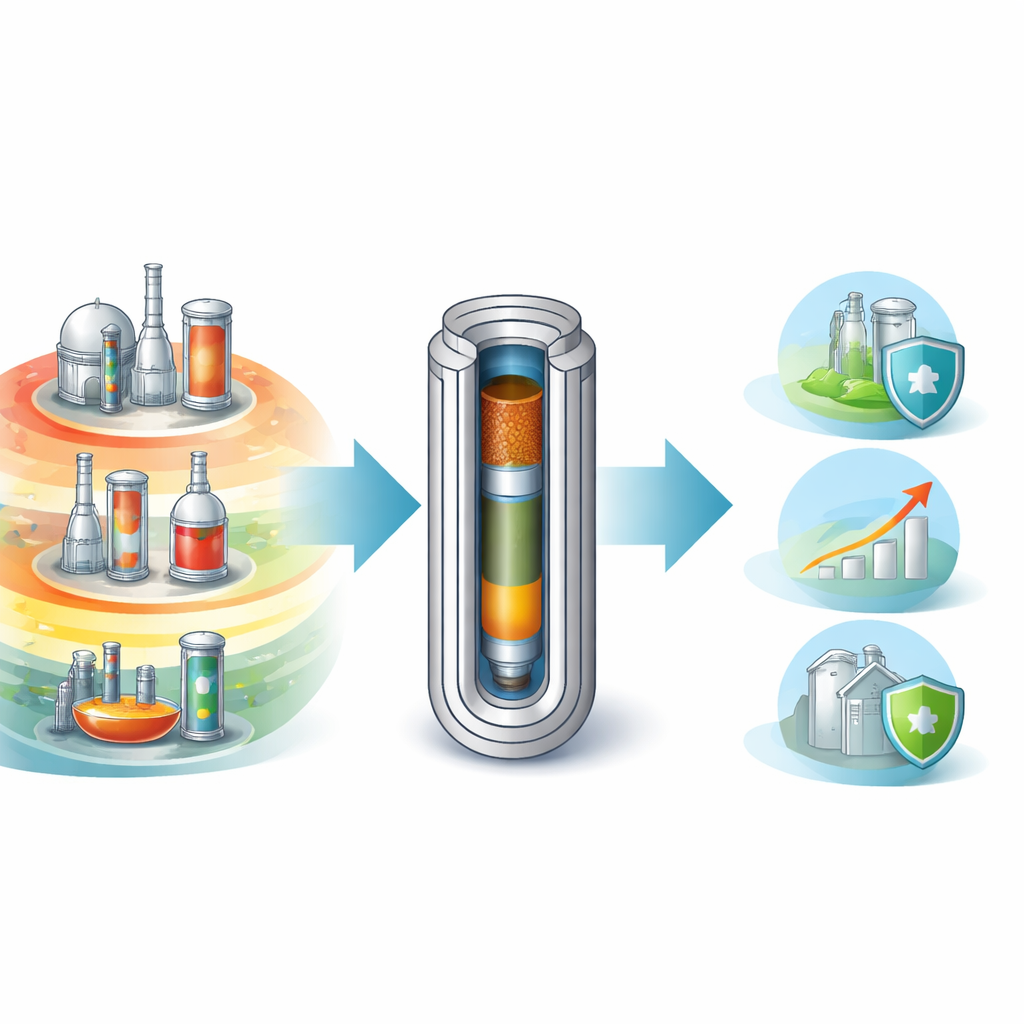
Inside a nuclear plant, different materials each play a specific role in turning atomic fission into usable electricity. Fuel must hold atoms such as uranium so they can split and release energy, while surviving bombardment by particles and the buildup of new, often damaging, elements. Cladding forms a tight metal or ceramic shell around that fuel to keep radioactive products from leaking into the coolant, which carries heat away to turbines. Other metals and ceramics make up the internal support structures, the thick pressure vessel that contains the core, and materials that slow or reflect neutrons so the chain reaction can be controlled. Each of these components faces unique combinations of temperature, radiation, stress, and chemical attack, which become even harsher in many advanced reactor designs now under development.
Why Traditional Development Takes Decades
Historically, new reactor materials have been created largely by trial and error. Engineers adjust alloy recipes and fabrication steps, then subject samples to years of testing in experimental reactors and hot laboratories. This method has produced workhorse technologies such as zirconium alloy cladding for today’s water‑cooled reactors, the high‑temperature alloy Inconel 617, and ceramic TRISO fuel particles used in some advanced designs. But the price of certainty has been long schedules and high cost: it can take 20 to 25 years or more to develop and qualify a new nuclear material, in part because regulators must be convinced that it will perform safely during normal operation, short‑term power swings, and rare accident scenarios.
Designing Materials on the Computer
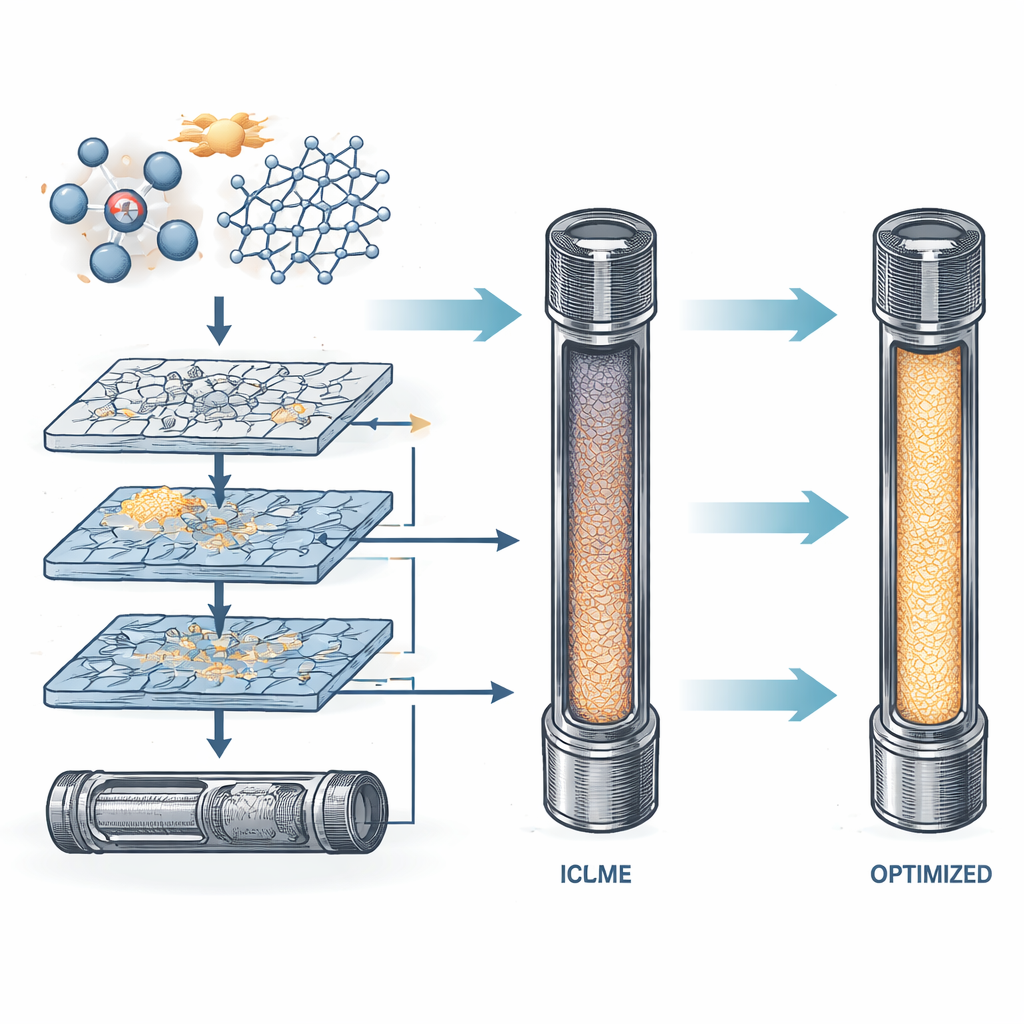
The authors describe a newer approach known as Integrated Computational Materials Engineering, or ICME, which aims to shorten this cycle dramatically. Instead of relying mainly on large test campaigns, ICME links models that operate from the atomic scale up to full components. At the smallest scales, quantum and molecular simulations predict how atoms arrange themselves and move under heat and radiation. These predictions feed into models of how microscopic features such as grains, voids, and precipitates evolve, and how these in turn affect properties like strength, thermal conductivity, and cracking resistance. Finally, engineering‑scale tools simulate how entire fuel rods, cladding tubes, and pressure vessels behave in a reactor over time. Data‑driven and machine‑learning methods help navigate vast design spaces and build fast surrogate models once the physics is understood.
Tailoring the Approach for Nuclear Extremes
Nuclear service adds twists that ordinary material design can often ignore. Within a reactor, the underlying microstructure and chemistry of a material do not stay fixed: radiation creates defects, gases form bubbles, and elements gradually segregate or precipitate. These slow changes can harden steels, weaken cladding, or alter how fuel swells and releases gas. The article argues that, for nuclear applications, this time evolution must be treated as a core design variable, not an afterthought. The authors propose an expanded design framework that explicitly tracks how processing, structure, properties, and performance all change as the material ages in a reactor. They also highlight the role of “separate‑effects” tests—experiments that isolate one or a few stresses at a time, such as heat alone or ion radiation alone—to calibrate and validate models when full‑scale reactor testing is impractical.
From Case Studies to a Digital Pipeline
The review presents concrete examples where this integrated modeling is already reshaping nuclear materials research. For conventional uranium dioxide fuel and a range of advanced fuels and claddings, multiscale models now capture grain growth, gas bubble formation, cracking, and corrosion in much greater detail than before, and they are being built into modern fuel‑performance codes. Similar strategies are being used to understand how reactor pressure vessel steels slowly embrittle, and how emerging manufacturing routes such as metal 3D printing might be qualified for safety‑critical parts. Looking ahead, the authors envision a “digital chain” in which data, models, experiments, and regulatory requirements are connected end‑to‑end. In this picture, validated models with quantified uncertainty guide which experiments to run, support risk‑informed licensing decisions, and eventually evolve into digital twins that track the health of materials during reactor operation.
What This Means for Future Reactors
For non‑specialists, the key message is that advanced computation can do more than make simulations prettier—it can change how quickly society gains access to safer, more efficient nuclear power. By designing fuels, claddings, and structural alloys on the computer, checking them with targeted experiments, and embedding regulatory needs from the start, ICME could cut development timelines from decades to under ten years while preserving or enhancing safety margins. If this vision is realized, the materials at the heart of reactors will be developed with the same kind of digital rigor now common in aircraft or microchips, helping nuclear energy better support the growing demands of our data‑driven world.
Citation: Tonks, M.R., Andersson, D.A. & Aitkaliyeva, A. Computational design of materials for nuclear reactors. npj Comput Mater 12, 106 (2026). https://doi.org/10.1038/s41524-026-01980-8
Keywords: nuclear materials, computational design, reactor safety, ICME, advanced reactors