Clear Sky Science · en
Multi-scale modeling GPAl-Li zones in Al-Li alloys starting from first-principles
Why lightweight metals matter
From rockets and fuel tanks to next‑generation airliners, designers crave metals that are both strong and light. Aluminum–lithium alloys are star candidates because just a small amount of lithium makes aluminum lighter and stiffer. Yet these alloys get their strength from tiny, hard‑to‑see clusters of atoms that form inside the metal when it is heat‑treated. This paper tackles a long‑standing mystery about one such cluster, the elusive GPAl–Li zone, and shows how it fits into the chain of changes that give the alloy its remarkable properties.
The hidden stages inside aluminum–lithium
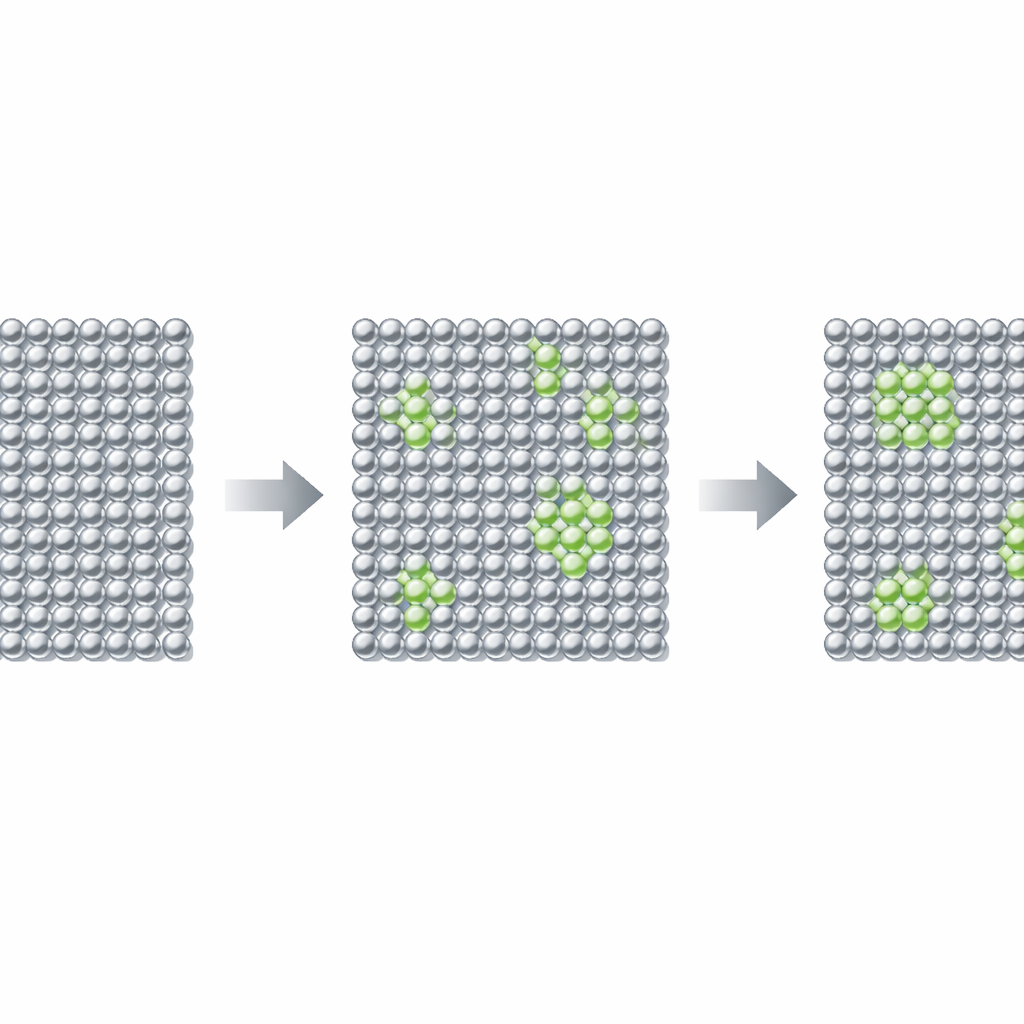
After aluminum–lithium alloys are made, they start out as a uniform solid solution: lithium atoms are scattered randomly among aluminum atoms. As the metal is aged at moderate temperature, the atoms slowly rearrange, passing through several stages before reaching a stable mixture of aluminum and lithium‑rich particles. Engineers have long believed that spherical particles called δ′ (with composition close to Al3Li) appear first and provide much of the strength. But experiments have hinted at an even earlier, more delicate stage: very small lithium‑rich regions dubbed GPAl–Li zones, analogous to the famous Guinier–Preston zones in classic aluminum–copper alloys. These early clusters are so short‑lived and so tiny that no one had firmly pinned down their structure or even proven that they truly exist as a distinct phase.
Simulating atoms across many scales
The authors attack this problem with a chain of computer models that connect quantum‑level behavior to microstructures visible under the microscope. First, they use density functional theory, a quantum method, to calculate the energy of many possible arrangements of aluminum and lithium atoms on a face‑centered cubic lattice like that of pure aluminum. They then train a cluster‑expansion model, a compact mathematical description that can rapidly estimate the energy for new arrangements. On top of this, they run a specialized Monte Carlo sampling method, enhanced by meta‑dynamics, to map out how the free energy of the alloy varies with lithium content and temperature—essentially building a detailed "landscape" that shows which atomic patterns are favored.
Discovering an ordered lithium cluster
This energy landscape reveals a distinct dip at about 12.5 atomic percent lithium, signaling a metastable configuration: the GPAl–Li zone. By inspecting the atomic pattern at this composition, the team finds a well‑ordered structure they label δ″ (close to Al7Li), in which lithium atoms occupy specific sites within the aluminum lattice while carefully avoiding being direct neighbors to each other. Electronic‑structure analysis shows why this arrangement is favored: lithium donates electrons to nearby aluminum atoms in a way that stabilizes certain bonds, but only if lithium atoms are spaced just right. The authors systematically substitute lithium into different neighbor positions and track both electron counts and energies, demonstrating that the configuration corresponding to the GPAl–Li zone is a genuine local energy minimum rather than a numerical artifact.
From early clusters to strengthening particles
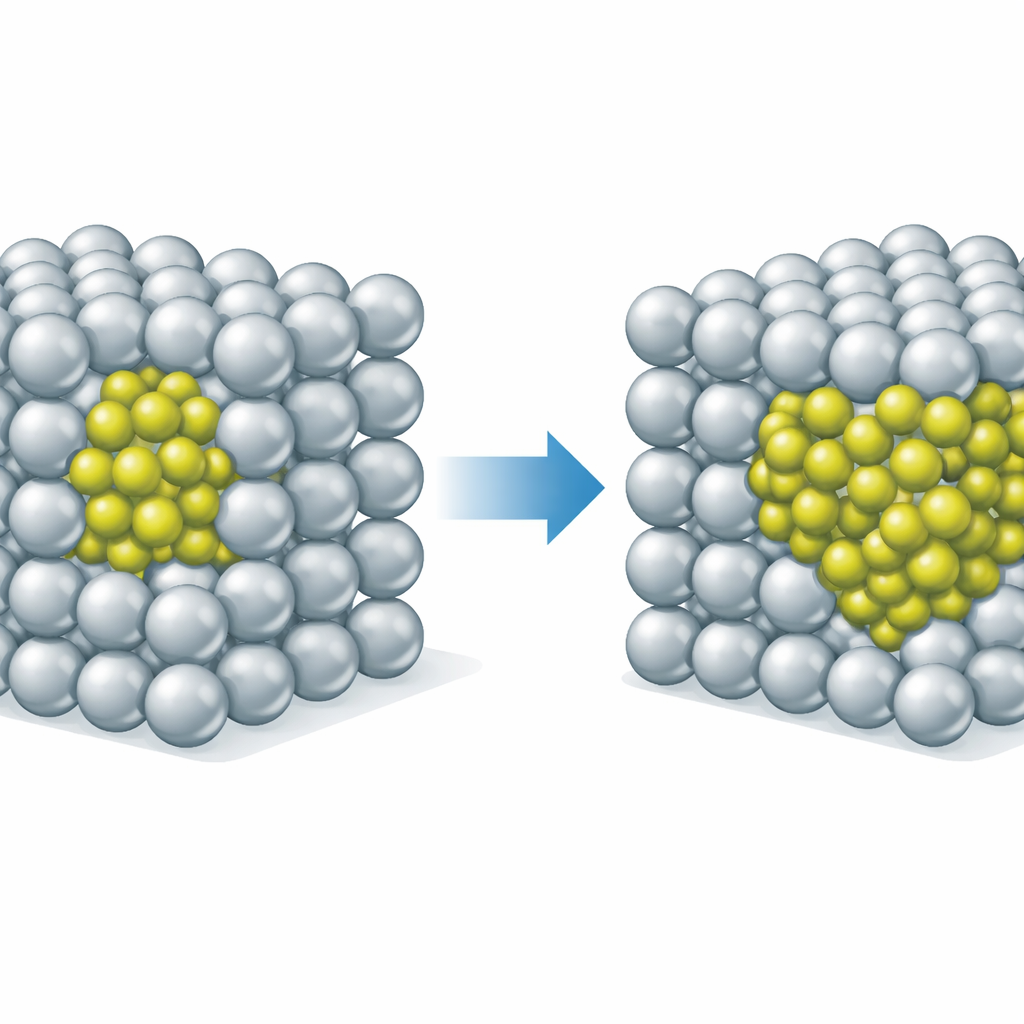
Armed with accurate free‑energy curves, the researchers next build a metastable phase diagram that includes the solid solution, the GPAl–Li zones, and the δ′ precipitates under the constraint that the lattice remains aluminum‑like. They compute the interface energy between δ′ particles and the aluminum matrix, then feed all this into a phase‑field model that simulates how lithium diffuses and how new phases appear and grow in three dimensions over time. These simulations show that, for a useful range of lithium contents and temperatures below about 483 K (roughly 210 °C), the alloy first forms widespread GPAl–Li zones, which later transform into δ′ particles. Near the ideal GPAl–Li composition, the presence of a deep local energy well actually slows the growth of δ′, explaining experimental reports where higher lithium content did not always lead to faster strengthening.
Why cryogenic treatments and copper additions matter
The modeling also clarifies why GPAl–Li zones are so hard to catch in the act. At room temperature and above, these zones are only briefly metastable and quickly evolve into δ′, leaving behind little direct evidence. At cryogenic temperatures, however, lithium diffuses much more slowly while the energy well for the GPAl–Li structure deepens, so the zones can persist long enough to be observed in carefully treated samples. Finally, by considering how these lithium‑rich zones interact with copper in more complex aluminum–lithium–copper alloys, the authors propose that GPAl–Li zones can act as preferred birthplaces for the important T1 (Al2CuLi) strengthening plates. This insight suggests new heat‑treatment and composition strategies for designing lighter, tougher aerospace alloys.
What this means for real alloys
Put simply, the study shows that the mysterious GPAl–Li zone is a real, ordered atomic arrangement that briefly appears between the initially uniform alloy and the familiar δ′ particles. By mapping when and how this stage forms and transforms, the work fills a crucial gap in the story of how aluminum–lithium alloys harden. For engineers, this means more reliable recipes for alloy composition and heat‑treatment—especially at low temperatures and in alloys that also contain copper—paving the way for lighter, safer aircraft and spacecraft structures.
Citation: Tian, Q., Hou, L., Wang, J. et al. Multi-scale modeling GPAl-Li zones in Al-Li alloys starting from first-principles. npj Comput Mater 12, 104 (2026). https://doi.org/10.1038/s41524-026-01974-6
Keywords: aluminum-lithium alloys, precipitation hardening, Guinier-Preston zones, computational materials, phase-field simulation