Clear Sky Science · en
A chemical bonding based descriptor for predicting the role of anharmonicity induced by quantum nuclear effects in hydride superconductors
Why tiny quantum jitters matter
Superconductors are materials that can carry electricity without any loss, but most only work at extremely low temperatures. Hydrogen-rich compounds under high pressure have recently pushed superconducting temperatures close to room temperature, raising hopes for ultra-efficient power grids and electronics. Yet theory often struggles to predict exactly when these exotic materials will superconduct — and by how much — because the light hydrogen atoms do not sit still, but jiggle in a distinctly quantum way. This article explores when those quantum jitters help superconductivity and when they hurt it, and introduces a simple bonding-based recipe to tell the difference in advance.
Two flavors of atomic order
Many promising hydride superconductors share a common feature: metal atoms form a framework that cages hydrogen atoms, a bit like marbles in a 3D scaffold. The authors sort these materials into two broad families based on how evenly the atoms share their chemical bonds. In “symmetric bonding” structures, each atom sits in a very regular environment, with neighboring atoms arranged almost perfectly evenly in all directions. In “asymmetric bonding” structures, some atoms have lopsided surroundings: a few bonds are short and strong, others longer and weaker. This seemingly subtle difference turns out to control how the material responds when the hydrogen atoms are treated as quantum objects rather than classical balls on springs. 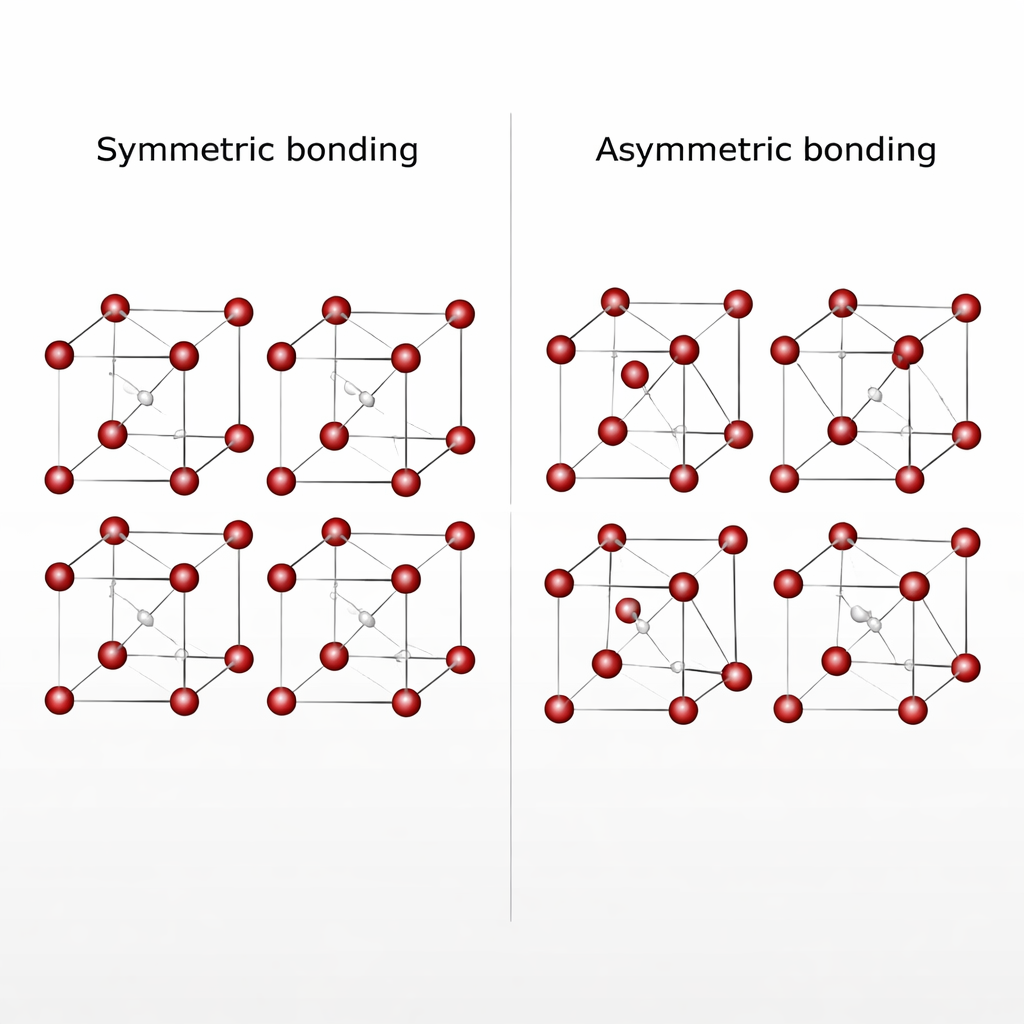
When quantum motion dampens superconductivity
In the symmetric group, which includes well-known hydrides such as LaH10, H3S, and YH6, letting the nuclei behave quantum mechanically barely shifts the average atomic positions. The crystal lattice remains almost perfectly regular. However, the quantum motion does stiffen many of the lattice vibrations, especially certain “optical” modes where atoms move against each other. Stiffer vibrations correspond to higher frequencies, and in conventional superconductors this generally weakens the glue that binds electrons into Cooper pairs. The calculations show that, across this whole symmetric family, the superconducting critical temperature Tc tends to drop when quantum effects are fully included, sometimes dramatically, even though the crystal structure itself hardly changes.
When quantum motion boosts superconductivity
The asymmetric family behaves in the opposite way. Examples include distorted forms of hydrogen sulfide (H3S), scandium hydrides with H2 units, and certain hydrogen and boron-rich phases. Here, treating the nuclei quantum mechanically actually nudges atoms into more balanced positions: uneven bond lengths are pulled toward equality, and bent local motifs straighten out. These structural adjustments soften key vibrations and often increase the number of electronic states able to participate in superconducting pairing. As a result, Tc can rise sharply — in some cases by factors of two to four — once quantum effects and anharmonic lattice motion are taken into account. Quantum fluctuations, instead of merely shaking the lattice, actively reshape it in a way that favors superconductivity.
A bonding-based shortcut for predictions
Full quantum calculations that capture these effects are computationally expensive. To find a shortcut, the authors introduce a “symmetry index” for each distinct type of atom in a crystal. This index is built from measures of bond strength, either using a quantum-chemistry-inspired quantity called the integrated crystal orbital bonding index (iCOBI) or a more empirical bond valence function. By treating each bond as a vector and summing them around an atom, the index reveals how symmetric or lopsided its bonding environment is. If all atoms have very low symmetry indices, the structure falls into the symmetric family and quantum effects are expected mainly to stiffen vibrations and lower Tc. If at least one atom has a large symmetry index, quantum relaxation is likely to rebalance its bonds, soften vibrations, and enhance Tc. Crucially, this diagnosis can be made using only the classical, easier-to-compute structure. 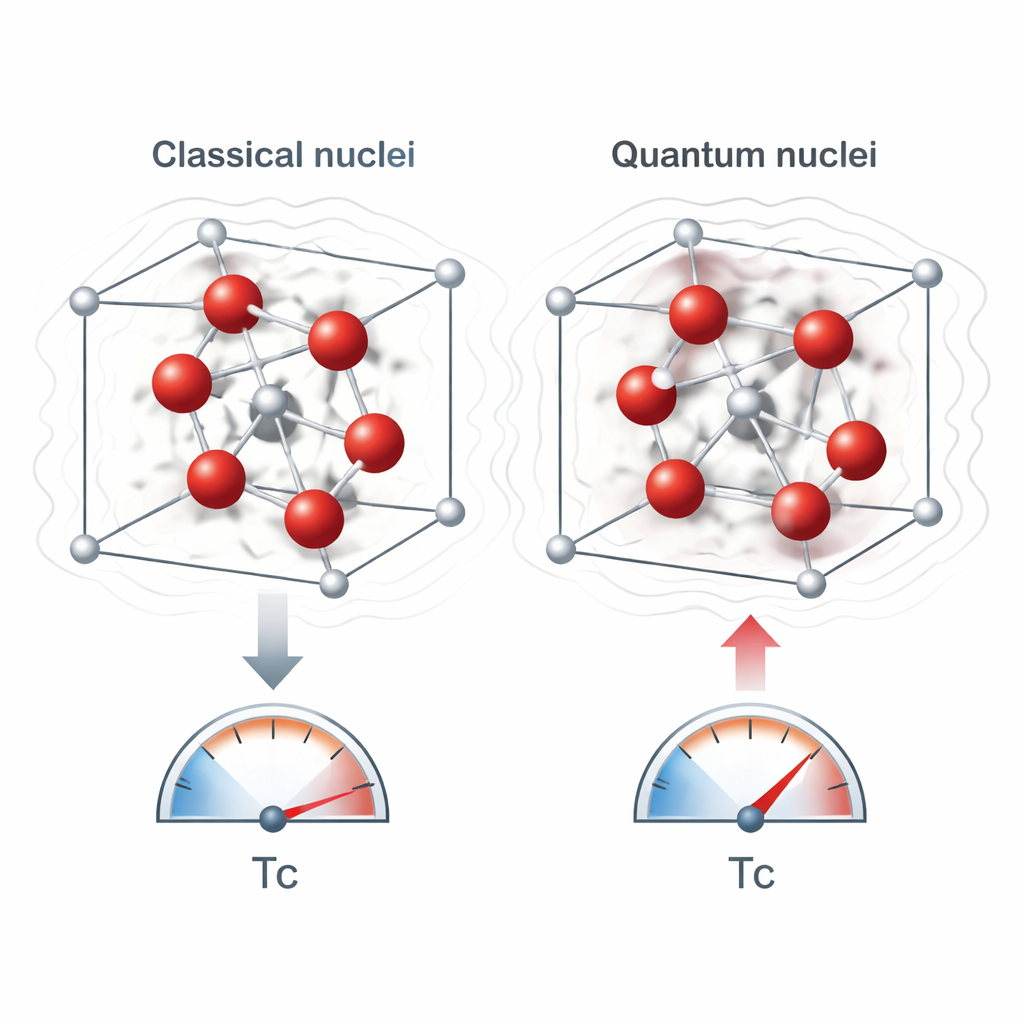
What this means for future superconductors
For non-specialists, the key message is that the usefulness of quantum motion in hydride superconductors depends on how fair the bonding is around each atom. Perfectly balanced bonding tends to make quantum effects a spoiler, reducing the superconducting temperature, whereas uneven bonding lets quantum jitters act as an internal “self-correcting” mechanism that can strengthen superconductivity. The symmetry index introduced here offers a practical tool for researchers to quickly screen new hydrogen-rich materials and guess whether quantum effects will help or hinder their superconducting performance, potentially speeding the search for superconductors that work at everyday conditions.
Citation: Belli, F., Zurek, E. & Errea, I. A chemical bonding based descriptor for predicting the role of anharmonicity induced by quantum nuclear effects in hydride superconductors. npj Comput Mater 12, 100 (2026). https://doi.org/10.1038/s41524-026-01973-7
Keywords: hydride superconductors, quantum nuclear effects, anharmonic phonons, chemical bonding symmetry, high pressure materials