Clear Sky Science · en
Accelerated discovery of supertetragonal perovskites with giant polarization via machine learning
Why this search for new crystals matters
From faster memory chips to more efficient solar cells and sensors that feel the faintest touch, many emerging technologies rely on a special class of materials called ferroelectrics, which carry a built‑in electric polarization. The stronger and more stable this internal electric alignment is, the more powerful and versatile the devices can become. This study shows how combining machine learning with quantum‑mechanical simulations can rapidly uncover new ferroelectric crystals with exceptionally large polarization that were previously unknown, potentially shortening years of trial‑and‑error lab work into a guided digital search.
Stretching crystals to boost electric power
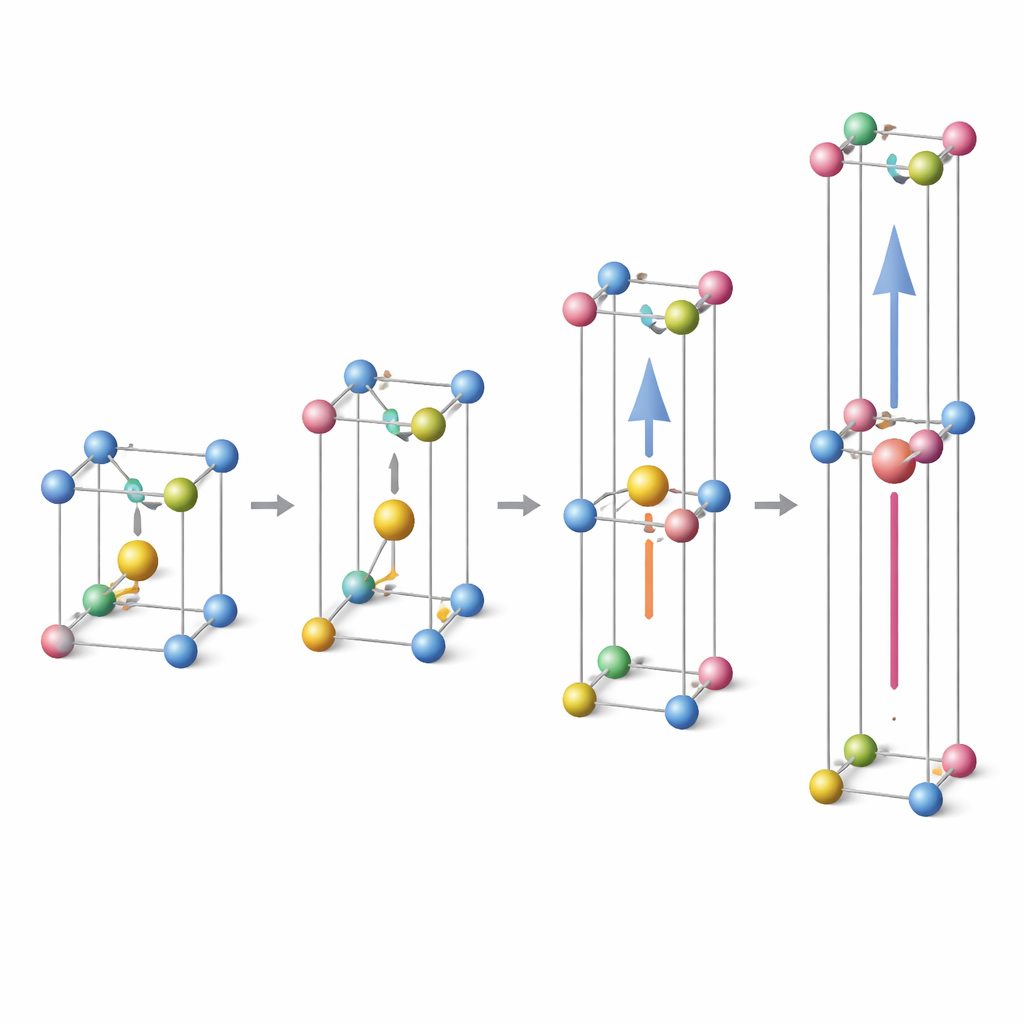
Many of the best ferroelectrics share a common crystal framework known as the perovskite structure, where atoms sit at the corners, faces, and center of a repeating cube. When this cube is stretched so that its height becomes much larger than its width, the structure becomes what scientists call "supertetragonal" and its internal electric polarization can grow dramatically. Unfortunately, such extreme shapes are usually hard to stabilize and often require special thin‑film growth conditions, high pressure, or defects. The authors set out to find new perovskites that naturally adopt this strongly stretched form while remaining stable at ordinary room temperature, making them far easier to use in real devices.

Teaching a computer to recognize promising recipes
Instead of testing thousands of possible chemical recipes one by one, the team trained a machine learning model to recognize which combinations of elements are likely to produce a highly stretched crystal. They began with 95 known perovskites and described each one using a compact set of ten basic quantities, such as how strongly different atoms attract electrons, how large the ions are, and simple geometric measures that capture how well the building blocks fit together. The model’s task was to predict whether a given material’s height‑to‑width ratio exceeded a key threshold that signals the supertetragonal state. After comparing several algorithms, they found that a method called an Extra Trees classifier could perfectly distinguish between stretched and normal structures in their test data, giving them confidence to apply it to a much larger pool of candidates.
Narrowing thousands of candidates down to a select few
Armed with this digital filter, the researchers explored a design space of 2,021 possible perovskites built from different choices of positively and negatively charged ions. The machine learning model first tagged 130 of these as likely to be strongly stretched. The team then applied additional simple structural rules, based on known bounds for geometric stability, to weed out crystals that would probably collapse or distort into other forms. This step reduced the list to 56 new oxide perovskites with promising shapes. For these, they carried out detailed quantum‑mechanical simulations to confirm the crystal structures, examine different magnetic arrangements where relevant, and compute how the atoms shift when the material polarizes, a key ingredient for estimating the electric response.
Eight standout materials and what makes them special
The combined screening and simulation pipeline ultimately delivered eight especially promising perovskite oxides, most of which had never been reported in this form. All exhibit very large spontaneous polarization values, comparable to or exceeding those of well‑known ferroelectrics, yet they are predicted to be stable at room temperature without exotic processing steps. Two compounds, based on strontium–lead and europium–tin combinations, stand out because their electronic band gaps sit near the ideal range for converting light into electricity, suggesting they could underpin efficient ferroelectric solar cells. Two others, involving tin–iron and calcium–tantalum, are predicted to be both electrically polar and metallic at the same time, an unusual combination that could open doors in spin‑based electronics and superconducting technologies. By analyzing how simple descriptors like ion size and electronegativity correlate with crystal stretching and polarization, the authors also distill practical design rules for choosing element combinations that are likely to yield powerful ferroelectrics.
What this means for future materials design
In essence, this work demonstrates that a carefully trained machine learning model, guided by basic chemical intuition and checked by rigorous quantum calculations, can efficiently navigate the vast landscape of possible perovskite compositions. The eight highlighted crystals are not just theoretical curiosities: they are predicted to be structurally and chemically stable, strongly polar, and in some cases well matched to photovoltaic or electronic applications. Just as importantly, the study clarifies which elemental traits tend to produce highly stretched, strongly polarized structures, turning the search for advanced ferroelectrics into a more predictable, rule‑based endeavor. This approach could accelerate the discovery of many other functional materials, helping turn data and algorithms into tangible advances in electronics and energy technology.
Citation: Hu, W., Wu, Z., Li, M. et al. Accelerated discovery of supertetragonal perovskites with giant polarization via machine learning. npj Comput Mater 12, 103 (2026). https://doi.org/10.1038/s41524-026-01970-w
Keywords: ferroelectric perovskites, machine learning materials discovery, supertetragonal oxides, polar metals, ferroelectric photovoltaics