Clear Sky Science · en
aLLoyM: a large language model for alloy phase diagram prediction
Teaching AI to Read Maps of Metal
When engineers design new metals for jet engines, batteries, or nuclear reactors, they rely on special maps called phase diagrams to show which mixtures of elements will be solid, liquid, or something in between at different temperatures. Creating these maps in the lab is slow and expensive. This study introduces a specialized artificial intelligence (AI) model, aLLoyM, that learns to read and even sketch these phase diagrams, potentially speeding up the search for better, tougher, and more efficient materials.
Why Phase Maps Matter for Everyday Tech
Phase diagrams are like weather maps for metals. Instead of predicting rain or sunshine, they show where mixtures of elements will melt, harden, or form different internal structures as conditions change. These details quietly determine how safe a bridge is, how long a turbine blade endures heat, or how stable a battery remains over time. But mapping out all the possible combinations of elements and temperatures is nearly impossible through experiments alone, because there are countless mixtures to test and each requires careful heating, cooling, and analysis. That gap between what we need to know and what we can actually measure is where AI can make a real difference.
Feeding Data into a Specialized Language Model
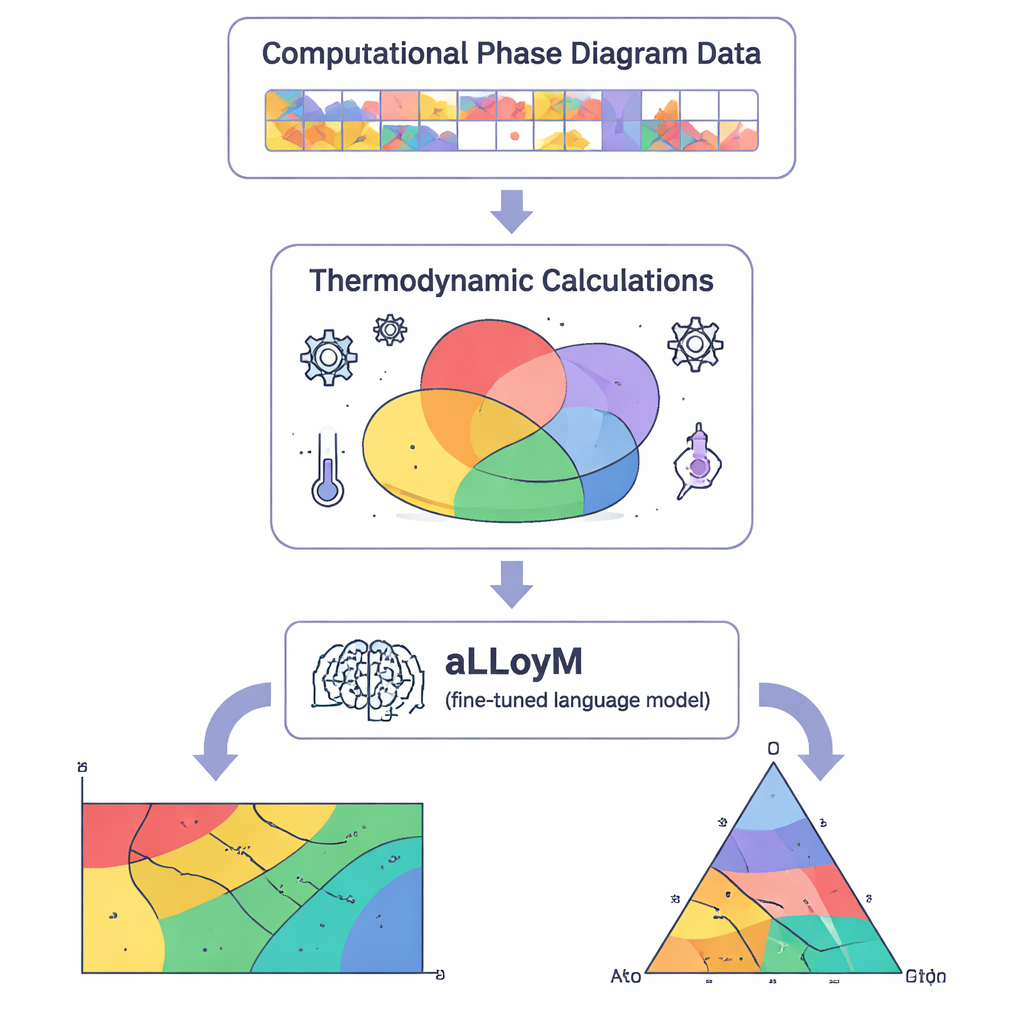
Instead of building yet another narrow mathematical model, the researchers fine-tuned a large language model—a kind of AI usually used for text—on the language of alloys. They drew on an open database of computer-calculated phase diagrams and converted 837,475 data points into question-and-answer pairs. A typical question might say, “Silver 46%, aluminum 54% at 900 Kelvin: what phases appear?” and the answer would list the phases present. Using a technique called low-rank adaptation, they adjusted only a small part of the underlying Mistral model so it could handle three kinds of tasks at once: predicting full phase details, naming which phases appear, or suggesting an alloy composition and temperature that produce a desired phase.
Checking Whether the AI Really Understands
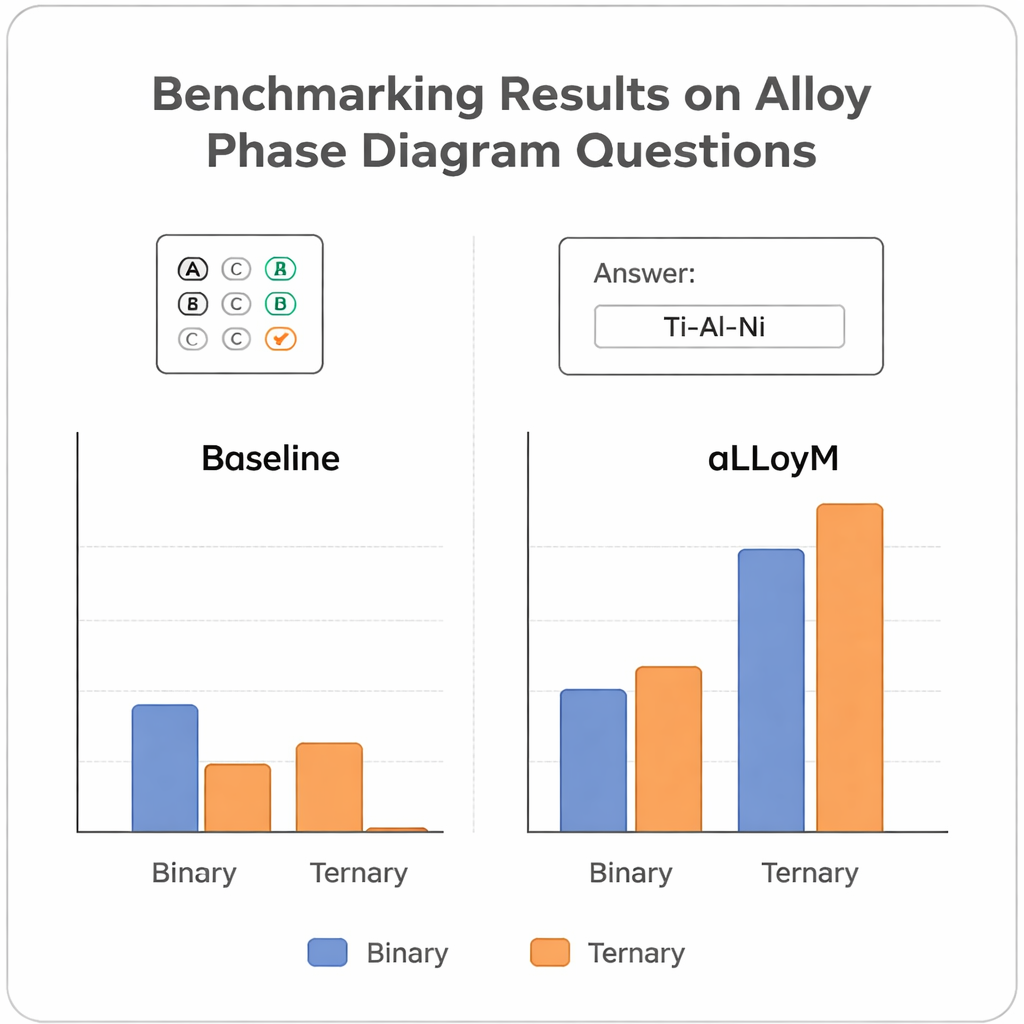
To see if aLLoyM was truly learning the rules behind phase diagrams, the team tested it on multiple-choice and free-form (short-answer) questions. For multiple-choice problems, the model had to pick the right answer from four options. The off-the-shelf baseline model performed barely better than random guessing. After fine-tuning, aLLoyM’s accuracy jumped sharply for all tasks and for both simpler two-element alloys and more complex three-element alloys. In the more demanding short-answer setting, where the model had to generate its own text instead of choosing from a list, it still produced phase names that closely matched the correct ones, even for alloy systems it had never seen during training. Performance was best when extrapolating from well-understood systems, and it dropped for mixtures with especially complicated behavior in the middle composition range—just as human experts find those regions tricky.
Imagining New Materials Beyond Today’s Experiments
Once trained, aLLoyM could be asked to “draw” phase diagrams for metals that are hard or impossible to study directly, such as mixtures involving radioactive or extremely short-lived elements. For example, the model estimated melting points and structural types for actinium and uranium mixtures, and proposed ternary diagrams for systems that have not yet been measured. Some of these predictions were impressively close to known values; others contained mistakes, like misidentifying the most stable crystal structure. The researchers also saw the model invent new phase labels, such as ones containing the word “WOLF,” and developed ways to test how reliable such surprises might be by probing the model’s internal confidence and how its answers change under different sampling settings.
What This Could Mean for Future Materials
To a non-specialist, the key message is that aLLoyM shows how a text-based AI can be trained to reason about the behavior of metals in much the same way a seasoned materials scientist does, but at far greater speed. It is not yet a drop-in replacement for careful experiments or detailed physics-based calculations, and it can still make confident errors. But as its training data grow and its uncertainty estimates and prompts improve, models like aLLoyM could help researchers narrow down which alloy recipes are worth testing in the lab. That guidance could shorten the long, expensive path from an idea for a new material to a real-world product, influencing technologies from cleaner power plants to longer-lasting consumer electronics.
Citation: Oikawa, Y., Deffrennes, G., Shimayoshi, R. et al. aLLoyM: a large language model for alloy phase diagram prediction. npj Comput Mater 12, 97 (2026). https://doi.org/10.1038/s41524-026-01966-6
Keywords: alloy phase diagrams, materials discovery, large language models, computational materials science, thermodynamic modeling