Clear Sky Science · en
Developing a complete AI-accelerated workflow for superconductor discovery
Why finding better superconductors matters
Superconductors are remarkable materials that can carry electricity with zero resistance, meaning no energy is lost as heat. They already power technologies like MRI machines and particle accelerators, and could one day enable ultra-efficient power grids and levitating trains. But discovering new superconductors has been slow and costly, because it usually requires painstaking experiments or heavy quantum-mechanical calculations on each candidate material. This article describes a new artificial intelligence (AI) workflow that drastically speeds up that search and has already led to the discovery and experimental confirmation of two new superconducting materials.
A smart shortcut through millions of possibilities
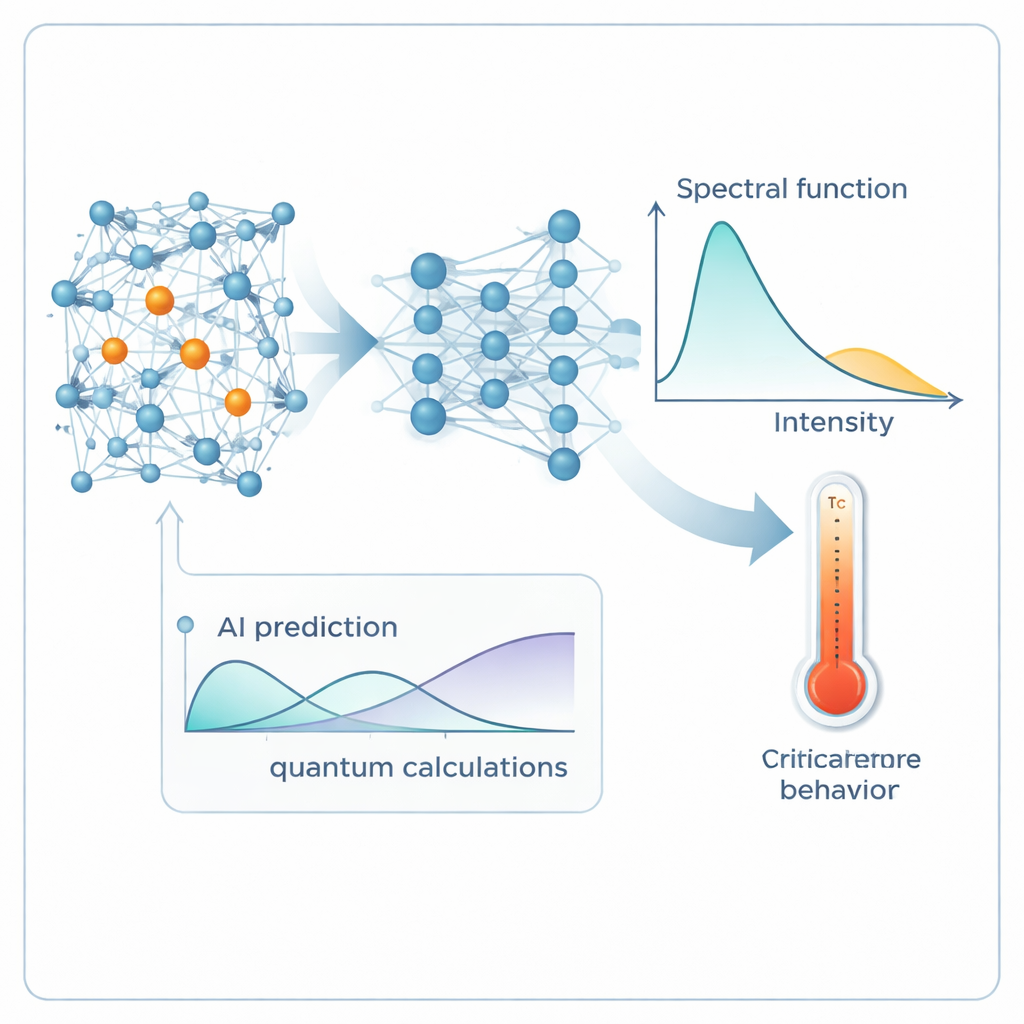
The authors set out to solve a key bottleneck in superconductor discovery: calculating how electrons interact with vibrations of the crystal lattice, a quantity that normally demands enormous computing power. Instead of doing these calculations from scratch for every material, they trained a powerful AI system called BEE-NET to learn this behavior from about 7,000 carefully computed examples. BEE-NET takes in information about a crystal’s atomic arrangement, and in one version also its vibrational spectrum, and then predicts a detailed “fingerprint” of how electrons couple to vibrations. From this fingerprint, the model can estimate the critical temperature—the point where a material becomes superconducting—with an average error of less than a degree Kelvin compared with full quantum calculations.
Teaching AI to say “no” with confidence
An important feature of this approach is that the AI is trained not just to guess the transition temperature directly, but to reconstruct the full spectrum of electron–vibration interactions. This richer description lets the model treat superconducting and non-superconducting materials on equal footing, and it turns out to be very good at ruling out bad candidates. In tests, BEE-NET correctly identified non-superconductors (those with transition temperatures below 5 kelvin) more than 99 percent of the time. That high “true negative” rate is crucial when screening vast materials spaces, because it avoids wasting expensive calculations on materials that are almost certainly not useful.
From millions of candidates to a few hundred winners
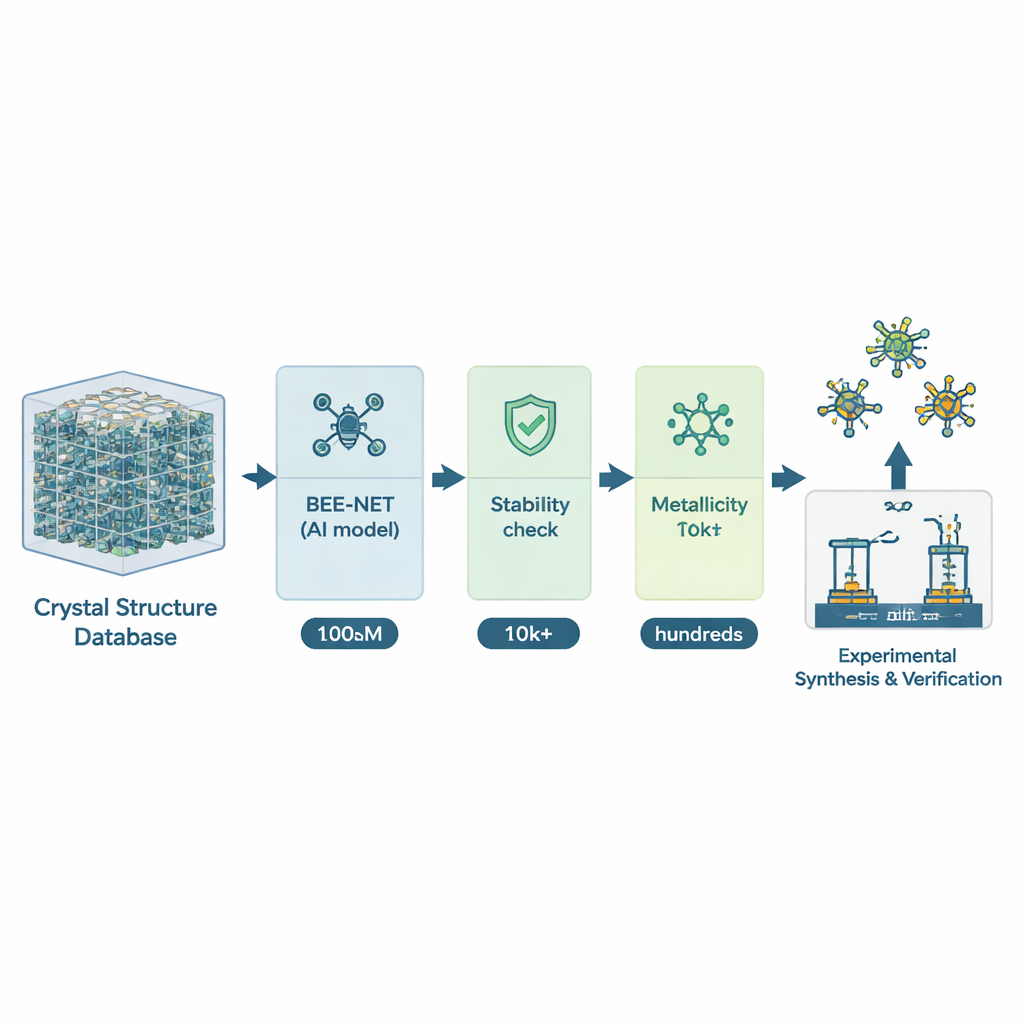
Armed with this AI, the team built a multi-step, AI-accelerated discovery pipeline. They started from two main sources: known metallic compounds listed in large online materials databases, and over a million new, hypothetical materials generated by systematically swapping chemical elements into known crystal structures. These raw candidates then passed through a series of filters. Other machine-learning models rapidly checked whether a material was likely to be metallic and thermodynamically stable. BEE-NET provided a fast first estimate of the superconducting transition temperature, eliminating materials predicted to fall below 5 kelvin. Only the survivors were then examined with more detailed quantum calculations, including stability tests based on lattice vibrations. In total, more than 1.3 million initial structures were narrowed down to just 741 metallic, dynamically and thermodynamically stable compounds with fully confirmed critical temperatures above 5 kelvin, including 69 with predicted values above 20 kelvin.
Turning predictions into real superconductors
To demonstrate that the workflow delivers real materials, not just promising numbers, the researchers chose two particularly attractive candidates for experimental testing. Both were derived from a known low-temperature superconductor, Be₂Nb₃, by partially replacing the element niobium (Nb) with hafnium (Hf) in specific positions within the crystal structure. After synthesizing the proposed Be₂Hf₂Nb and Be₂HfNb₂ compounds in the laboratory and carefully analyzing their crystal structures, the team measured their electrical resistance and heat capacity at low temperatures. Both materials showed clear superconducting transitions, confirming the AI-guided predictions, even though their exact critical temperatures ended up a bit lower than the most optimistic theoretical estimates due to structural disorder and impurities.
What this means for future materials
The study shows that combining advanced machine learning with quantum calculations and targeted experiments can turn superconductor discovery from a trial-and-error process into a systematic search. BEE-NET and the surrounding workflow can scan millions of potential materials in a reasonable time, highlight the most promising few hundred, and guide experimentalists toward compounds that are both stable and likely to superconduct. While the current models focus on a particular class of superconductors and moderate temperature ranges, the same strategy could be extended to other pressure conditions and material families. In the long run, such AI-driven pipelines may uncover superconductors that operate at much higher temperatures and in more practical forms, opening the door to more efficient power grids, faster electronics, and new magnetic technologies.
Citation: Gibson, J.B., Hire, A.C., Prakash, P. et al. Developing a complete AI-accelerated workflow for superconductor discovery. npj Comput Mater 12, 95 (2026). https://doi.org/10.1038/s41524-026-01964-8
Keywords: superconductors, machine learning, materials discovery, graph neural networks, high-throughput screening