Clear Sky Science · en
Colossal magnetoresistance and unusual resistivity behaviors in magnetic semiconductors: Mn3Si2Te6 as a case study
Why a magnetic material can change electricity so dramatically
Some crystals can change their electrical resistance by many orders of magnitude when a magnet is switched on. This effect, called colossal magnetoresistance, is attractive for ultra-sensitive magnetic sensors and future memory devices. In this study, researchers look closely at one such material, the magnetic semiconductor Mn3Si2Te6, and ask a basic question: can we explain its wild changes in resistance using well-known physics, without invoking exotic new states of matter?
A tale of two surprising resistance patterns
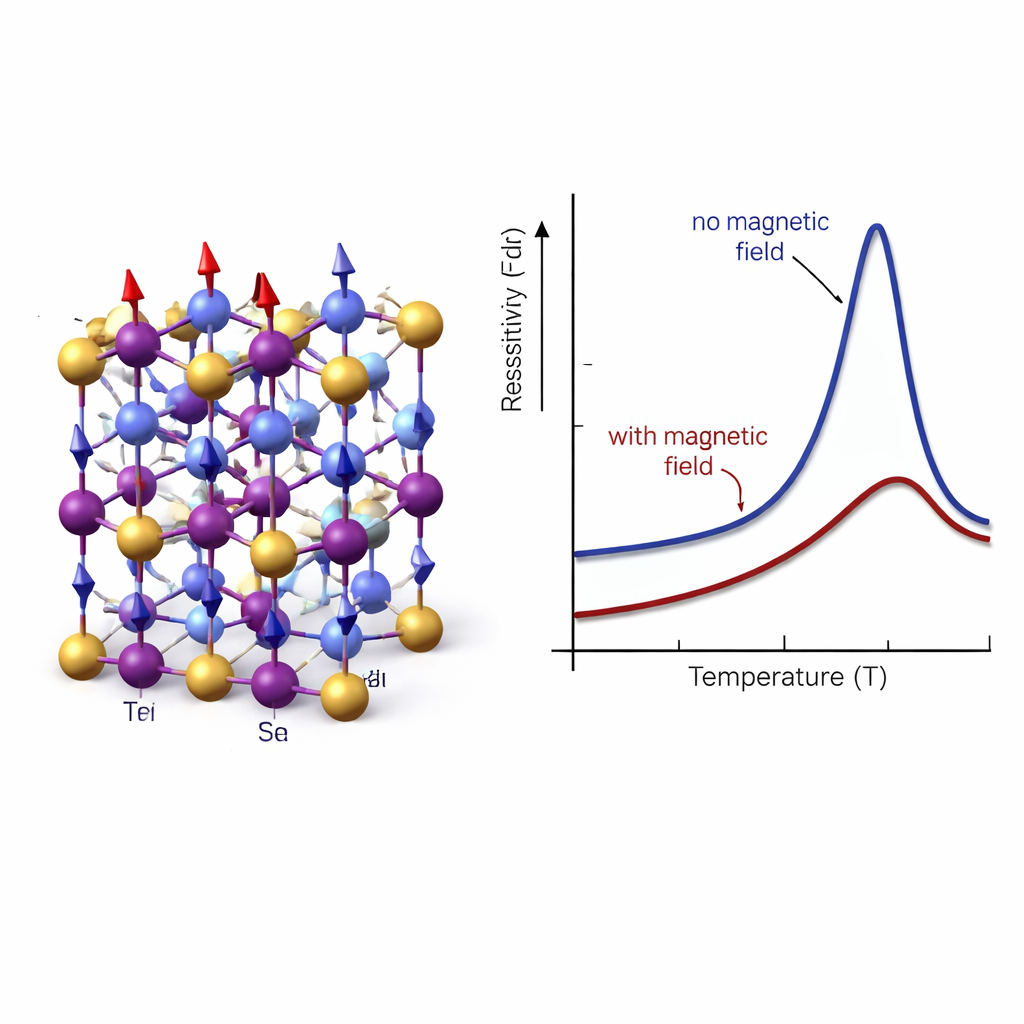
Most colossal magnetoresistance materials show a single, broad bump in resistance as the crystal warms through its magnetic transition temperature. A magnetic field knocks down this bump, making the material far more conductive near this temperature. Mn3Si2Te6 is stranger. As it cools, its resistance first shoots up sharply at low temperatures, then forms a second broad peak around the magnetic transition. Both the low-temperature upturn and the higher-temperature peak are strongly reduced by a magnetic field. Previous explanations often relied on complex ideas such as tiny magnetic clusters or competing magnetic phases, but those do not fit well here, because Mn3Si2Te6 shows no extra magnetic phase transitions at low temperatures.
From simple carriers to a flexible energy gap
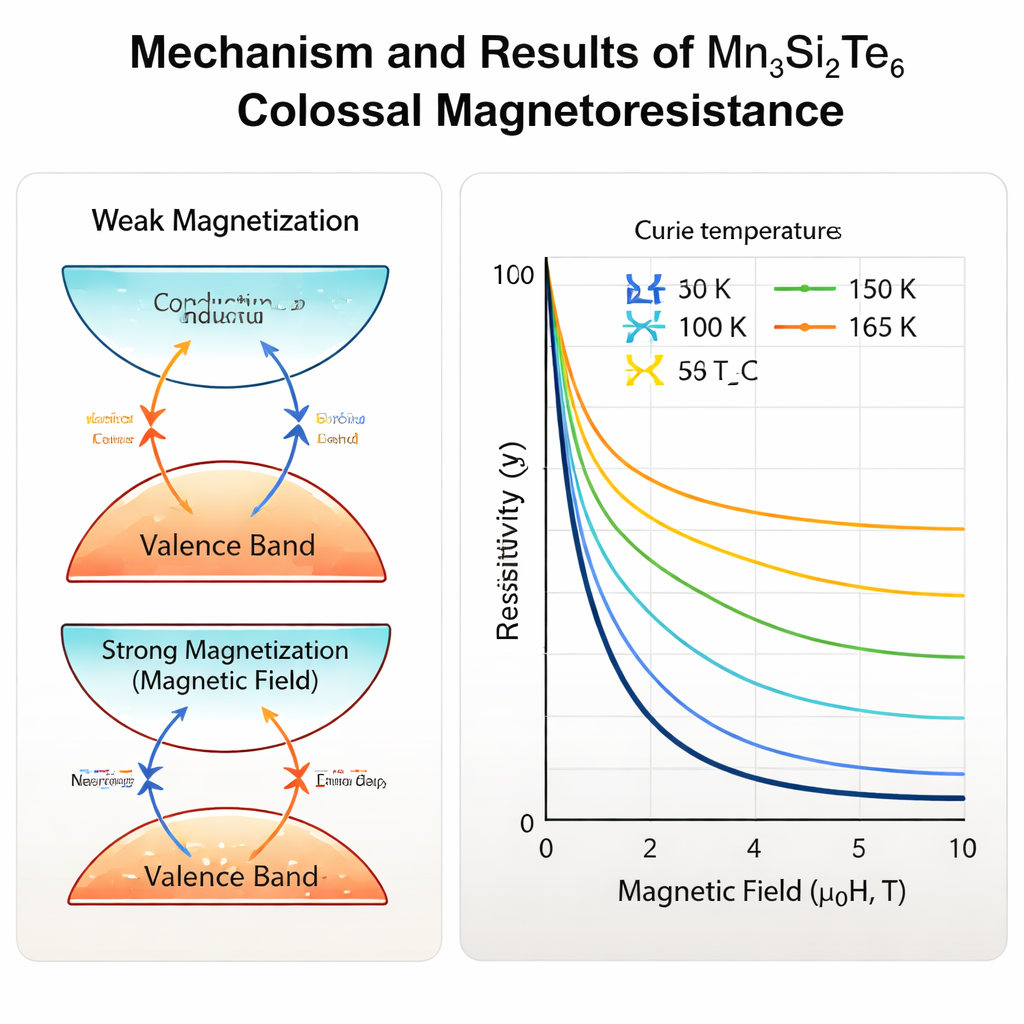
The authors build a model that keeps the ingredients as simple as possible. They treat Mn3Si2Te6 as a semiconductor where electrons and holes are thermally excited across an energy gap between filled and empty states. Electrical current then flows through these two types of charge carriers, whose numbers and mobilities can be described with standard semiconductor and Drude transport formulas. The crucial twist is that the size of the energy gap itself depends strongly on how magnetized the material is. When the atomic moments tilt and align under an applied magnetic field, the gap narrows and can even close, greatly increasing the number of carriers and dropping the resistance.
Reproducing the strange temperature and field trends
Using realistic values for the energy gap and its magnetic-field dependence, together with a simple description of how impurity and vibration scattering grow with temperature, the model reproduces the full pattern of measured resistivity in Mn3Si2Te6. At very low temperatures and zero field, the large gap starves the material of carriers, so the resistance climbs sharply. A magnetic field rapidly increases the magnetization, squeezes the gap, and unleashes carriers, producing an enormous fall in resistance—up to ten orders of magnitude—known as upturn-type colossal magnetoresistance. Near the magnetic transition temperature, the magnetization changes quickly with temperature, causing the gap to widen just as thermal excitations are trying to add carriers. This tug-of-war produces a broad resistance peak whose position shifts to higher temperature when the field grows, matching experiments without needing to assume magnetic clusters or phase separation.
When electric current itself reshapes the measurement
Mn3Si2Te6 shows yet another puzzle: increasing the direct current used to probe the sample appears to lower the transition temperature and even creates a jump-like change in resistance. Earlier work connected this to a proposed chiral orbital current state, an exotic arrangement of circulating electron motion. The authors instead show that plain Joule heating can account for these effects. Because the crystal conducts heat poorly, electrical current warms it above the surrounding environment. By balancing the heat generated by the current with the heat lost to the surroundings, and feeding this extra temperature into their resistivity model, they naturally obtain a shift of the apparent transition to lower measured temperatures and a sharp resistance step when the current is large.
What this means for future magnetic electronics
For non-specialists, the key message is that extreme magnetically controlled changes in resistance do not always require mysterious new phases. In Mn3Si2Te6, a conventional picture—a semiconductor with a magnetization-sensitive energy gap, ordinary impurities, and simple heating—can explain both the colossal low-temperature drop in resistance and the unusual behavior near the magnetic transition. This framework should apply to other materials whose electronic gaps respond strongly to magnetism, offering a practical roadmap for discovering and designing new compounds with dramatic, tunable electrical responses for sensors and spintronic devices.
Citation: Liu, Z., Fang, Z., Weng, H. et al. Colossal magnetoresistance and unusual resistivity behaviors in magnetic semiconductors: Mn3Si2Te6 as a case study. npj Comput Mater 12, 94 (2026). https://doi.org/10.1038/s41524-026-01963-9
Keywords: colossal magnetoresistance, magnetic semiconductors, Mn3Si2Te6, band gap tuning, spintronics