Clear Sky Science · en
Origin of the insulating phase and metal-insulator transition in the organic molecular solid κ-(BEDT-TTF)2Cu2(CN)3
Why this strange crystal matters
Most everyday materials are either good conductors of electricity, like copper wires, or good insulators, like plastic. But some exotic crystals made from organic molecules can switch between being insulators, metals, and even superconductors—materials that carry electricity with zero resistance. This article explores one such compound, called κ-(BEDT-TTF)₂Cu₂(CN)₃, and shows how its basic molecular building blocks control these dramatic changes, especially when the material is squeezed under pressure. 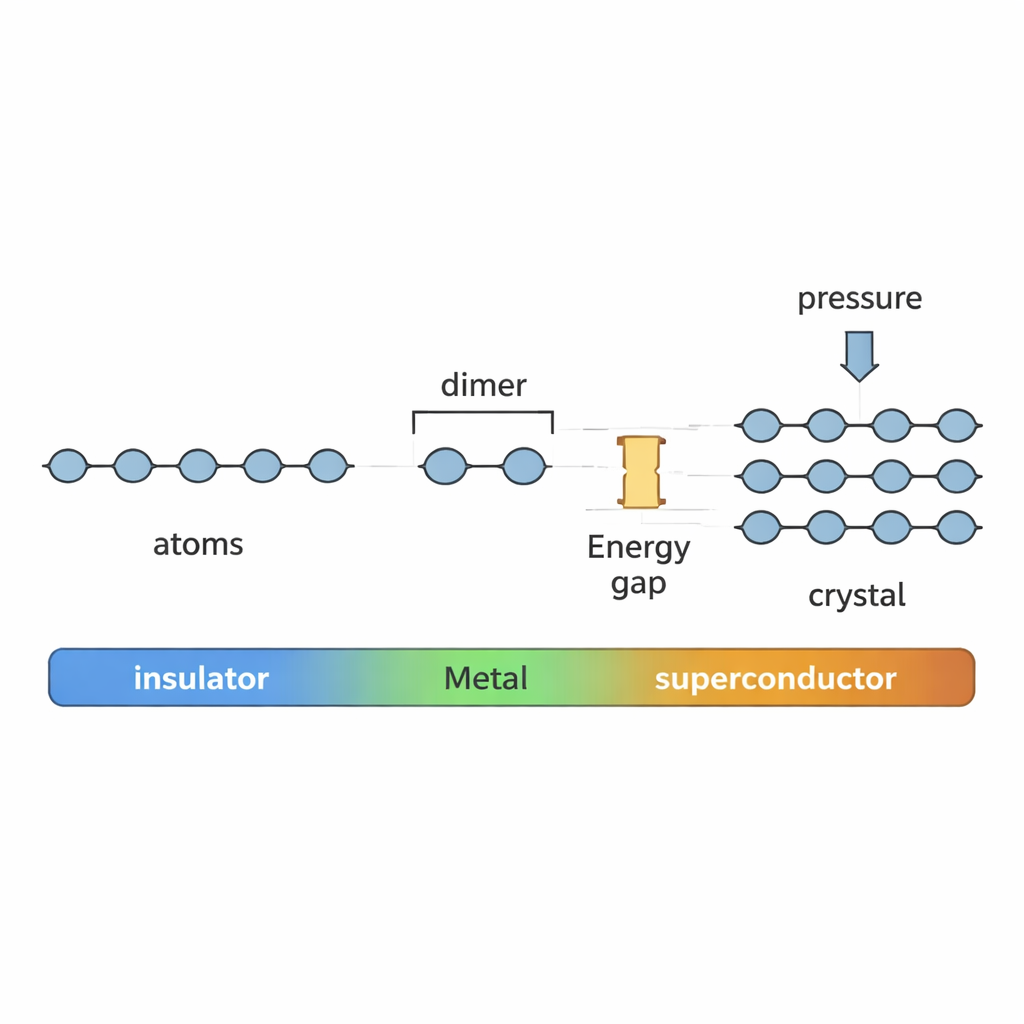
From simple chains to smart molecules
The authors begin with a simple picture: a row of equally spaced atoms can behave like a metal, allowing electrons to flow freely along the chain. If the atoms pair up into dimers—two atoms acting as a unit—the spacing and bonding change, and an energy gap can appear, turning the system into an insulator. They then translate this idea to molecular solids, where the basic units are not single atoms but complex molecules. The key quantity becomes the energy separation between a molecule’s highest filled state and its lowest empty state, known as the HOMO–LUMO gap. If this gap is large, electrons have a hard time jumping to conducting states, and the material behaves like an insulator.
A layered crystal built from paired molecules
In κ-(BEDT-TTF)₂Cu₂(CN)₃, the BEDT-TTF molecules naturally form dimers, and these dimers arrange themselves in nearly two-dimensional layers, supported by a copper–cyanide framework. Because of charge transfer between the layers, each dimer effectively carries one extra positive charge. The authors show that the electronic bands of the crystal are largely built from the HOMO and LUMO of these dimers, just as the simple chain’s bands come from individual atomic orbitals. Whether the whole crystal turns out metallic or insulating depends on the tug-of-war between how strongly electrons hop between dimers and how large the HOMO–LUMO gap is inside each dimer.
Fixing theory to match experiment
Previous computer simulations based on standard density functional theory often predicted that κ-(BEDT-TTF)₂Cu₂(CN)₃ should be metallic at normal pressure, in clear conflict with experiments that show it is an insulator. The authors correct this by using an advanced method, called DFT+GOU, that focuses the so‑called Hubbard U correction directly on the molecular orbitals of the dimers instead of on individual atoms. By tuning this correction to reproduce more accurate molecular energy gaps, they open a realistic gap in the crystal’s band structure. With this approach, they obtain an insulating state with a band gap of about 50–60 milli–electron volts, an optical response that follows the same frequency trends seen in measurements, and a metal–insulator transition under pressure at nearly the same critical pressure that experiments report.
Pressure, flat bands, and a superconducting dome
When external pressure is applied, the dimers are pushed closer together, increasing the ease with which electrons hop from one dimer to another and effectively shrinking the internal HOMO–LUMO gap. This closes the insulating gap and drives the material into a metallic state. Around the critical pressure, the authors find a very flat electronic band right at the energy level where electrons reside, which creates a sharp peak in the density of available electronic states. Using a simplified version of the BCS theory of superconductivity, and feeding in this peak from their calculations, they can qualitatively reproduce the experimentally observed “superconducting dome”: a range of pressures where the critical temperature first rises to a maximum and then falls again. 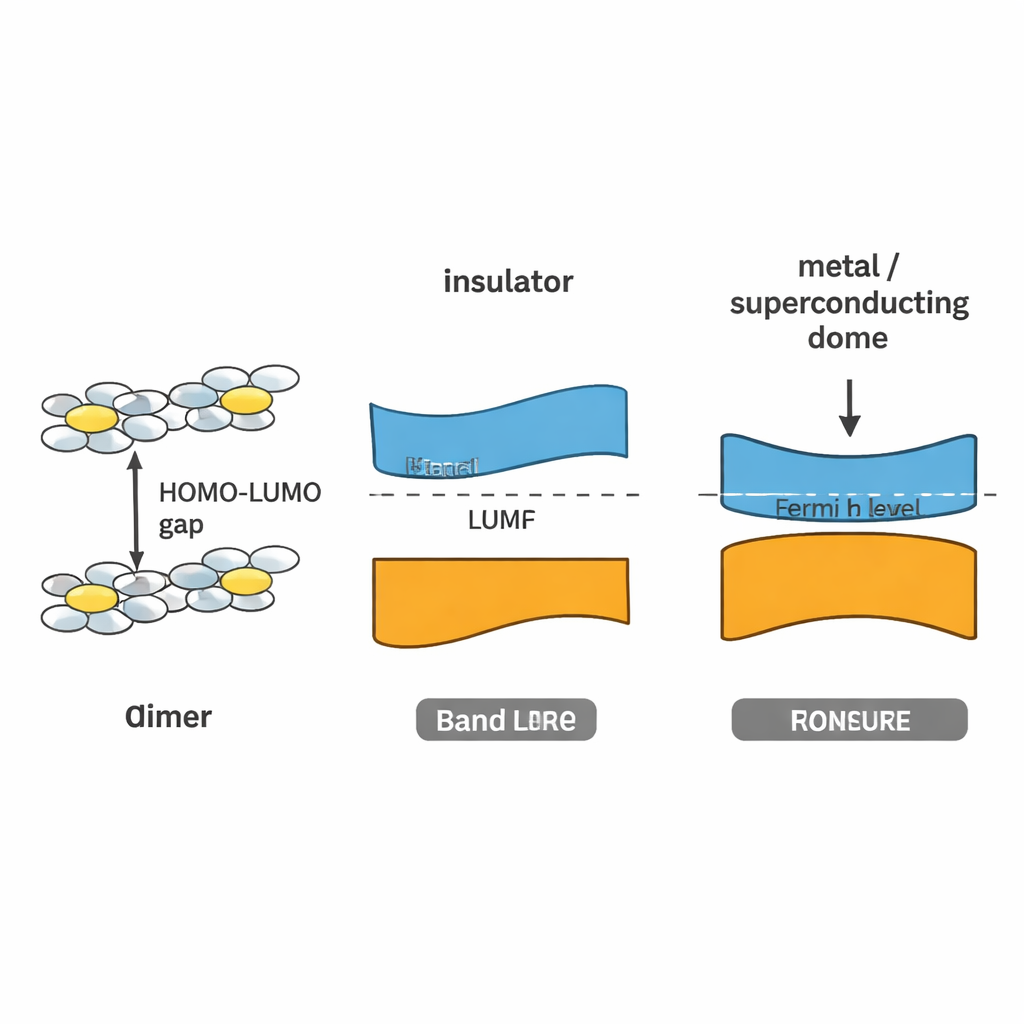
A new roadmap for complex organic solids
To help other researchers study magnetism, quantum spin liquids, and light‑induced superconductivity in this and related materials, the authors extract a compact lattice model that captures the essential physics: hopping between dimers on a triangular grid and an internal energy gap within each dimer. Their main message to non‑specialists is that the remarkable behavior of κ-(BEDT-TTF)₂Cu₂(CN)₃ is rooted in the fine structure of its molecular building blocks. Once theory correctly accounts for how electrons interact within those dimers, many puzzling experimental observations—insulation, the pressure‑driven transition to a metal, and the emergence of superconductivity—fall into place.
Citation: Shin, D., Pavošević, F., Tancogne-Dejean, N. et al. Origin of the insulating phase and metal-insulator transition in the organic molecular solid κ-(BEDT-TTF)2Cu2(CN)3. npj Comput Mater 12, 93 (2026). https://doi.org/10.1038/s41524-026-01960-y
Keywords: organic superconductors, metal-insulator transition, molecular crystals, quantum spin liquids, density functional theory