Clear Sky Science · en
Extracellular vesicles as structured vectors of quorum sensing signals influence aquatic microbial communities
How Microbes Whisper in Water
Rivers, lakes, and reservoirs are teeming with microscopic life, and these tiny residents need ways to coordinate their actions—whether that is forming biofilms, cycling nutrients, or blooming into algae swarms. Yet their chemical “whispers” are quickly diluted or destroyed in open water. This study reveals that many aquatic microbes have solved this problem by packaging their messages into nanosized bubbles called extracellular vesicles, which shield and deliver signals that would otherwise vanish. 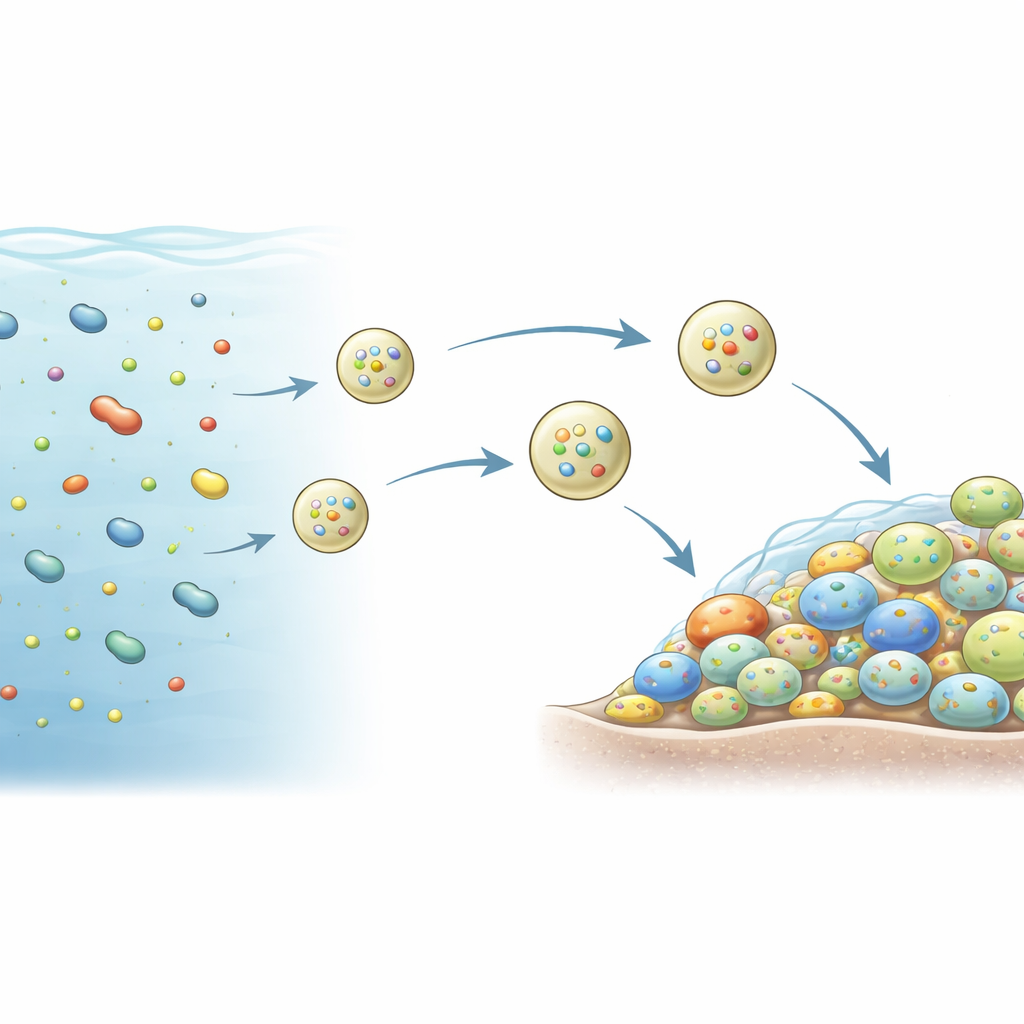
Invisible Messages in a Harsh Environment
Many bacteria communicate through quorum sensing, a system where cells release and detect small molecules to gauge how many neighbors are nearby and then switch on group behaviors. In natural waters, these signals face a hostile environment: they are easily diluted, broken apart by alkaline conditions, or degraded by enzymes. The researchers focused on a common class of signals called acyl-homoserine lactones, which often dislike water and tend to fall apart under real-world conditions. Measurements in a subtropical urban reservoir showed that freely dissolved signals rarely reached levels known to trigger coordinated responses, suggesting there must be another way these messages survive and travel.
Tiny Bubbles as Message Carriers
The team investigated extracellular vesicles—minute, membrane-wrapped particles released by cells across all domains of life—as potential couriers. Working with dozens of bacterial strains isolated from the reservoir, they discovered that vesicles selectively loaded the more water-hating signal molecules, concentrating them inside these protective shells. In laboratory tests, individual vesicles carried multiple signal molecules clustered close together, effectively boosting local concentration. These vesicle-packaged signals also degraded much more slowly at high pH than free molecules, meaning the messages could last longer and travel farther through the water before fading.
Selective Delivery to the Right Neighbors
Protection alone is not enough; messages must reach meaningful recipients. The researchers tracked fluorescently labeled vesicles from a key bacterial species and watched how they interacted with other organisms, including algae and natural microbial communities from the same reservoir. Vesicles did not bind randomly: certain algae and bacterial groups took them up or had them stick to their surfaces more frequently. When intact vesicles were added to miniature ecosystems in bottles, the overall community structure shifted in ways similar to adding the source bacteria themselves, and predicted metabolic capabilities—such as sugar breakdown and cell-wall construction—were enhanced. In contrast, broken vesicles or vesicle-free fluids had little effect, underscoring that intact particles are crucial for ecological impact. 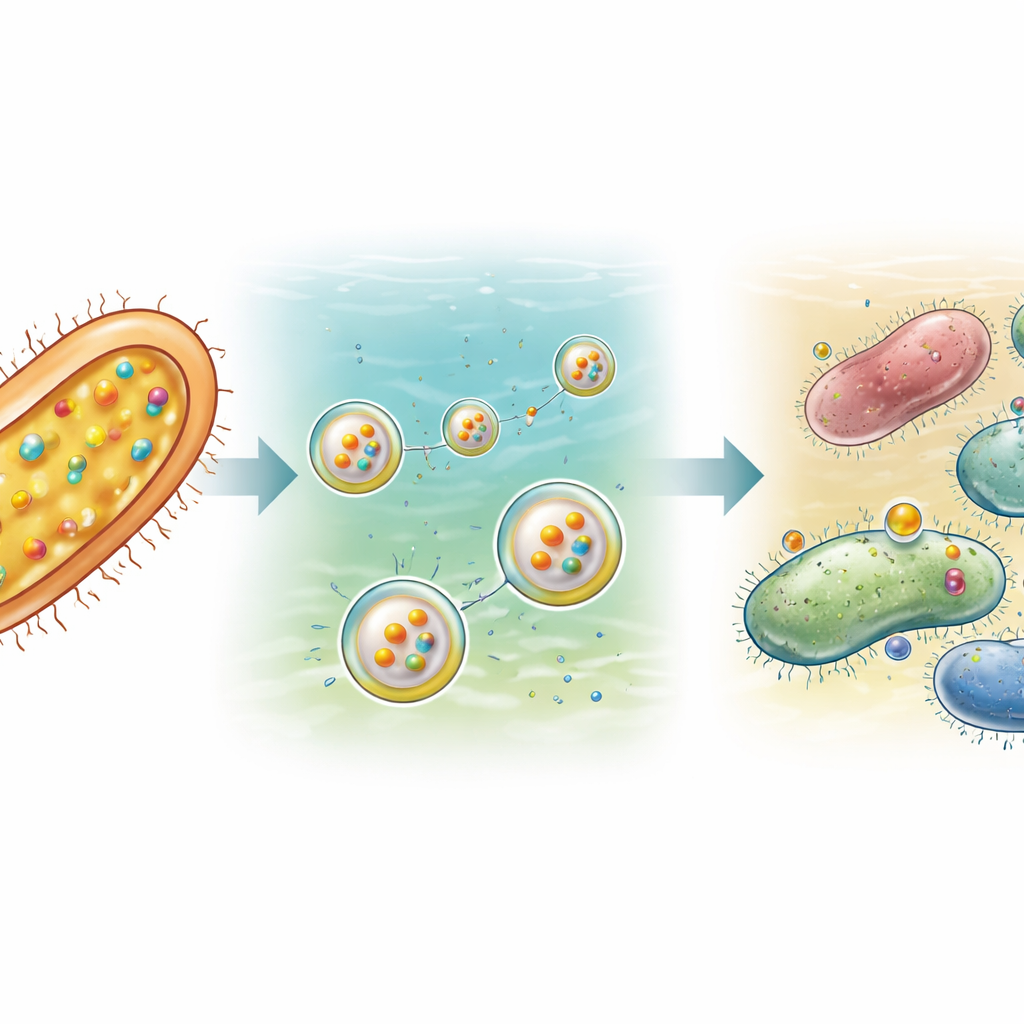
Who Makes Vesicles, and When?
To understand how this system behaves in nature, the team surveyed an entire river watershed feeding the reservoir. Vesicles were abundant everywhere, with higher counts and more vesicle-associated proteins downstream where salinity, nutrients, chlorophyll, and biomass were elevated. Statistical models showed that both environmental factors (like pH, oxygen, and algae levels) and the mix of species influenced vesicle abundance. By comparing DNA found inside vesicles with DNA from whole communities, the researchers could infer which organisms were active vesicle producers and estimate whether they released many or few vesicles. Species that produced moderate amounts—rather than extremely high or undetectable levels—turned out to occupy central positions in ecological networks, contributing disproportionately to community stability, seasonal shifts, and key nutrient-cycling functions.
Cross-Talk Among Many Microbial Voices
Delving deeper, the team built a catalog of species in the reservoir that use different communication “languages,” based on genes for producing and sensing diverse signal types. They found a densely connected web in which many important families—including Burkholderiaceae, Pseudomonadaceae, Rhodobacteraceae, Roseobacteraceae, and Flavobacteriaceae—both produced vesicles and held keystone roles in the community. Some species possessed several signal systems at once, suggesting they can listen and speak in multiple dialects. Many microbes carried signal receptors without the matching signal-making genes, implying they rely on cues made by others and may “eavesdrop” on the conversation. Proteins involved in making and sensing signals were detected inside field vesicles, hinting that vesicles may ferry not only the chemical messages but also the molecular hardware needed to interpret them.
Why These Findings Matter
Taken together, this work shows that extracellular vesicles solve a fundamental problem for microbial life in open water: they allow fragile, water-hating signals to be concentrated, protected, and delivered to suitable partners over ecologically relevant distances. Vesicles and their moderate-producing hosts emerge as central organizers of who talks to whom, which functions are expressed, and how stable the community remains as conditions change. For a lay reader, the key message is that aquatic microbes do not simply shout into a noisy, dissolving chemical soup; instead, they build and launch tiny armored packages that keep their whispers intact, helping to shape the health and behavior of entire aquatic ecosystems.
Citation: Xu, X., Lin, J., Zhu, LT. et al. Extracellular vesicles as structured vectors of quorum sensing signals influence aquatic microbial communities. npj Biofilms Microbiomes 12, 57 (2026). https://doi.org/10.1038/s41522-026-00924-w
Keywords: microbial communication, aquatic ecosystems, extracellular vesicles, quorum sensing, biofilms