Clear Sky Science · en
Modulation of gut microbiota and its metabolite Equol by Huaier granule suppresses hepatocellular carcinoma via the gut-liver axis
How a Traditional Remedy May Help Fight Liver Cancer
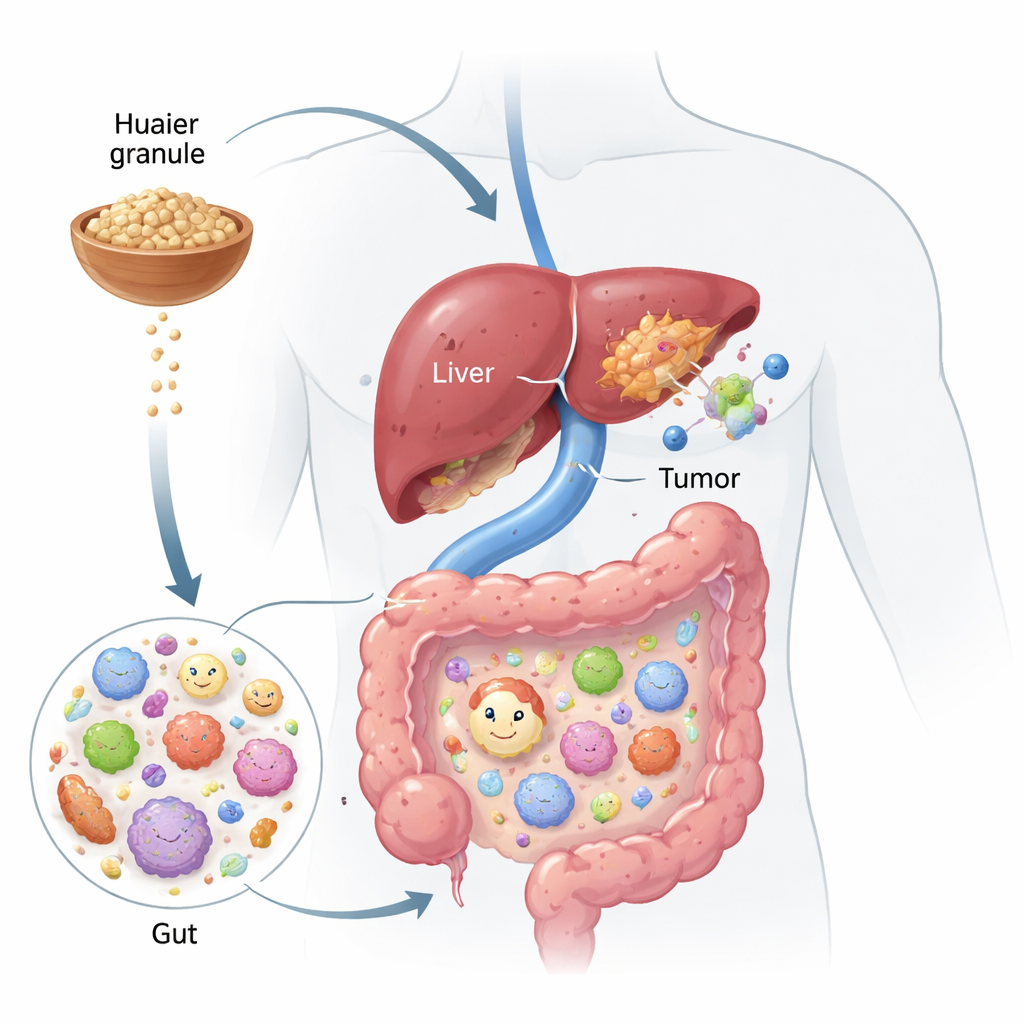
Liver cancer is one of the deadliest cancers worldwide, and many patients cannot tolerate existing drugs because of strong side effects. This study explores an approved traditional Chinese medicine, Huaier granule, to see how it might fight liver tumors in a gentler way—by working through the bacteria in our gut and a natural compound they make called Equol.
A Medicine That Talks to Your Gut
Huaier granule is made from a medicinal fungus long used in China and is already given to liver cancer patients to reduce tumor relapse. The authors used mice with liver tumors to ask a basic question: does Huaier still work if the intestinal bacteria are wiped out? When mice had a normal gut community, Huaier clearly shrank their liver tumors without harming major organs. But when the animals were pretreated with a strong cocktail of antibiotics, stripping away more than 90% of their gut microbes, Huaier largely lost its power. In a complementary test, transplanting stool from Huaier-treated mice into other tumor-bearing mice transferred much of the anti-tumor benefit. These experiments argue that the drug’s effectiveness depends heavily on a living, responsive gut microbiota.
Rebuilding the Inner Barrier and Local Defenses
The team then examined how Huaier reshaped the microbial ecosystem. Using DNA sequencing of stool samples, they found that treated mice gained new bacterial varieties and a healthier balance between major microbe groups. Potentially helpful genera such as Adlercreutzia and short-chain–fatty-acid producers became more abundant, while bacteria linked to inflammation declined. In the colon, Huaier repaired damaged lining cells, restored tight junction proteins that seal the gut wall, and increased mucus-secreting cells. At the same time, it lowered several pro-inflammatory signaling molecules and adjusted immune factors in ways thought to slow cancer-related inflammation, suggesting that the drug strengthens the gut barrier and calms harmful immune overreactions.
From Gut to Liver: Tuning the Tumor’s Immune Climate
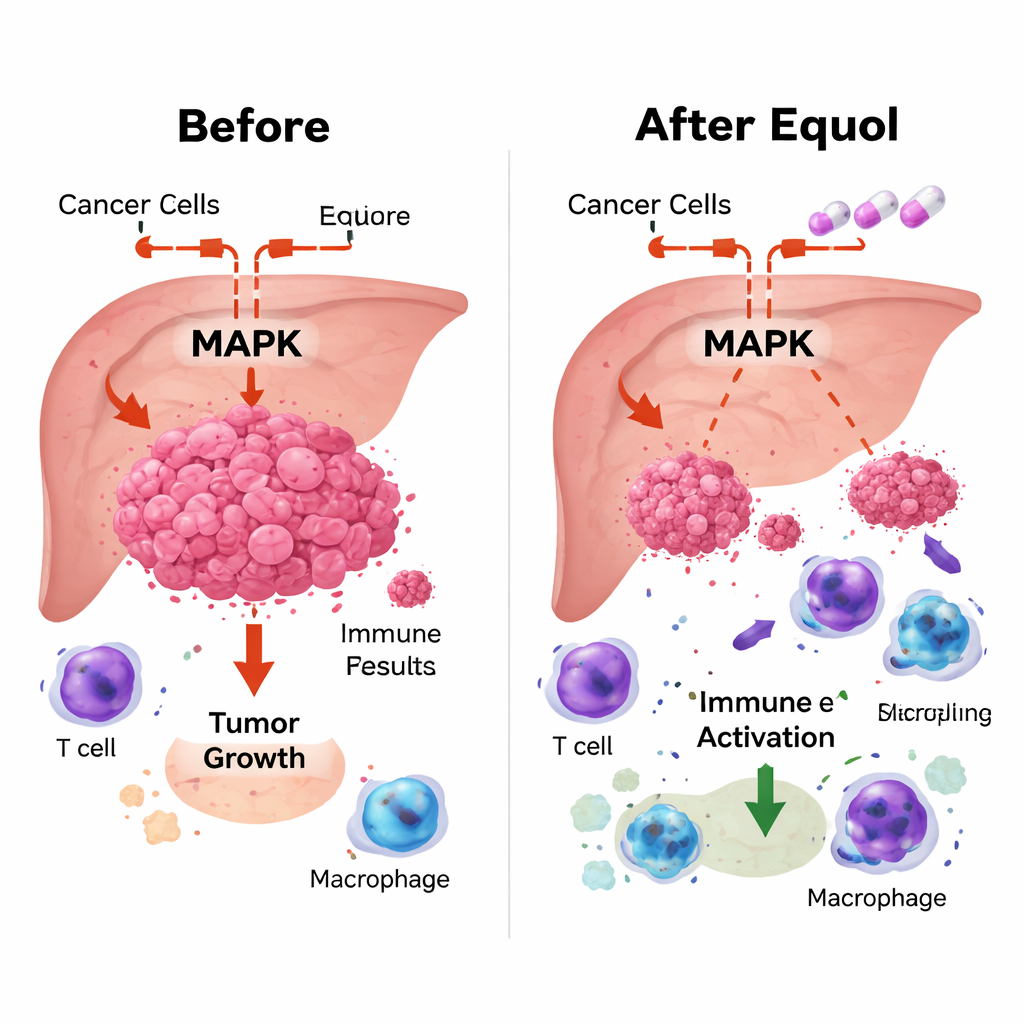
Because the gut drains directly into the liver, changes in intestinal microbes and their products can strongly influence liver tumors. In the treated mice, liver cancers contained more cancer-fighting CD4+ and CD8+ T cells and more “attack mode” (M1) macrophages, with fewer “healing mode” (M2) macrophages that often help tumors hide. Levels of tumor-promoting messengers, including IL‑6, TNF‑α, and IL‑17, fell, while the tumor-killing signal IFN‑γ rose. Molecular tests showed that Huaier dampened a central growth and stress pathway in tumor cells, known as MAPK. When this pathway is active, cancers resist immune attack; when it is toned down, immune cells can infiltrate and function more effectively. Fecal transplants from Huaier-treated animals produced similar immune and signaling changes, reinforcing the idea that the gut microbes are key messengers in this gut–liver conversation.
Equol: A Microbial Molecule at Center Stage
To pinpoint which microbial chemicals might be carrying Huaier’s signal, the researchers combined broad metabolite profiling of feces with microbiome data and prior literature. Among many altered compounds, one stood out: Equol, a molecule normally formed when certain gut bacteria, including Adlercreutzia, break down soy isoflavones. Huaier increased both Adlercreutzia and Equol levels. In lab dishes, Equol strongly slowed the growth of human liver cancer cells, while a comparison metabolite did not. In mice fed a special diet that blocks their own Equol production, Huaier’s anti-tumor effect was noticeably weaker, suggesting that Equol is not just a bystander but an important part of the drug’s action.
How Equol Stops Tumors While Sparing Healthy Cells
Further experiments showed that Equol on its own reduced tumor size in mice without causing weight loss or organ damage. Inside tumors, Equol boosted helpful T cells and M1 macrophages, reduced M2 macrophages, and suppressed the same MAPK pathway that Huaier affected. In human liver cancer cell lines, Equol pushed cells to pause in the early (G0/G1) phase of the cell cycle by shutting down a control module called Cyclin E1–CDK2–Rb, which is needed for cells to copy their DNA and divide. Remarkably, at similar doses, Equol did not impair the growth or cell cycle of normal human liver cells, hinting at some selectivity for cancer over healthy tissue.
What This Could Mean for Future Liver Cancer Care
In plain terms, this work suggests that Huaier granule helps the gut microbiota make more Equol, and together they strengthen the gut wall, calm harmful inflammation, and rearm immune cells in and around liver tumors. By quieting a key growth pathway and halting cancer cells before they divide, Equol emerges as a promising, microbe-derived partner in liver cancer therapy. While these results are from animal and cell studies and more work in people is needed, they provide a scientific basis for Huaier’s clinical use and highlight Equol as a potential future treatment or add-on to existing liver cancer drugs.
Citation: Wei, X., Huang, H., Wang, F. et al. Modulation of gut microbiota and its metabolite Equol by Huaier granule suppresses hepatocellular carcinoma via the gut-liver axis. npj Biofilms Microbiomes 12, 54 (2026). https://doi.org/10.1038/s41522-026-00919-7
Keywords: liver cancer, gut microbiota, Huaier granule, Equol, tumor immunology