Clear Sky Science · en
Lactobacillus-vectored nanobodies improve broiler productivity under sub-clinical necrotic enteritis with associated microbiome and transcriptome changes
Why chicken gut health matters to your dinner plate
Modern chicken farms walk a tightrope: they must raise billions of birds efficiently while cutting back on antibiotics that can fuel drug-resistant infections in people. One of the biggest hidden threats to broiler chickens is a gut disease called sub-clinical necrotic enteritis. Birds with this condition often look normal but grow more slowly and eat more feed to gain the same weight, quietly driving up the cost and environmental footprint of chicken meat. This study explores a new, highly targeted probiotic approach that arms friendly bacteria with tiny antibody fragments to neutralize disease-causing toxins right inside the gut.
A costly, mostly invisible gut disease
Necrotic enteritis is caused by the common gut bacterium Clostridium perfringens when it overgrows and releases powerful toxins. In its severe form, the disease kills birds and causes obvious intestinal damage. But far more common is the sub-clinical form, where toxins such as NetB and alpha toxin subtly injure the intestinal lining. Birds digest feed less efficiently, gain less weight, and yet show few outward signs of illness. Globally, this quiet drain on productivity is estimated to cost poultry producers more than US $2 billion each year. Historically, farms controlled the problem with in-feed antibiotics, but rising concern about antimicrobial resistance and consumer demand for “raised without antibiotics” chicken have made those drugs less acceptable, creating an urgent need for precise, drug-free alternatives.
Turning probiotics into targeted toxin-blockers
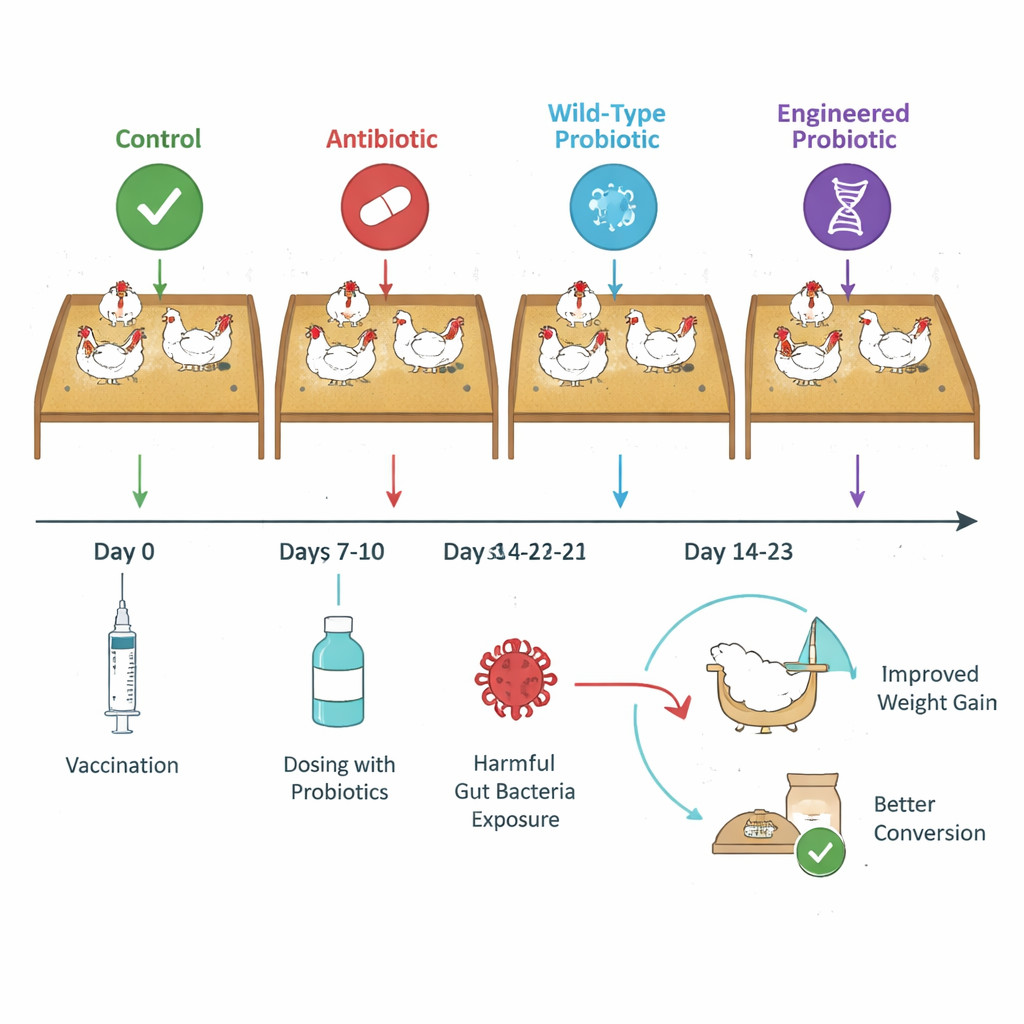
The researchers built on earlier work in which they engineered two strains of the probiotic bacterium Limosilactobacillus reuteri to secrete “nanobodies” – very small antibody fragments – that latch onto NetB or alpha toxin and neutralize them. In the new study, they tested whether these designer probiotics could improve performance in broiler chickens facing a mild, commercially realistic form of the disease. Over a 43-day trial, more than 2,000 birds were divided into four groups: a challenged control group; a group receiving a common prophylactic antibiotic (bacitracin methylene disalicylate, BMD); a group given the engineered nanobody-producing strains (called NE01 and NE06); and a group given the original, non-engineered parent probiotic strains. All birds were vaccinated for coccidiosis and then exposed to C. perfringens to trigger sub-clinical disease.
Better growth with fewer hidden costs
Birds that received the nanobody-producing strains consistently converted feed into body weight more efficiently than the other groups. Their mortality-adjusted feed conversion ratio improved by 4–7 “points” (0.04–0.07 units) relative to untreated birds at different time points, and they were 34–81 grams heavier by the end of the study compared with either the challenge control, the antibiotic group, or the birds given regular probiotics. Interestingly, classic disease measures—such as visible gut lesions and counts of C. perfringens in feces and cecal contents—showed only minor differences between treatments. This means the birds were all experiencing a similar level of low-grade challenge, but the nanobody group was coping with it much more efficiently, turning the same feed into more meat.
Calmer microbiomes and quieter immune systems
To understand why performance improved, the team looked beyond gross pathology and examined the microbiome and gene activity in the gut and liver. Metatranscriptomic analysis of jejunal (small intestine) contents showed that birds receiving the engineered strains had more L. reuteri transcripts and detectable expression of the nanobody genes, confirming that the probiotics survived in the gut and produced their toxin-blocking molecules. Overall microbial composition shifted mainly with bird age rather than treatment, but the nanobody group had less sample-to-sample variability, suggesting a more stable and resilient gut community. Functionally, the gut microbes in this group expressed more genes linked to fermentation and protein synthesis and fewer genes tied to respiration and nitrate use—patterns associated with a less inflamed environment. The researchers also saw increased expression of enzymes for producing a compound called 2,3-butanediol, which has anti-inflammatory effects in animal models.
Protecting distant organs and boosting efficiency
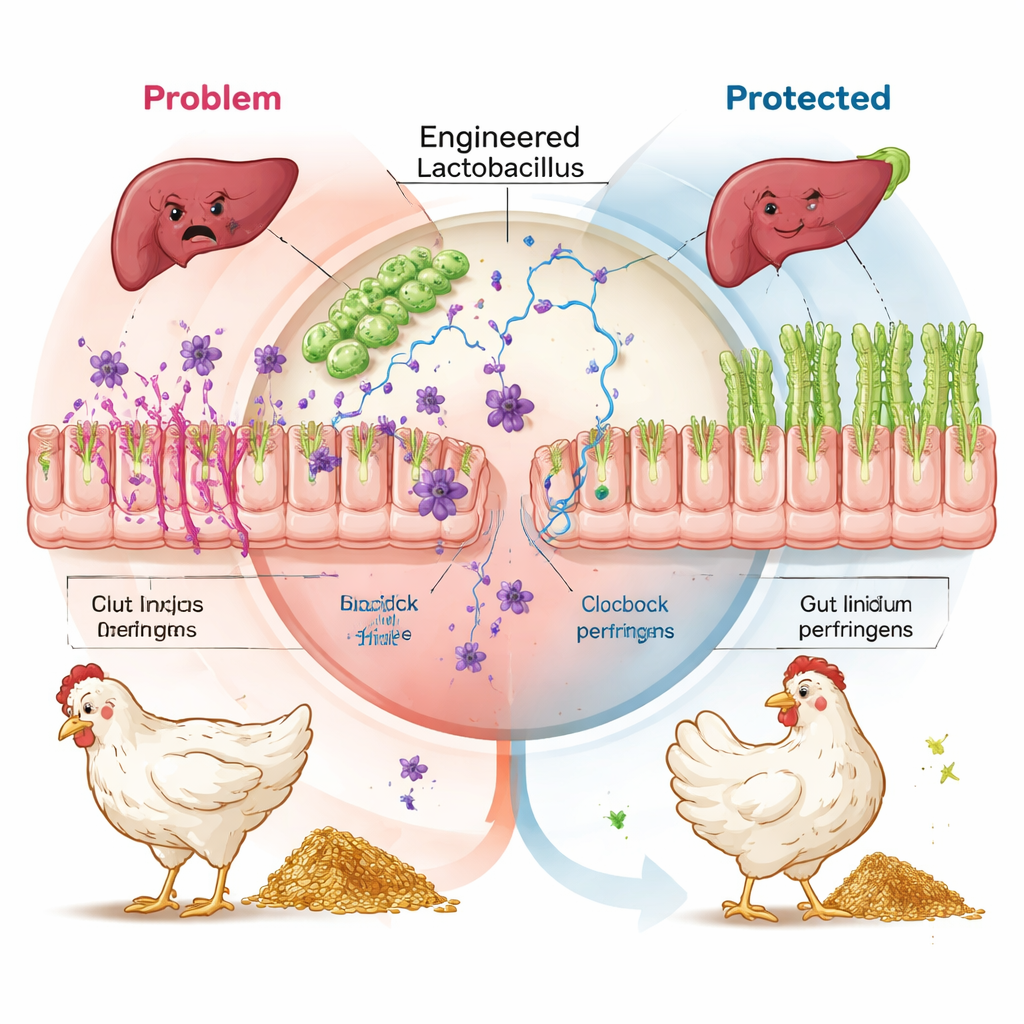
The story extended beyond the intestine. Gene expression in the jejunum and liver revealed that birds given the engineered probiotics had markedly lower activation of immune and oxidative stress pathways compared to challenged controls, and in many cases compared to the antibiotic and regular probiotic groups. In the liver—an organ that suffers collateral damage from bacterial toxins—the nanobody group showed reduced signaling through insulin and mTOR pathways that are known to ramp up during toxin-induced injury, while boosting antioxidant and energy-generating pathways. Taken together, these findings suggest that neutralizing NetB and alpha toxin at the gut surface prevents a cascade of inflammation and tissue damage, saving the bird from the heavy metabolic costs of constantly fighting hidden infections.
What this means for future chicken and human health
For a general reader, the key message is that not all “probiotics” are the same. By equipping helpful bacteria with precisely targeted nanobodies, the researchers created a living therapy that protects chickens from a common, largely invisible gut disease without relying on traditional antibiotics—and it outperformed both an antibiotic regimen and standard probiotics. The birds ate less feed to reach market weight, with fewer signs of internal stress. If similar strategies can be extended to other livestock, and eventually to humans, engineered probiotics could offer a powerful way to disarm harmful gut toxins while preserving beneficial microbes and slowing the spread of antibiotic resistance.
Citation: Hall, A.N., Manuja, S., Payling, L.M. et al. Lactobacillus-vectored nanobodies improve broiler productivity under sub-clinical necrotic enteritis with associated microbiome and transcriptome changes. npj Biofilms Microbiomes 12, 52 (2026). https://doi.org/10.1038/s41522-026-00916-w
Keywords: engineered probiotics, necrotic enteritis, poultry gut health, nanobodies, antibiotic alternatives