Clear Sky Science · en
Grape expectations: disentangling environmental drivers of microbiome establishment in winegrowing ecosystems
Why microbes matter for your glass of wine
Wine lovers often talk about “terroir” – the way a place’s soil, climate, and landscape give a wine its character. This study adds a hidden but powerful player to that story: the microscopic communities of fungi and bacteria that live in vineyard soils, on vine bark, leaves, and grape skins. By tracking these microbes in Swiss vineyards over several years, and linking them to chemistry, aroma, and taste, the researchers show that tiny organisms help explain why wines from nearby plots can still taste uniquely their own.
Small region, big differences
The team focused on 12 Chasselas vineyards packed within just 2.5 kilometers in the Lavaux region overlooking Lake Geneva. Because all vines shared the same grape variety, rootstock, and general farming style, the remaining differences mostly came from each site’s climate and topography – things like slope, altitude, and sun exposure. Over three years, they logged temperature and humidity, analyzed soil and grape chemistry, sequenced microbial DNA from soil, bark, leaves, berries, and fermenting juice, and even ran small-scale wines through advanced chemical and sensory testing. 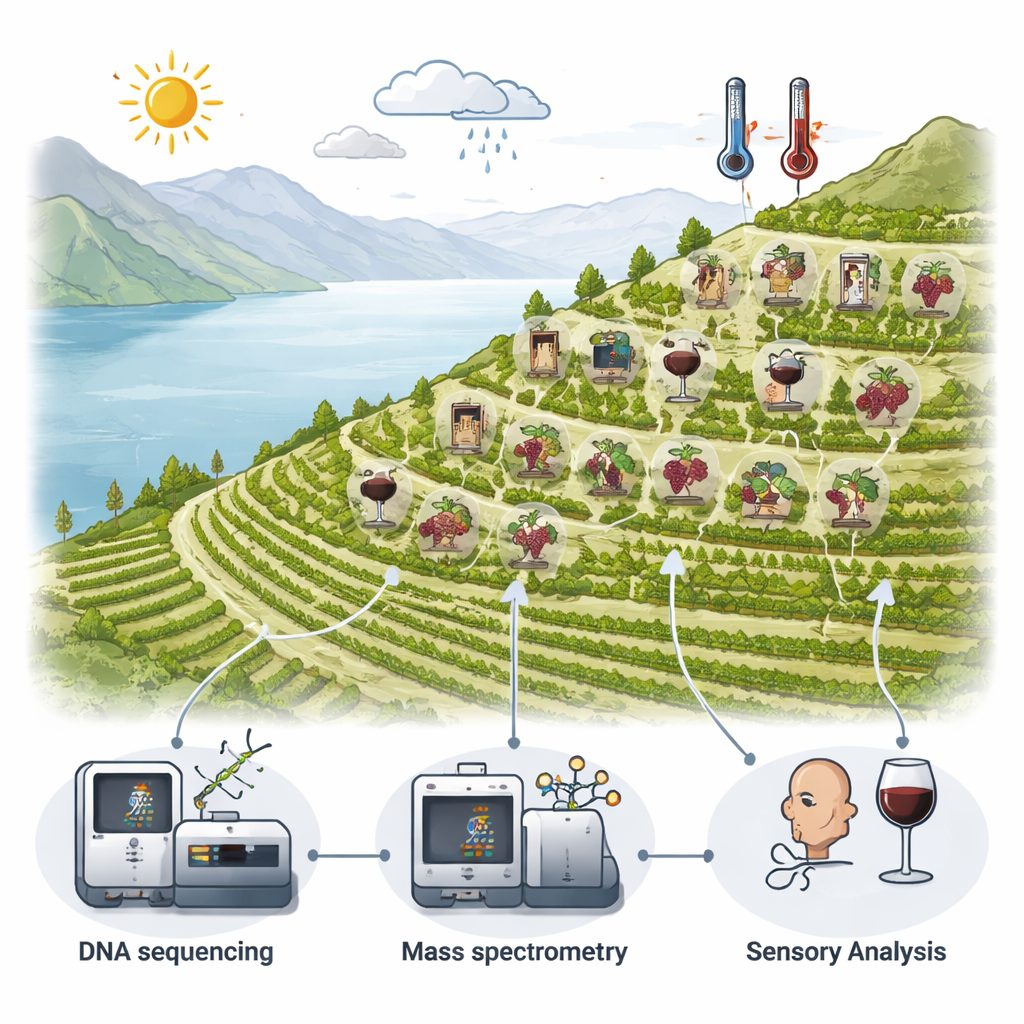
Distinct microbial neighborhoods on the vine
The vine turned out to be a patchwork of microbial habitats. Soil and bark hosted rich, relatively stable communities that differed strongly from vineyard to vineyard but changed little from year to year. Leaves and berries were more fickle, with their fungi shifting noticeably across seasons and vintages. Among all sample types, the fungi living on grape skins showed the clearest site-specific signature: even between vineyards only a short walk apart, the mix of fungal species was distinct enough that a machine-learning model could often predict which plot a sample came from. At larger scales, berries from a different Swiss wine region had even more divergent fungal communities, confirming that location leaves a strong and consistent microbial imprint.
Climate, slopes, and the rise of key wine yeasts
What drives these differences on grape skins? The study points to a partnership between climate and landscape. Slight shifts in relative humidity and temperature, together with features like altitude and slope, nudged fungal communities in different directions. Relative humidity was especially important: plots with more humid conditions favored certain yeast families, including Hanseniaspora, while others that were cooler or drier tended to favor Saccharomyces, the classic wine yeast. These yeasts did not just appear or disappear – their abundances tracked grape chemistry, with Hanseniaspora linked to higher sugar levels and humidity, and Saccharomyces more associated with organic acids. By feeding the microbial data into predictive models, the researchers could estimate a vineyard’s typical humidity and temperature surprisingly well, simply from which fungi were present. 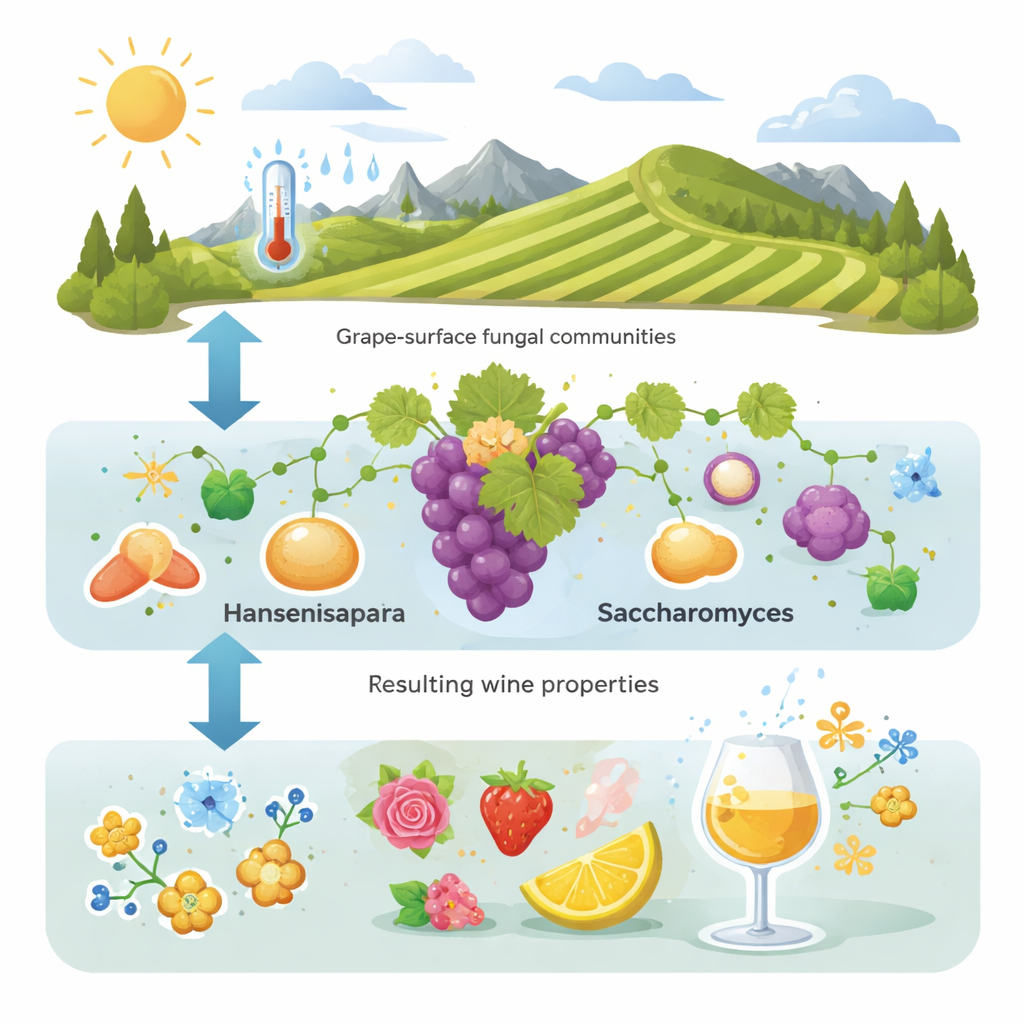
From invisible microbes to aroma and flavor
The team then followed the story into the cellar. Grapes from each plot were fermented under controlled conditions and analyzed with state-of-the-art metabolomics tools that detect hundreds of aroma and flavor-related molecules. Wines were also rated by trained tasters for attributes such as citrus notes, exotic fruit, sweetness, and overall balance. Year-to-year weather differences emerged clearly in both the chemical and sensory profiles: 2021, which was cooler and more humid, produced different wines than the warmer, drier 2022 and 2023. Certain microbes lined up closely with particular aroma compounds. Hanseniaspora species were strongly associated with floral and fruity volatiles and with wines described as having exotic fruit character and good balance, while Saccharomyces correlated with specific plant-derived acids that may favor yeast over bacteria. Some fungi linked to plant disease, by contrast, tracked with oxidative, less intense aromas in the finished wines.
What this means for wine and beyond
For non-specialists, the study’s takeaway is straightforward: microbes are a crucial, dynamic part of terroir. Even among neighboring vineyards growing the same grape variety, subtle differences in slope, humidity, and temperature foster unique microbial communities on grape skins. Those microbes, in turn, interact with grape chemistry and fermentation to shape the wine’s smell and taste from year to year. Rather than being a fixed regional stamp, microbial terroir is better seen as a living, changing expression of both place and season. Understanding this hidden layer could help growers adapt to climate shifts, fine-tune vineyard practices, and preserve the distinctive character of their wines – and the same principles likely apply to many other foods shaped by fermentation and plant–microbe partnerships.
Citation: Flörl, L., Schönenberger, P., Rienth, M. et al. Grape expectations: disentangling environmental drivers of microbiome establishment in winegrowing ecosystems. npj Biofilms Microbiomes 12, 49 (2026). https://doi.org/10.1038/s41522-026-00915-x
Keywords: wine microbiome, terroir, grapevine fungi, yeast and aroma, viticulture climate