Clear Sky Science · en
Association of brain age gap with BMD and incident fractures in the UK Biobank
Why your brain and bones age together
As people live longer, doctors are trying to understand why some older adults stay sharp and mobile while others face memory problems and broken bones. This study looks at a new way to measure how fast the brain is aging and asks a simple but far-reaching question: if your brain is aging faster than average, are your bones also in worse shape and more likely to break?
A new clock for the aging brain
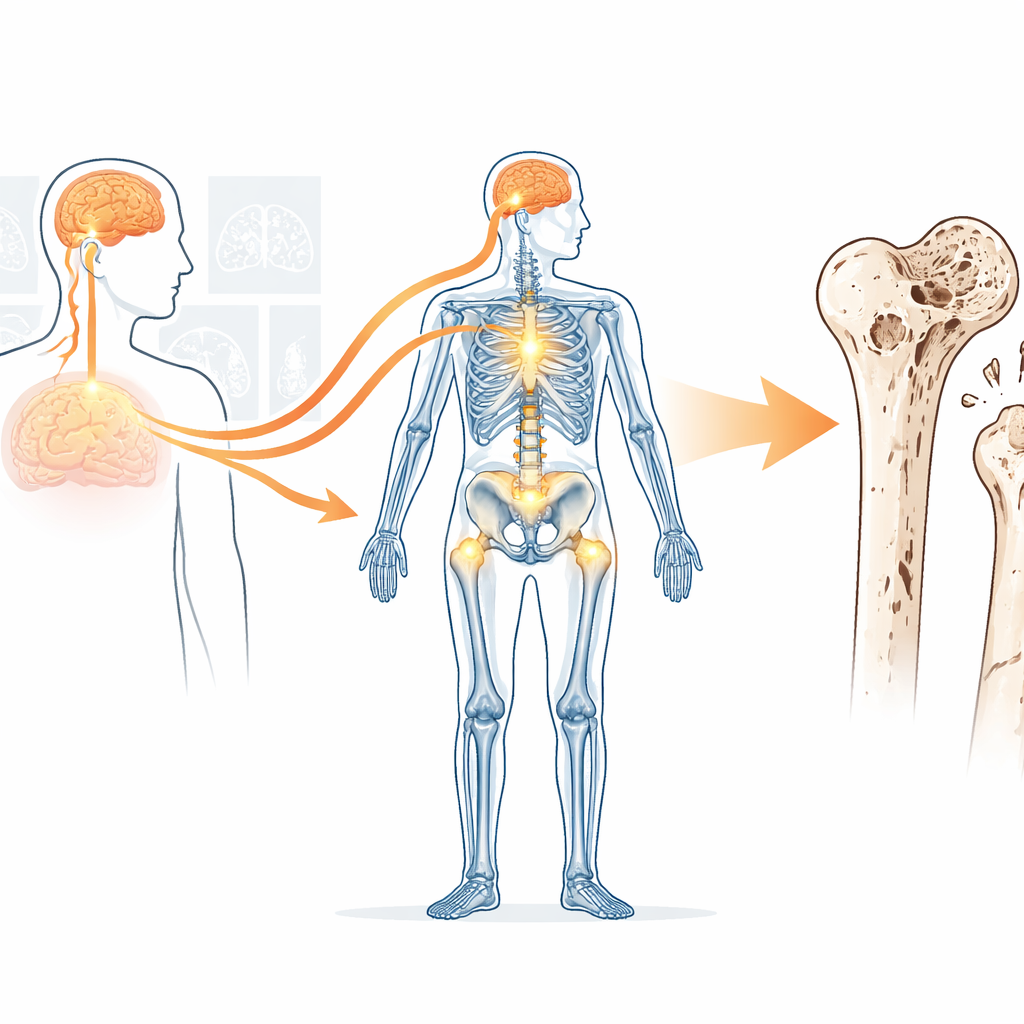
Instead of relying only on birthdays, researchers now use brain scans to build an internal “age clock” for the brain. In this project, scientists analyzed detailed MRI scans from more than 28,000 volunteers in the UK Biobank, a large health study in Britain. They fed 1,705 different features from the scans into a computer model that learned to predict a person’s age from the structure and wiring of their brain. The gap between the predicted brain age and the person’s actual age, called the brain age gap, shows whether a brain looks older or younger than expected. A positive gap means the brain appears older than the calendar suggests.
Connecting brain age to bone strength
The team then linked this brain age gap to measures of bone mineral density, a standard marker of bone strength, at four key locations: the hip’s neck and trochanter regions, the lumbar spine, and the entire skeleton. They also tracked new fractures over nearly four years, focusing on hip fractures and breaks anywhere in the body. After accounting for body weight, physical activity, smoking, alcohol use, vitamin D levels, and other health and social factors, a clear pattern emerged. For every extra “brain year” beyond a person’s real age, bone density was slightly lower at all four sites, and the risk of having any fracture rose by about 6 percent.
Who is most at risk
The link between an older-looking brain and weaker bones was not the same for everyone. Men showed a stronger drop in bone density per extra brain year than women did. When the researchers looked at age groups, people under 65 with older-appearing brains were more likely to lose bone density in the hip and whole body, and they were also the ones in whom fracture risk clearly increased. Among women, menopause mattered: postmenopausal women with older-looking brains had lower bone density at all four sites and a notably higher risk of fractures, while the results were less certain in women who had not yet gone through menopause, partly because fewer fractures occurred in that group.
Signals that may link brain wear and tear to fragile bones
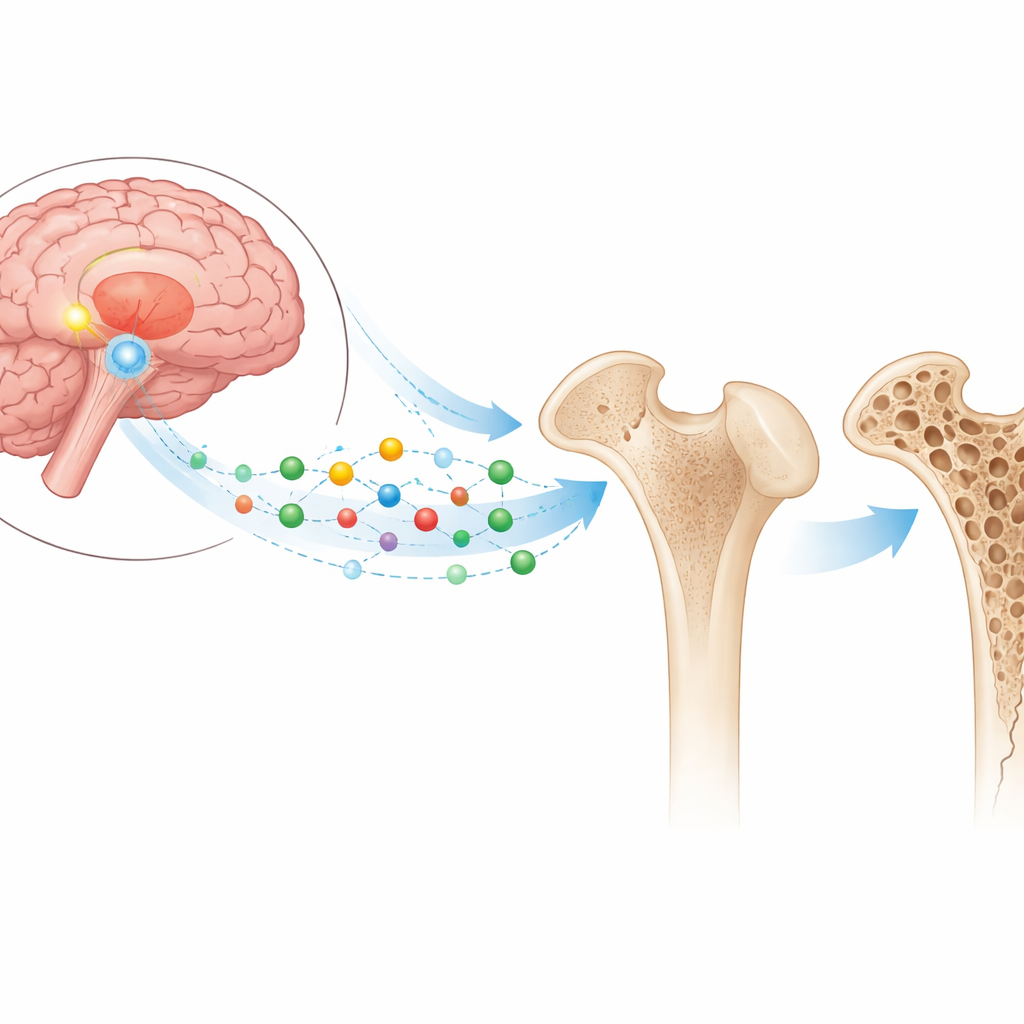
To explore how the brain and skeleton might talk to each other, the scientists examined proteins in the blood that are related to aging and cell wear and tear. They focused on 13 proteins previously tied to brain aging and found that all of them were associated with the brain age gap. Two of these proteins, called TIMP4 and ADAM22, appeared to play a small but measurable role in carrying the effect of brain aging to bone health. This finding supports the idea of a “brain–bone axis,” where changes in the brain and changes in bone share common biological messengers, such as immune-like cells, chemical signals, and hormones that travel throughout the body.
What this means for healthy aging
This work suggests that an older-appearing brain is not just a concern for thinking and memory; it may also warn of thinning bones and higher fracture risk, especially in men and postmenopausal women. While each added brain year only nudges risk upward, the effects can add up across the population, where millions are living longer with fragile bones. The study cannot yet prove that brain aging directly causes broken bones, and the volunteers were mostly of European background, so results may differ in other groups. Still, brain age gap could become a new tool to spot people who might benefit early from bone-strengthening steps such as exercise, diet changes, or medications. In simple terms, keeping the brain biologically “younger” may turn out to be one more way to protect our skeletons as we grow older.
Citation: Liu, J., Cai, L., Li, P. et al. Association of brain age gap with BMD and incident fractures in the UK Biobank. npj Aging 12, 43 (2026). https://doi.org/10.1038/s41514-026-00347-z
Keywords: brain age, bone mineral density, fracture risk, osteoporosis, aging biomarkers